How Children Develop Number Sense in PreK and Kindergarten
Early number understanding predicts math success through high school.
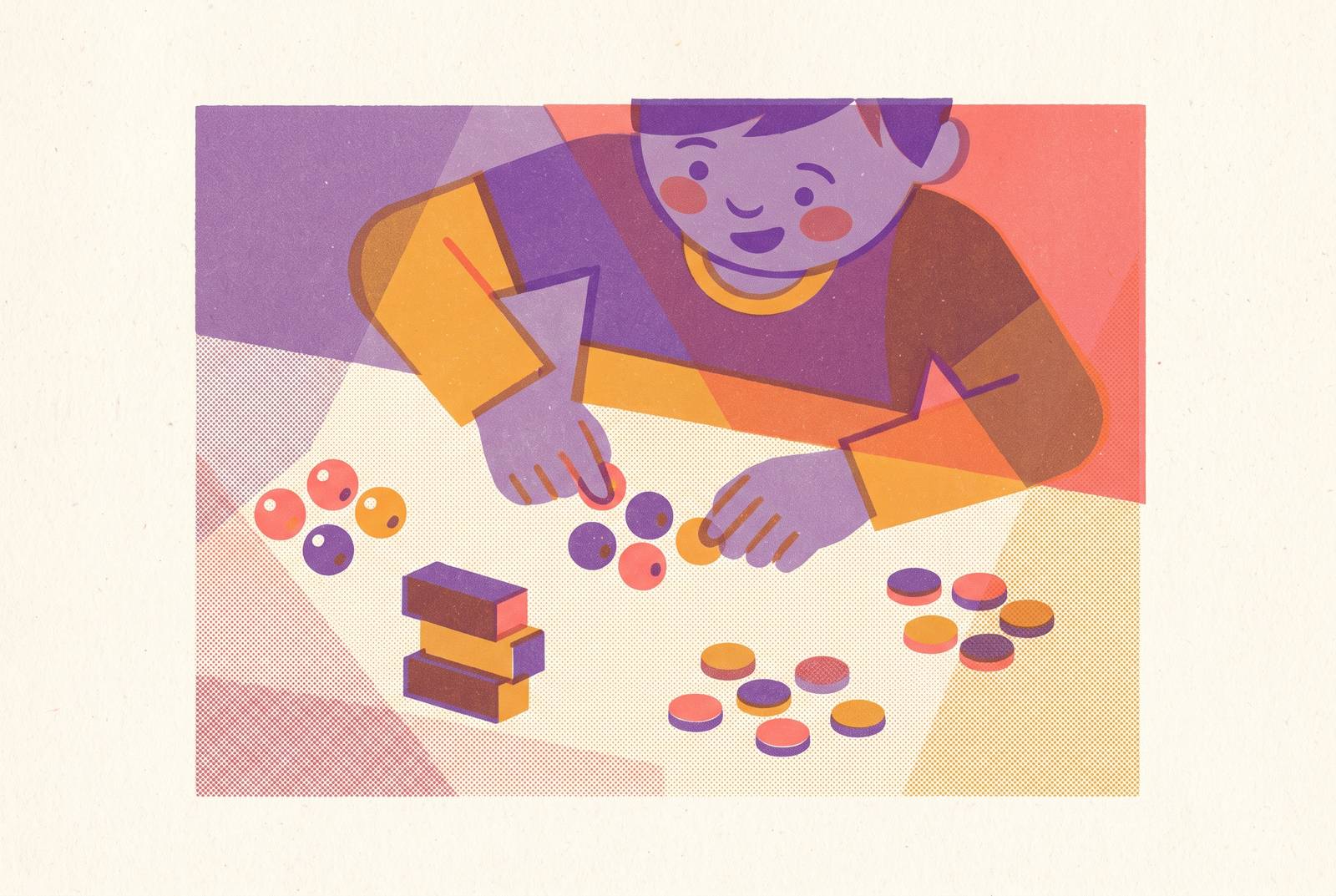
A child counts aloud to 20 fluently, then cannot tell you how many objects are in a group of five in front of them. That gap trips up a lot of parents, and it should, because it points to something real: reciting numbers and understanding numbers are two different skills that just happen to look similar from across the room.
Number sense is what a child understands about what numbers mean and how they relate to each other, not whether they can recognize the symbols or repeat a sequence from memory. The numeral 8 is nothing but a curved shape on a page until a child can actually build a group of eight objects, break that group apart, and tell you how it compares to seven or to nine. Counting out loud is a performance. Number sense is the machinery underneath it: it lets a child actually reason about quantity.
That machinery includes several distinct pieces. A child needs to count with one-to-one correspondence, matching each number word to a single object. They need to connect a written numeral to an actual amount, and recognize small quantities instantly without counting. They need to compare groups and say which has more, represent the same number in different physical forms, and understand that numbers can be broken apart and reassembled. Eventually, they need to notice the patterns that connect numbers to each other, the fact that three is always one more than two no matter what's being counted.
None of this is a warm-up act before "real" math starts. Addition, subtraction, and place value are built directly on top of these skills, not layered on afterward as a separate subject. A child who hasn't built the foundation will hit a wall in first or second grade that looks like a sudden math problem but is really an old gap finally catching up.
Early math skills matter more than most parents realize
The stakes here are higher than most parents assume. A study cited by NWEA found that preschool math knowledge may predict a child's math achievement all the way through age 15, and that the growth a child makes specifically in kindergarten and first grade is an even stronger predictor of where they'll land later.
A report from the Centre for Independent Studies in Australia, written by Nancy C. Jordan and Nancy Dyson, goes further and says early math skills predict later academic success more strongly than early reading skills do. The same report notes that strong number sense in early childhood pays off in reading and general problem-solving too, not just in math class. Gaps that show up early in counting, number recognition, or basic arithmetic get harder and costlier to close the longer they sit, which makes PreK and kindergarten the cheapest, highest-leverage window for catching and fixing them. Left alone, weak early math instruction doesn't just shrink math scores. Weak early math instruction widens education gaps that follow kids into adulthood and reduces workforce capability later.
DROP (pending claim text for verification)
The progression that unfolds: from correspondence to cardinality
Number sense doesn't arrive all at once. It builds in a sequence, and each stage exists because the one before it made it possible.
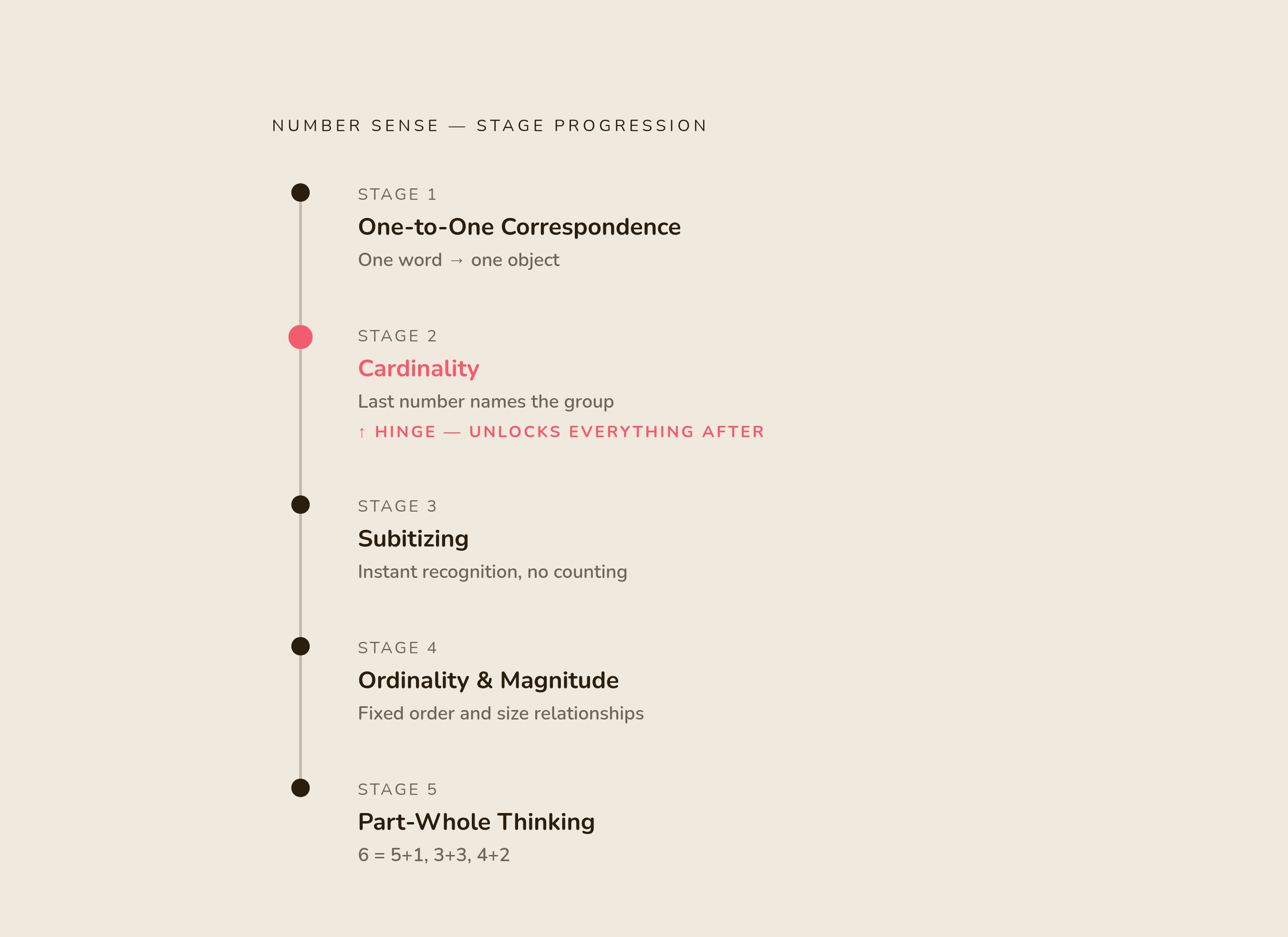
The first stage is one-to-one correspondence: touching or moving each object as you count it, so that every number word lines up with exactly one item. A child who points at three crackers but says "one, two, three, four" because they double-counted one of them hasn't locked this in yet. This is the hinge between rote counting, which is just a memorized verbal string, and counting that actually measures something real in the world.
The second stage is cardinality, sometimes called the Cardinal Word Principle. It's the understanding that the last number said while counting a group tells you the size of the whole group. A child who counts five toys correctly and then, when asked "so how many are there?", starts counting all over again from one, hasn't grasped this yet. There's emerging evidence that some children begin interpreting multidigit numbers as early as age 3, and a 2025 peer-reviewed study of 320 children, split between 147 three-year-olds and 173 four-year-olds, confirmed that numerical relational and counting skills can be measured reliably at that age and connect to how children process symbolic magnitude. Cardinality matters because it unlocks everything that comes after it. Without it, the next two stages are just disconnected impressions rather than actual number knowledge.
Stage three is subitizing, the ability to instantly recognize a small quantity without counting, like recognizing three dots on a die without pointing to each one. There are two distinct flavors of this. Perceptual subitizing is the innate, near-instant visual recognition of very small quantities, and it's present from very early in life. Conceptual subitizing is different: it's seeing a bigger group as made up of smaller recognizable chunks, like spotting seven as a full five-frame plus two more, and it develops later, once cardinality is already in place. A 2026 study tested two screening tools, the Ability to Quickly See Quantities (AQSQ) test and the Number Sense Test (NST), on 74 kindergarten students, specifically to measure subitizing and part-whole thinking.
Stage four is ordinality and magnitude comparison, understanding that numbers are in a fixed order and that each position carries a specific size relationship: three is one more than two and one less than four. Kids start comparing groups, more, fewer, the same, well before they can explain their reasoning out loud. That instinct is what eventually turns into a mental number line, the scaffolding that place value and estimation get hung on later.
Stage five is part-whole thinking and number flexibility, seeing that six can be broken into 5 and 1, or 3 and 3, or 4 and 2. Number sense moves from being about individual numbers in isolation to being about how numbers behave and interact, because this is the actual mental foundation underneath addition, subtraction, multiplication, and division. Recognizing that three is always one more than two, no matter what's being counted, lives here too. It's the payoff of the whole sequence. Two distinct types were identified, per the research.
What Spontaneous Focus on Numerosity reveals about individual differences
Two children can be the same age and sit at very different points on that ladder, and the reason often has nothing to do with how much either one has been taught. Researchers call this Spontaneous Focus on Numerosity, or SFON: how naturally a child pays attention to quantity in everyday moments.
A child with high SFON notices number constantly and unprompted, how many crackers are left, how many stairs to the top, who has more grapes. A child with low SFON might walk past all the same moments and never register the quantity at all unless an adult points it out directly. That's a difference in attention, not a deficiency. It's a difference in attention, and it shapes which counting skills a child builds first, since SFON connects directly to how kids develop subitizing-based recognition, verbal counting, and object counting.
There isn't one ladder every child climbs at an identical pace. There are several entry points, and where a child enters changes what kind of support actually helps. Jordan and Dyson's report makes this concrete. For kids who start school behind, working on number and number relations is the highest-leverage move. For kids who arrive with cardinality and counting already solid, pushing into number operations is what sets up strong later achievement. Same goal, different starting line, different next step.
Sorting, patterns, and spatial reasoning in number development
Plenty of what builds number sense doesn't look like math. The National Council of Teachers of Mathematics, cited in Stanford's PreK Math resource, points to sorting, comparing and building with blocks, drawing, spotting patterns in daily routines and nursery rhymes, and puzzle-based spatial reasoning as core paths into number understanding.
None of these activities register as "math" in a child's head while they're happening. They become mathematical once an adult reflects them back, discusses them, and pulls the underlying idea out into the open. That's the actual job of the adult in the room, not to teach math directly but to name what's already happening.
Sorting is classification practice. A kid separating buttons by color or blocks by size is exercising the same mental muscle used later to group quantities. Pattern recognition works the same way: repeating rhymes, predictable daily routines, and books with a refrain train a child to expect that things follow a rule, which is the same habit of mind behind number sequences. Spatial reasoning through block building and puzzles teaches how parts combine into a whole, which is a direct rehearsal for part-whole number thinking down the line.
The conversion happens through questions asked at the right moment. "How many crayons do we need at this table?" "Who's second in line?" Those small prompts are what turn an ordinary afternoon of play into number sense development, without anyone sitting down to a worksheet.
The teaching approaches that build number sense (and the ones that don't)
Some methods build number sense reliably. Others feel productive but don't move the needle much, and it's worth knowing the difference.
What works starts with explicit instruction paired with repetition and structured practice. Jordan and Dyson's 2025 report found this combination is how children actually learn number sense, not by stumbling onto it. It also means going concrete before abstract: if a child is stuck on the numeral 7 on a worksheet, hand them seven counters instead, and let them count, build, break apart, and represent seven a few different ways before circling back to the written symbol. Five-frames and ten-frames help enormously here, because they train kids to see a quantity at a glance instead of recounting every single object; a child who spots seven as a full five-frame plus two more is doing conceptual subitizing, not just counting faster. Representing the same number multiple ways, counters, then linking cubes, then fingers, then a ten-frame, deepens the concept each time it's rebuilt. And math talk affects how well children develop reasoning skills: asking not just "how many?" but "how did you see it?" surfaces a child's actual reasoning and lets them hear how classmates solved the same problem differently. Even five minutes of that kind of conversation daily is genuinely meaningful. Instruction that differentiates by entry point, giving kids with weaker number sense more time on number relations and kids with stronger foundations a push into operations, is what the NWEA 2025 research points to as most effective.
What doesn't work as well is relying on unstructured discovery learning as the main method. Jordan and Dyson found that children struggle more in classrooms that lean on open-ended discovery instead of direct instruction paired with cumulative practice. Rushing to written numerals is a related trap: kids get pushed to "write it down" before they've had enough time with the actual concept, which just teaches symbol production without the understanding it should be built on. And rote counting milestones can be misleading as a measure of progress. A report card that checks off "counts to 100" or "skip counts by 5s" doesn't tell you whether that child understands cardinality or can subitize at all. Plenty of kids can reason through a problem out loud who'd struggle to show that same thinking on paper, so worksheets can be misleading as the primary measure of what a child knows.
Actions parents can take at home at each stage of the progression
Match the activity to where the child actually is in the progression, not to their age or grade label. That's the whole organizing idea here.
For one-to-one correspondence, have kids touch or move each object as they count it, crackers, stairs, toys going back in the bin, and follow up with simple questions afterward: how many are there, what if we add one more, which pile has more?
For cardinality, ask "so how many is that?" right after a child finishes counting a group. If they start counting again from one, that's the signal they need more practice with the idea that the last number said names the whole group. There are five."
For subitizing, flash a small group of objects briefly and ask what they saw, then follow with a more useful question: how did you see it. Dice, dominoes, and dot cards are natural tools here; a lot of kids who already play board games have some intuitive subitizing built in without anyone teaching it directly.
For ordinality and comparison, compare two groups often, at snack time, during play, using words like more, fewer, same. Ask what number comes right before or right after a given number, and talk through why.
For part-whole thinking, challenge a child who already knows a number to show it a different way, can they make six using the same counters but arranged differently. Ten-frames earn their keep here too; a child who sees seven as "five and two more" is already doing the mental work that becomes addition. And there's no rush: spending real time on the numbers 1 through 5 builds a foundation that makes 6 through 10 and beyond click faster later. Slowing down here isn't wasted time.
Adaptive, one-on-one instruction for children at different points in this progression
A single classroom may have children at stage 1. A teacher managing that spread has to choose, sentence by sentence, who the current explanation is actually for. That's not a criticism of teachers.
That's the specific problem adaptive, one-on-one instruction is built to solve. Instruction that listens to how a child answers, not just whether the answer was right, can tell the difference between a child who recounts from one because they haven't grasped cardinality and a child who recounts out of habit despite already knowing it. Given how much the research above shows the starting point determines what actually helps next, that kind of responsiveness is essential to how the progression works. It's the mechanism that makes the whole progression work for the specific child in front of it.
Sources
- Early Numbers, Big Ideas. Fostering Number Sense in Young Children - The Centre for Independent Studies
- Developing Number Sense in Pre-kindergarten and ...
- Developing Number Sense in Pre-K with Five-Frames
- Full article: Early Numeracy in 3- to 4-Year-Old Children: The Role of Family Variables, Child’s Gender, and Language Skills
- Spontaneous focusing on numerosity as a domain-specific predictor of arithmetical skills - PubMed
- Stability of early number sense competencies for predicting mathematics difficulties - ScienceDirect