Decoding Skills Children Need Before 2nd Grade
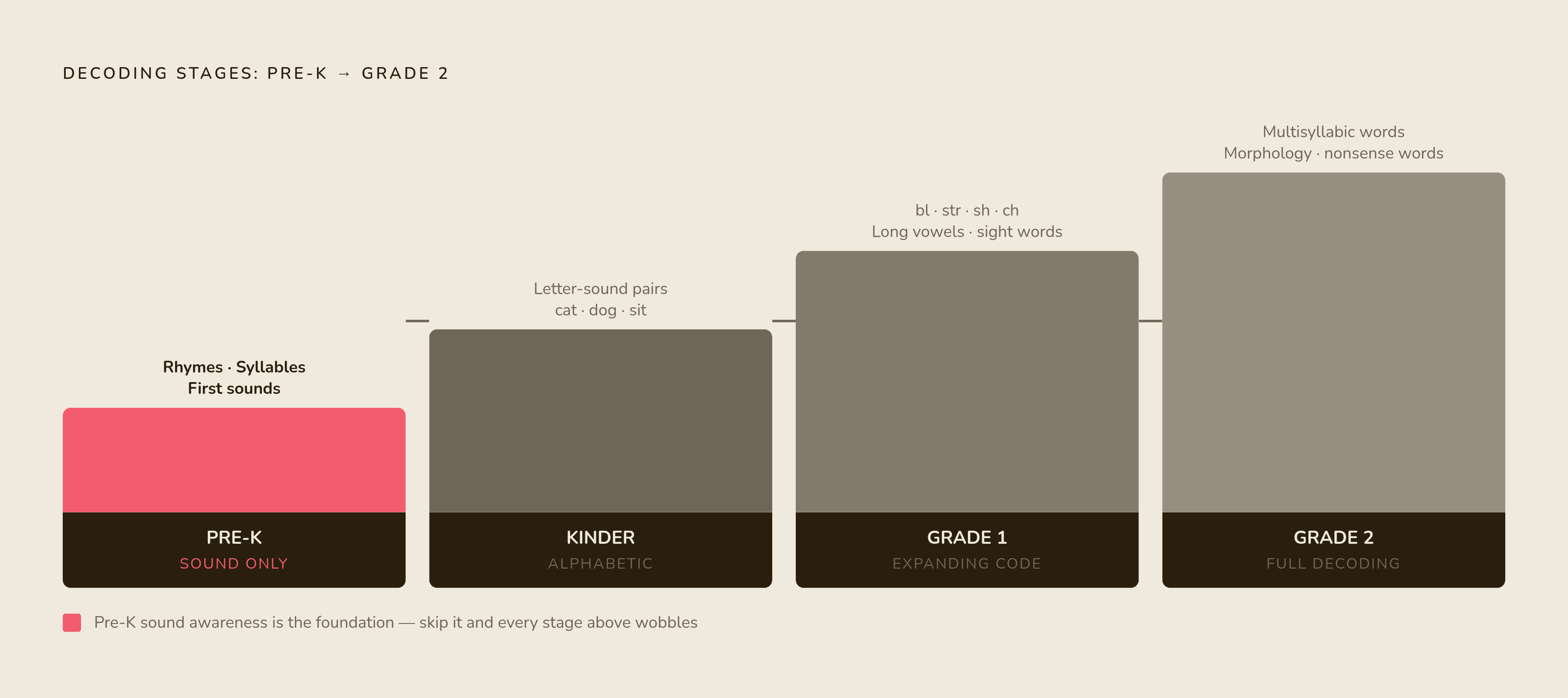
Decoding isn't one skill but a fixed sequence that builds from sound awareness through second grade.
Decoding means turning printed letters into spoken words, using knowledge of which sounds match which symbols. Most parents hear "decoding" and think it means "sounding out," but it's actually a stack of separate skills that build in a fixed order, starting before a child ever sees a letter and ending, by second grade, with a kid who can attack almost any unfamiliar word on the page. Skipping a step in that order makes everything built on top of it wobble. This sequence is a dependency chain, and most reading advice glosses right over that fact. It's a dependency chain, and most reading advice glosses right over that fact.
Reading doesn't develop the way spoken language does. Speech comes from exposure alone, kids just absorb it from being talked to and talked around. Print doesn't work that way. Kids need explicit teaching in how the code works, and the Science of Reading research is blunt about what happens when that teaching gets skipped: you get guessers, not readers. The pipeline runs decoding to fluency to comprehension, in that order, and a weak first link means the other two struggle no matter how sharp a child's vocabulary or background knowledge happens to be. Programs that lead with comprehension strategies or rich vocabulary exposure before decoding is solid are building on sand, and this raises a ceiling later that nobody can explain.
Three terms get flattened into one in everyday conversation, and that's where parents lose the thread. Phonemic awareness is purely auditory: hearing that "cat" is three sounds, no letters involved. Phonics is the letter-sound connection, this squiggle makes this sound. Decoding is what happens when a child uses that phonics knowledge to actually read a word off a page. These are different skills on different timelines. Confusing them is the single biggest reason parents misdiagnose where a struggling reader is actually stuck.
Phonological and phonemic awareness in Pre-K
Before letters enter the picture, a child needs to notice that spoken words are built from smaller sound units. That's phonological awareness: the umbrella term covering sensitivity to rhyme, syllables, and onset-rime chunks inside words ("c" plus "at" in "cat"). Phonemic awareness sits inside that umbrella as the most granular layer, the ability to hear and manipulate individual phonemes, the smallest sound units in speech.
Pre-K, around age four, is where this gets built, and the order matters. Kids learn to recognize rhymes, clap out syllables, and isolate the first sound in a word, all without a single letter in sight. No one connects "cat" to its written letters until they've heard, clearly, that "cat" breaks into three separate sounds. Letters come later. Sound awareness comes first, and there's no shortcut around it.
This groundwork carries more weight than it looks like it should. Research highlighted by NWEA points to phonemic awareness and alphabet knowledge, together, as among the most significant early indicators of which kids will struggle with decoding down the line. Screening for these two skills in Pre-K can flag at-risk kids years before they'd show up as "behind" in a first-grade reading group, which is exactly the window most classrooms miss because formal screening usually starts later.
If a Pre-K child can't rhyme "cat" and "hat," or can't clap the two beats in "ta-ble," that's the priority to fix. Flashcards with letters can wait. And for bilingual households, or kids learning English as an additional language, the research carries good news: phonological awareness built in a home language transfers to English. The auditory skill of noticing sound structure isn't tied to one language. It carries over.
The alphabetic principle and letter-sound correspondence: what kindergarten introduces
Letters appear in kindergarten, where the alphabetic principle takes over: the idea that letters and letter combinations represent spoken sounds in a systematic, predictable way. This is the real entry point for phonics. Kids learn that B makes a specific sound, that A can make a short sound, and that none of these pairings are random. They're rules, and the rules hold.
A lot of programs get the sequencing backward here, teaching sounds in isolation before ever connecting them to letters. That's the weaker method. NWEA's 2025 analysis found that hearing a phoneme while simultaneously connecting it to its letter speeds up learning compared to working with sound alone. The two skills reinforce each other rather than stacking strictly in sequence: sharper phonemic awareness makes phonics click faster, and solid phonics sharpens phonemic awareness right back. It's a loop, not a ladder, and teaching them apart wastes the loop.
Kindergarten milestones follow from that loop: single consonant sounds, short vowel sounds, simple CVC words like "cat," "dog," and "sit." The instructional method matters as much as the content here. Systematic, explicit phonics instruction, taught early and in a planned sequence, beats phonics picked up incidentally or folded loosely into other activities every time. Decodable texts belong in this stage too, short passages built entirely from letter-sound patterns a child has already been taught, so early reading practice builds accuracy instead of guesswork.
A kindergartner who can hear the three sounds in "cat" and match each one to its letter is exactly on schedule. That's the milestone, and it's a real one.
Blends, digraphs, and the expanding code: first grade's core work
First grade is where the code gets complicated fast. Kids move past single CVC words into consonant blends, two or three consonants stacked together where every sound stays audible ("bl" in "black," "str" in "string"), and digraphs, where two letters combine into one brand-new sound that neither letter makes alone.
Reading Rockets calls this cluster the "H Brothers": sh, ch, th, wh, ck. Each gets taught as its own unit, because a kid sounding out "ship" letter by letter (/s/ /h/ /i/ /p/) lands on the wrong word every time. "Sh" has to be taught as a single sound chunk, not two separate letters bolted together.
Long vowel patterns also appear here: silent-e words like "cake" and "line," and vowel teams like "ai," "ea," and "oa." Alongside all this, first graders start banking sight words, words like "said," "the," and "was" that break the regular rules. The right approach decodes the regular part of the word and treats only the irregular chunk as memorized. Swallowing the whole word as a shape to recognize is the weaker method, and one that becomes a visible ceiling on vocabulary growth later.
Onset-rime work threads through as a bridge skill, connecting word families like "cat," "bat," and "hat" by swapping the first sound and keeping the rest fixed. Classrooms that run this well keep the routine almost boring on purpose: brief daily review of sounds already taught, then one new pattern layered in. Predictable structure lowers the mental load for every kid in the room, especially the ones already behind.
A first grader who can read "ship," "black," and "cake," using digraph, blend, and long-vowel knowledge respectively, is building the code piece by piece, the way it's supposed to go. Kids who arrive in first grade with shaky phonemic awareness need direct, intensive work on phoneme manipulation before any of these more complex patterns will make sense. Skipping that step and pushing straight into blends just stacks confusion on a foundation that was never solid.
Second grade decoding when the foundation is solid
By the end of second grade, Reading Rockets lists five specific things a child should be able to do: recognize a growing bank of words by sight, use letter-sound knowledge to sound out unfamiliar words, accurately decode multisyllabic words that follow regular spelling patterns (think "capital" or "Kalamazoo"), sound out made-up nonsense words that follow regular patterns, and read a good number of irregularly spelled words accurately.
That nonsense-word piece deserves attention, because it's the cleanest test available. A child who can sound out "flig" or "bront" is decoding for real, applying rules to something never seen before, not pulling a memorized word out of storage. Memorization can fake fluency on familiar text. It cannot fake nonsense words, ever. It belongs in any real assessment for this reason.
Word study widens out at this stage past basic phonics into syllabication (breaking "fantastic" into "fan-tas-tic"), morphology (prefix, root, suffix), and more advanced vowel patterns. English's real irregularity gets impossible to ignore here: "dot," "taut," and "thought" all rhyme, spelled three completely different ways. NWEA's analysis found that word study makes that irregularity navigable instead of just baffling.
Reading Rockets recommends a build-a-word activity that captures morphological awareness in action: give a child "heat," then ask for "reheat," "heated," "heater," "heating." A kid adding and swapping those pieces correctly is showing real understanding of how English words go together.
Sight vocabulary keeps growing too, but as a byproduct, not a separate task. Kids who decode more words encounter those same words in print more often, and eventually recognize them instantly without sounding them out. That's fluency, and it grows out of decoding practice, never the other way around, no matter how many sight-word flashcard decks get sold on that premise.
Instruction gaps in the classroom and home awareness
Not every classroom teaches this sequence the same way, and the gap is bigger than most parents assume. A poll of teachers spanning kindergarten through third grade, run by a research institute and another research organization, found roughly a third still mixing phonics instruction with cueing, the practice of guessing a word from a picture or surrounding context instead of sounding it out. Cueing trains kids to guess, and it's a documented drag on fluency down the line. There's no version of cueing that's harmless. It just costs a kid less visibly at first and more later.
The same poll found 84% of teachers who'd completed reading professional development said phonics got "a lot" or "some" focus in that training, and 83% said the same for phonemic and phonological awareness. That leaves somewhere between one in six and one in five teachers surveyed with training that gave these foundational skills less than "some" attention. That's a real gap even against otherwise solid numbers.
Policy is starting to close that gap in some places. One state's reading law took effect July 1, 2024, for the 2024-25 school year, mandating instruction aligned with reading research, including explicit phonics, with a full ban on three-cueing methods arriving in 2025-26. But policy and classroom practice don't move in lockstep, and a law on the books doesn't guarantee a teacher retrained fast enough to match it. A parent who knows the sequence outlined above can walk into a parent-teacher conference and ask, specifically, whether a child is sounding out words or guessing from pictures. That one question reveals more than most report cards do.
How to tell if your child is behind, and what "behind" means at each stage
"Behind" only means something measured against this sequence. A child can be right on track with phonemic awareness while carrying a real gap in phonics, or the reverse. Grade level alone doesn't tell the story, and treating it as the only benchmark is how gaps get missed for years.
Pre-K red flags: can't rhyme simple words, can't clap out syllables, doesn't notice a word's first sound. The auditory foundation isn't there yet, and no amount of letter drilling fixes that.
Kindergarten red flags: can't connect most consonant letters to their sounds, can't blend three phonemes together into a word out loud.
First grade red flags: guesses at whole words from pictures or context instead of sounding them out, can't reliably read simple CVC words, avoids reading out loud whenever possible.
Second grade red flags: still reads slowly, sound-by-sound, even on short familiar words (automaticity never developed), can't decode a simple two-syllable regular word, skips or swaps in guesses for unfamiliar words instead of attempting them.
The nonsense-word test works at home too. Ask a second grader to read "zab" or "fep" out loud. Real trouble here should get flagged to the teacher directly, since it points to genuine decoding weakness rather than a fluency issue that smooths out with more practice.
Kids who reach second grade without solid basic decoding can catch up, but research is consistent that catch-up needs supplemental, targeted intervention running alongside grade-level instruction, not instead of it. Kids with dyslexia or other reading differences move through this exact same sequence: phonemic awareness, then phonics, then blends and digraphs, then multisyllabic decoding. They need more intensive, more explicit instruction to get through each stage, but the order itself doesn't change. The intensity does.
What parents can do at each stage to reinforce the sequence at home
Pre-K, at home, is about play, not worksheets: songs, rhymes, chants. The rhythm and repetition do the actual work of building auditory sensitivity to sound structure, and no workbook replaces that.
Kindergarten calls for connecting sounds a child already hears to the letters they're learning to see. Point to a letter, say its sound out loud. Play "I spy something that starts with /b/" in the car or at the grocery store. Low stakes, frequent repetition, no pressure attached.
First grade is a good time for word ladders, changing one letter at a time to shift "line" into "fine," then "five," then "dive." Reading Rockets recommends this activity, and it makes visible, in real time, that words are built from swappable parts rather than memorized as whole shapes.
Second grade opens up more real-world options. Reading cereal boxes and grocery labels together works because it's genuinely varied text, and a child can pick their own "stretch" words to attempt. The build-a-word exercise ("heat" into "reheat," "heated," "heater") turns a kitchen conversation into morphology practice without anyone noticing it's a lesson. Signs, restaurant menus, movie posters, anything printed in the wild counts, kept brief and low-pressure.
One rule holds across every stage, and it's the one parents break most often: give the child time to sound a word out before jumping in with the answer. The pause is uncomfortable to sit through, but it's where the actual decoding practice happens. Jumping in early to rescue a stuck kid feels kind in the moment and costs them the rep. Reading to a child and listening to a child read are two different activities, and both need to happen regularly. Read-alouds build vocabulary and comprehension. Listening to a child read out loud is what builds decoding itself, and no amount of read-aloud time substitutes for it.
For kids who resist reading practice, shorter and more frequent sessions beat one long, grinding one every time. Pairing the material with something the child already loves, a dinosaur obsession, a favorite cartoon character, lowers the resistance considerably. The one-on-one, real-time corrective feedback that actually moves decoding forward is hard to sustain at home night after night, and that's the specific gap some AI reading tools built for young readers are designed to fill, provided the tool actually listens to the child read and responds to specific errors instead of just playing back pre-set content regardless of what the child says.
What to look for in a tool or program that claims to teach decoding
The core question for any reading app, workbook, or program: does it follow a planned, explicit sequence, simple to complex, single sounds before blends, blends before digraphs, CVC words before multisyllabic ones? Or does it teach phonics in whatever order happens to be entertaining that week? Most programs on the shelf fail this test, and the failure becomes visible fast once you know what to check.
Trustworthy signs include skills introduced in a deliberate order rather than scattered, decodable texts used for practice rather than leveled texts sorted by general difficulty, explicit correction when a child makes a decoding error rather than a bare "wrong, try again," and phonemic awareness activities built in alongside phonics, especially at the Pre-K and kindergarten stages.
Signs of real caution: tools that reward guessing from a picture, that skip phonemic awareness work entirely, or that present phonics as a game with no corrective feedback loop when a child makes a mistake. A flashy interface with none of these underlying mechanics is worse than no tool at all, because it looks like progress while teaching guessing habits that have to get unlearned later. That's the trap most parents fall into: judging a program by how polished it looks on a screen rather than by what it actually corrects.
Adaptive pacing matters too. A child already solid on CVC words shouldn't sit repeating them for weeks on end. A well-built tool detects mastery and moves the child forward instead of stalling out on content already learned. A 2024 systematic review in SAGE Open found digital literacy tools vary widely in effectiveness based on the content, the age-appropriateness, and the presence of an adult built into the loop. Passive apps, the kind a child sits in front of with no real response to what they're doing, consistently underperform tools that respond to the child in real time.
Reporting back to parents rounds out the picture. A program that shows what a child practiced, where their errors are clustering, and what's coming next turns a parent from a bystander into an actual partner, able to reinforce the right thing at the right stage instead of guessing at it.
Sources
- Phonics and Decoding: Activities for Your Second Grader | Reading Rockets
- What the science of reading tells us about how to teach decoding—including phonics
- Teaching the Alphabetic Code: Phonics and Decoding | Reading Rockets
- Target the Problem: Word Decoding and Phonics | Reading Rockets
- Phonological and Phonemic Awareness: Introduction | Reading Rockets
- sciencedirect.com
- readingrockets.org
- readingrockets.org