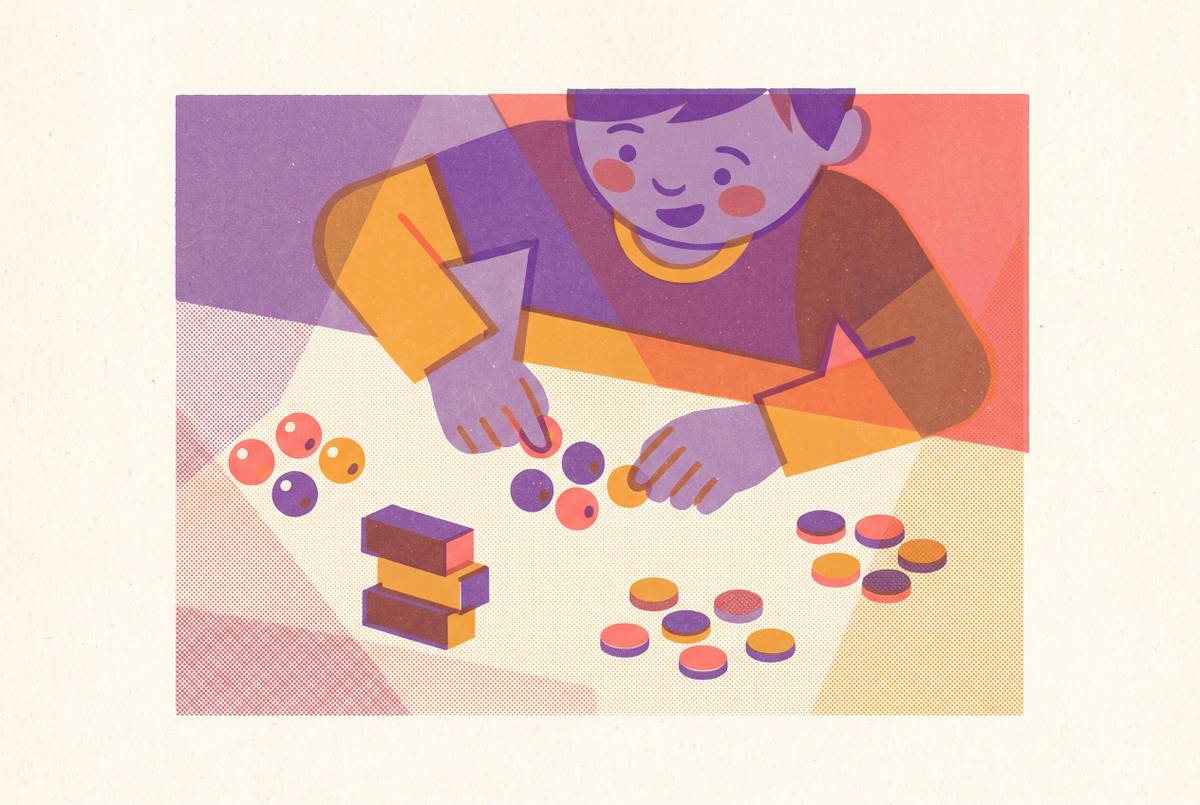
Numeracy Milestones for Children Ages 4 Through 8
Early math skills in kindergarten predict academic success better than reading does.
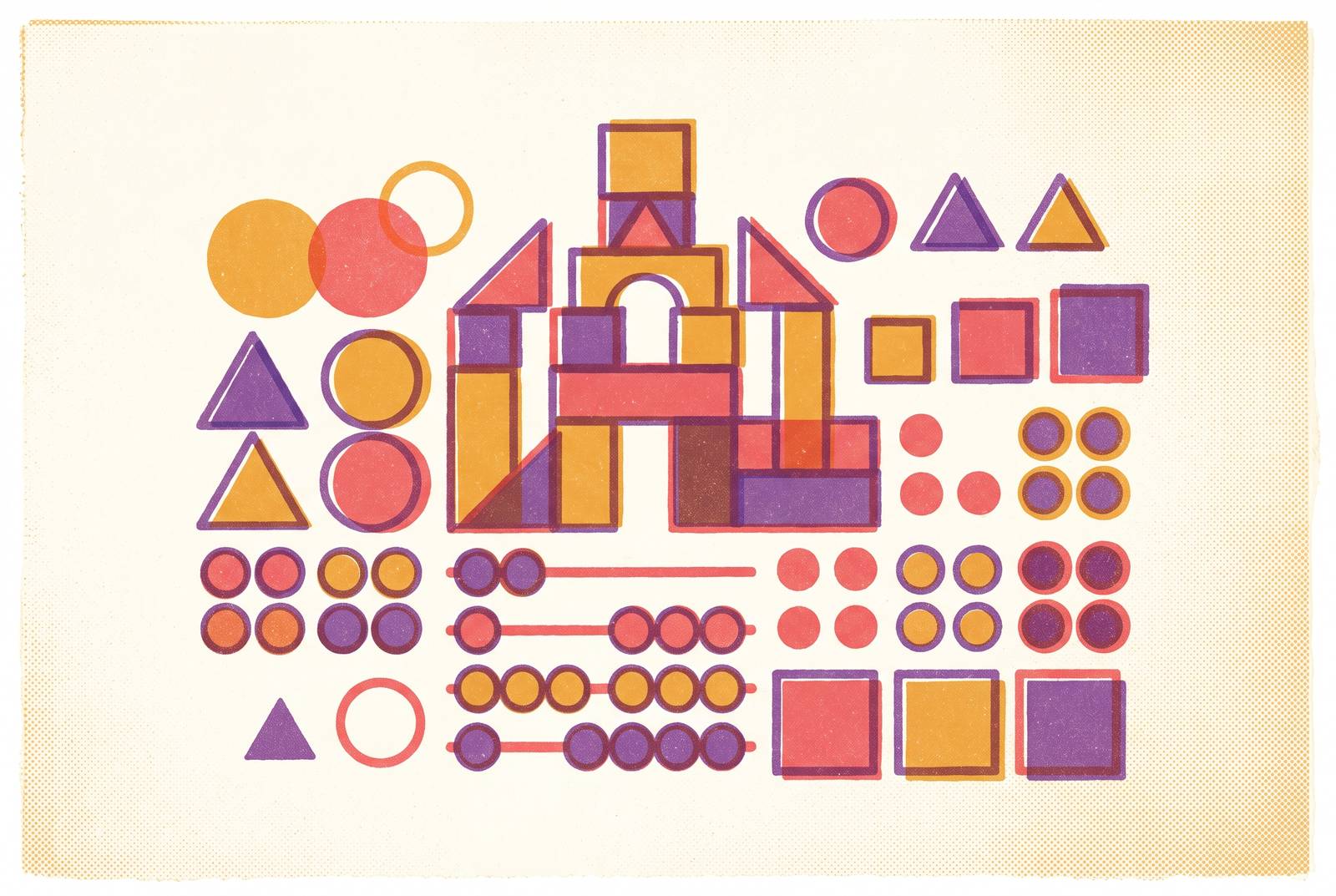
Numeracy Milestones for Children Ages 4 Through 8.
What early numeracy means for children ages 4-8
Numeracy isn't just counting out loud. It covers number recognition, comparing quantities, spotting patterns, spatial reasoning, and the earliest forms of problem-solving, and between ages 4 and 8, children move through a genuinely structured sequence of these skills, one that builds in a specific order. The Australian Early Years Learning Framework states that foundational numeracy includes number sense, pattern recognition, spatial awareness, and measurement, and all of it starts developing within the first five years of life.
The stakes are higher than they might look from the outside. A study in Developmental Psychology, cited by EdSurge, found that early math skills at kindergarten entry rank among the strongest predictors of later academic achievement, and the research suggests they actually outpace early reading skills as a predictor. A separate 2025 study following 1,252 children confirmed the same pattern: early numeracy predicts math achievement well into mid-primary school, with a telling wrinkle. Growth accelerates during kindergarten, then decelerates in Grade 1, which points to the kindergarten window as an especially sensitive stretch of time.
Most preschoolers spend less than a minute a day on math activities. Milestones are a guide, not a fixed checklist, and every child moves at a different pace, so none of this should read as a scorecard. Still, most preschoolers spend less than a minute a day on math activities, and that mismatch, between how developmentally ready young children are and how little structured exposure they actually get, is why parents have a real role to play here Your Child's First Math Program.
Ages 3-4: subitizing, counting to 10, and the first connections between numbers and quantity
It sounds like a minor party trick. The trick sounds minor, but it lacks the triviality that description implies. Subitizing is a foundational skill that often gets overlooked, and it's one of the earliest signs a child is building real number sense rather than just memorizing a sequence of words.
A 2025 peer-reviewed study on Tandfonline, drawing on samples of 147 three-year-olds and 173 four-year-olds, found that counting skills and numerical relational understanding at this age can be measured reliably, and that they're tied to symbolic magnitude processing, an early marker of later math competence. That's a research way of confirming what most parents sense intuitively: the way a 3-year-old handles numbers now says something about how they'll handle numbers years down the line.
The real leap at this stage is connecting a number to an actual quantity. It's connecting a number to an actual quantity, understanding that the word "five" corresponds to five actual things in front of them. Common stumbles include skipping numbers mid-count, mismatching a number to an object when counting a group, and struggling with the abstract idea that a numeral stands for something countable. If a child recites numbers but cannot tell you how many objects are in a small group, or cannot sort by a single attribute, that signals a stumble worth addressing. Children count to 10, often through rote repetition before true understanding. Children develop subitizing, the ability to recognize small quantities (typically up to 4–5 objects) without counting, a foundational and often underappreciated skill.
Ages 4-5: pattern recognition, counting to 20, and the first steps toward addition
This is also the age when pattern recognition takes off. Kids start noticing, creating, and extending simple repeating sequences, an ABAB block pattern, alternating colors, that sort of thing, and this is an early form of algebraic thinking, even if nobody in the room would call it that.
Writing numbers usually enters the picture around now too, which lines up with kindergarten-level expectations under Common Core. Spatial vocabulary expands as well: kids start exploring 3D shapes and using position words like "in," "on," "under," and "next to" with more precision.
There's a neurological reason this age carries so much weight. By age 5, roughly 90% of brain development is already complete, according to Funexpected Math's citation of neurodevelopmental research, which means the wiring for mathematical thinking is largely in place by now. That reframes what this stage is actually for. It's less about introducing brand-new concepts and more about consolidating ones the brain is already primed to handle. Common challenges at this age include confusing what a numeral looks like with what it actually represents, getting stuck on patterns with more than two elements, and leaning too heavily on counting from one instead of counting on from a known number. Children recognize numbers up to 20 and count that high. Children subitize up to roughly 5 objects without counting.
Ages 5-6: counting to 100, skip counting, and understanding addition and subtraction as operations
Skip counting shapes the multiplication skills a child builds a couple of years later. It's the conceptual seed that multiplication grows out of a couple years later.
This is also the stage the 2025 study of 1,252 children flagged as especially sensitive. Growth in numeracy accelerates through kindergarten, then slows down in Grade 1, and that pattern is the single strongest argument for early screening: a gap caused by this deceleration tends to become visible right around here.
Kids at this stage are also shifting from "counting all" (starting from one every single time) to "counting on" (starting from a known quantity and building from there), and they're beginning to grasp that subtraction is simply addition's inverse. Place value starts entering the picture too, at least at a basic level, the idea that "10" isn't just a random pair of symbols but a one and a zero that mean something specific. Parents watching for gaps should note one thing in particular: a child who still needs to count every single object from one, rather than starting from a number they already know, may be missing the cardinality concept that's supposed to be locking into place right about now. Children count to 20 or beyond, and work toward 100.
Ages 6-7: place value, addition and subtraction to 20, and first encounters with word problems
Understanding place value at the tens and ones level becomes a real conceptual target, grasping that 14 means one ten and four ones, not just a symbol.
Place value is, honestly, the hinge this whole stage turns on. Kids who don't get a firm grip on tens and ones now tend to struggle once multi-digit arithmetic shows up in Grade 2, so it's worth giving explicit attention at home as well as in the classroom.
A 2025 cross-lagged longitudinal study found that phonological processing skills and basic number knowledge in 5- to 6-year-olds predict each other's development over the following year, so a child struggling with early reading may also show early math risk signals, and vice versa. A child struggling with early reading may be quietly showing early math risk signals too, and the reverse holds just as true, so parents tracking one skill should keep half an eye on the other. Children count to 100 and perform addition and subtraction within 20.
Ages 7-8: multi-digit operations, larger place values, and the introduction of multiplication and division
At age 8, typically Grade 3, the curriculum shifts toward four central areas: multiplication, division, fractions, and area and 2D shapes. Multiplication at this stage is supposed to start as a concept. It's supposed to start as a concept, equal groups, arrays, repeated addition, because building this conceptual structure first produces genuine understanding of the operation, which recall from memory alone does not. Fractions shift too, moving from "a slice of pizza" toward numbers that live on a number line, with actual magnitude and position.
This is also the age where earlier cracks tend to become visible. Multi-digit subtraction with regrouping (the "borrowing" most adults remember from their own childhood) requires cardinality, counting on, and place value to all be solid simultaneously, so a shaky foundation in any one of those areas produces visible errors right here.
A 2025 growth-curve study of 1,252 children found no ceiling effect at this stage, indicating many children are still developing suboptimally, which the researchers interpret as a signal for the need for early screening (not waiting until Grade 2 or 3 to identify a child who needed support in kindergarten).
How the numeracy sequence builds when a stage is shaky
The sequence is genuinely cumulative. It's genuinely cumulative. Subitizing feeds into cardinality (understanding that a number represents a specific quantity), cardinality feeds into counting on, counting on feeds into addition, addition feeds into place value, and place value feeds into multi-digit operations and eventually multiplication.
Skip a stage, or rush through it, and the skills involved don't just vanish. A child can look perfectly fine, keeping up, seemingly on track, right up until a later concept demands the exact foundation that got skipped. That's precisely why gaps caused by earlier skipped foundations become visible suddenly in Grade 2 or 3, even when nothing looked wrong back in kindergarten. The 1,252-child study backs this up directly: the deceleration researchers observed in Grade 1, right after the kindergarten growth surge, may reflect suboptimal development rather than a normal plateau, and the study calls explicitly for early screening rather than a wait-and-see approach.
The language connection deepens the picture further. And the home environment isn't incidental. Formal activities, like actively teaching numbers and calculations, have been linked to stronger symbolic number knowledge across a range of studies from 2021 to 2025, though results vary across samples. Informal exposure carries real weight too: counting snacks, reading a clock, sorting laundry by pairs, all of it builds the everyday mathematical vocabulary kids need before they can apply it formally.
Signs a child may be behind at each stage
Milestones work as a guide. The real question is whether a child is moving forward at all, not whether they hit some precise date on a chart. It's whether they're moving forward at all.
Certain signals at each stage indicate a child may need extra support.
Root causes vary. Difficulty with one-to-one correspondence, limited exposure to math at home, math anxiety that builds from early frustration, language barriers that muddy math vocabulary, even fine motor delays that make writing numbers a struggle in its own right, all of these appear in the research as contributing factors. Math anxiety deserves particular attention here. Early frustration can push a child to avoid numeracy activities altogether, and once avoidance sets in, practice drops off, which only widens the gap further. A positive emotional environment around math isn't a nice-to-have. It's part of what determines whether a child engages enough to build the skill in the first place.
So how does a parent tell a gap from a pace difference? A child running one or two months behind a benchmark in a single area, while still showing forward progress, looks nothing like a child who's stalled entirely, avoiding math activities, or struggling across several numeracy domains at once. The first is normal variation. The second is worth a conversation with a teacher. At ages 3–4, a child may recite numbers but cannot tell you how many objects are in a small group, and cannot sort by a single attribute. At ages 4–5, a child may still be counting every object from 1, cannot identify or continue a simple repeating pattern, and does not recognize any written numerals. At ages 5–6, a child may not count reliably to 20, shows no skip counting at all, and cannot perform the simplest addition even with objects in hand. At ages 6–7, a child may count from 1 for every calculation, has no understanding that 14 is one ten and four ones, and cannot solve a simple word problem even when the math involved is addition within 10. At ages 7–8, a child may be unable to perform two-digit addition or subtraction, has no conceptual grasp of multiplication as equal groups, and finds fractions entirely opaque.
What parents can do at home to support numeracy at each stage without turning it into a lesson
Play-based, embedded daily activity isn't a fallback for parents who can't manage formal instruction. For this age range, it's the method the research actually supports, formal instruction alone doesn't cut it for early childhood math.
Sorting by color, size, or shape works well here too, and so do simple counting songs and spotting shapes out in the world.
Balance-scale play introduces the idea of equality in a hands-on way, and folding number into daily routines, counting snacks, pairing socks, counting steps up the stairs, keeps it low-pressure. Simple card games and dominoes reinforce number recognition and comparison without ever feeling like homework.
Setting the table, one fork per person, is a one-to-one correspondence exercise disguised as a chore. Number hunts, hunting for numerals on signs, license plates, mailboxes, keep the search playful.
For ages 6 to 7, reading a clock, both analog and digital, builds numerical fluency in a genuinely useful skill https://funexpectedapps.com/en/blog-posts/math-learning-milestones-ages-3-to-7-explained [1]. Number-based puzzles and riddles sharpen reasoning, and informal scheduling questions, how many days until the weekend, how many minutes until dinner, fold time and number sense together without ever feeling like a worksheet.
None of this requires a curriculum or a workbook. It requires noticing where a child already sits in the sequence, and meeting them there, one snack, one sock, one number on a mailbox at a time. Ages 4–5 activities:. Parents can support numeracy through creating and extending patterns with blocks, socks, or objects, using ABAB sequences and then more complex ones.
Sources
- Full article: Early Numeracy in 3- to 4-Year-Old Children: The Role of Family Variables, Child’s Gender, and Language Skills
- Math Learning Milestones: Ages 3 to 7 Explained - Funexpected Math | Your Child's First Math Program
- Reciprocal development of numeracy, mathematical language, and general language skills from age 2 ½ to 4 years: A cross-lagged panel perspective - ScienceDirect
- (PDF) The Role of Early Numeracy Skills in Predicting Long-Term Mathematics Achievement