Common Core Math Standards for Kindergarten Through 3rd Grade
These standards build math skills layer by layer, not topic by topic.
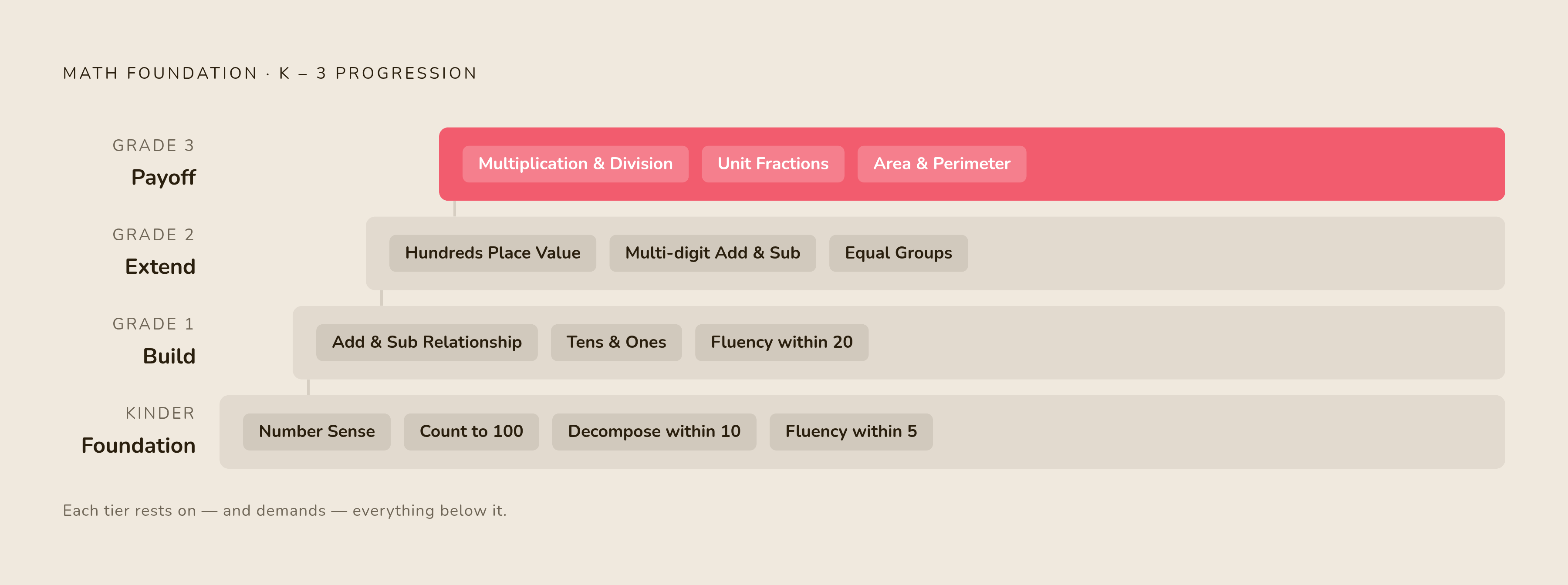
The Common Core math standards for K–3 are built on a deliberate developmental sequence, not a grade-by-grade checklist, each year's work is scaffolded on the last and prepares the ground for what follows. Each grade's work sits on top of the grade before it and sets up the grade after it. A skill taught in kindergarten gets picked up again a year later as the beginning of something larger.
The standards themselves explain why they were built this way. The standards document opens with an explicit critique of U.S. math curricula as "a mile wide and an inch deep".
Two pillars run through every grade: conceptual understanding and procedural fluency, treated as equally important and equally assessable. One is conceptual understanding, or knowing why a piece of math works the way it does. The other is procedural fluency, or knowing how to actually do it, quickly and accurately. Neither one substitutes for the other. A child can add 347 + 215 by decomposing by place value (300 + 200, 40 + 10, 7 + 5) rather than only using a memorized algorithm, and that is what mastery looks like at this level.
For a parent, this framing helps spot a gap early, before it turns into a much bigger problem. A child who's behind on a kindergarten or first-grade standard stays behind in the years that follow. They're missing a piece that the next two or three years of math are quietly assuming is already in place. Knowing what each grade is actually building, and why, makes it possible to spot a gap early, instead of discovering it later as a much bigger problem.
Kindergarten: building number sense before arithmetic begins
Kindergarten math is almost entirely about number, and that's by design. The standards direct more instructional time toward number in kindergarten than toward any other topic, because nearly everything a child will do in math later depends on a solid feel for what numbers are and how they behave. The kindergarten year is organized around two priorities, in this order: representing and comparing whole numbers, often using physical objects like blocks or counters, and describing shapes and space.
Counting and cardinality make up the largest single piece of the kindergarten standards. A kindergartner is expected to count to 100 by ones and by tens, and to pick up counting from any number in the sequence rather than always starting over at one. They're expected to write numbers from 0 to 20, and to match a written numeral to an actual quantity of objects, including understanding that 0 means there's nothing there. They're expected to compare groups of objects to say which has more or less, and to compare two written numbers between 1 and 10 the same way.
A child learns to decompose numbers up to 10 into pairs in more than one way, such as 5 = 2 + 3 and 5 = 4 + 1. That's the real content of cardinality, and it's the foundation everything else in math sits on.
Alongside counting, kindergartners start working with addition and subtraction, though not in the form most adults picture. The standards call for representing these operations with objects, fingers, drawings, claps, spoken explanations, or simple equations, and for solving word problems by adding and subtracting within 10. A child is expected to break a number down into pairs in more than one way, so 5 might be shown as 2 and 3, or as 4 and 1. For any number from 1 to 9, they should be able to find what number completes it to 10. The one specific fluency target for the entire kindergarten year is addition and subtraction within 5, a narrow, deliberately modest bar that reflects how early this is in a child's math life.
There's also a first brush with place value, tucked into a single standard: composing and decomposing numbers 11-19 into ten ones and some further ones, the first encounter with place value logic.
Measurement and geometry round out the year with a lighter touch. Kindergartners describe measurable features of objects, compare two objects directly to say which has more or less of some attribute, and learn to name and sort shapes regardless of their size or orientation, including telling flat shapes apart from solid ones.
What does mastery actually look like at this age? A kindergartner who can pick up counting from any number, break a single-digit number apart in more than one way, and recognize that a teen number is a ten plus some ones is working right at standard. Reciting numbers from memory isn't the goal. Understanding what those numbers represent is.
First grade: addition and subtraction become a system, not a set of facts
Kindergarten asks "how many?" First grade asks a harder question: what happens when groups of things get combined or pulled apart? That shift, from counting quantities to reasoning about how quantities change, is what makes first grade feel like a real step up. Addition and subtraction stop being something a child works out by moving objects around and start becoming a mental system they can reason through.
The year is organized around four critical areas that build directly on one another: developing a real understanding of addition and subtraction and building strategies for solving problems within 20, understanding whole numbers and place value well enough to group them into tens and ones, measuring length, and reasoning about the properties of shapes.
Word problems carry a lot of weight in first grade, more than pure computation drills do. Within Operations and Algebraic Thinking, students represent and solve problems using addition and subtraction, add and subtract within 20 as they build toward real fluency, and work with equations from both directions. That last point means a first grader is expected to solve 3 + 4 =? and also solve 3 +? = 7. Being able to work an equation from either side is a sign that a child understands what the equal sign means.
In Number and Operations in Base Ten, the counting sequence gets extended, and students deepen their grip on place value, with tens and ones as the organizing structure behind every number they'll work with going forward. That structure gets put to use immediately: students apply their place value understanding, along with the properties of operations, to actually add and subtract.
Measurement and Data work covers measuring length indirectly and by repeating a unit, telling and writing time, and representing and interpreting simple data. Geometry asks students to reason about shapes and their attributes, continuing the spatial reasoning strand from kindergarten.
The real conceptual center of first grade is the relationship between addition and subtraction. These are two related skills, tied together rather than memorized side by side. They're inverse operations, and understanding that link is what eventually makes fast, flexible mental math possible. A first grader who grasps that 9 − 5 = 4 because 5 + 4 = 9 is reasoning at exactly the level the standard asks for, and that's a meaningfully different skill from a child who has simply memorized that 9 minus 5 equals 4. One of those children can rebuild the fact if they forget it. The other one is stuck when memory fails.
Second grade: place value deepens and multi-digit arithmetic arrives
Second grade takes the tens-and-ones structure introduced in first grade and stretches it out to three-digit numbers, pushing addition and subtraction up to a scale where shortcuts stop working and real understanding of the base-ten system becomes necessary.
Operations and Algebraic Thinking keeps building fluency: students continue adding and subtracting within 20, and now fluency is the actual target. Alongside that, students start working with equal groups of objects. This isn't multiplication yet, but it's the mental model multiplication will formalize the following year.
Place value is where the year's real weight sits. Students extend their understanding to hundreds, grasping that a hundred is composed of tens, which are themselves composed of ones. That structure then gets applied directly: students use place value understanding and the properties of operations to add and subtract, including adding up to four two-digit numbers at once.
Measurement and Data work has students measuring and estimating length in standard units, connecting addition and subtraction to length itself, working with time and money, and interpreting data. Geometry continues the thread of reasoning about shapes and their attributes.
Mastery at this stage looks like flexibility. A second grader who can add 347 and 215 by breaking each number into hundreds, tens, and ones (300 + 200, 40 + 10, 7 + 5) and recombining the pieces is demonstrating real place value understanding. Second grade builds that flexibility. It's the bridge between first grade's addition facts and third grade's multiplication, and it only works if a child can take a number apart and put it back together on purpose.
Third grade: multiplication, division, and fractions, the year the math gets harder for a reason
Third grade is the most demanding year in the K–3 span, and the difficulty isn't an accident. Multiplication, division, and fractions are gateway concepts.
Four critical areas define the year: developing real understanding of multiplication and division and building strategies for solving problems within 100, understanding fractions with a particular focus on unit fractions, understanding rectangular arrays and area, and describing and analyzing two-dimensional shapes.
Within Operations and Algebraic Thinking, students represent and solve problems involving multiplication and division. Multiplying and dividing within 100 is the specific fluency target for the year. Students also solve problems that combine all four operations and start identifying and explaining patterns in arithmetic, a step toward the kind of reasoning that algebra will later demand explicitly.
Number and Operations in Base Ten carries this forward into multi-digit arithmetic, applying place value understanding and the properties of operations to numbers larger than what second grade covered.
The biggest structural change in third grade is a brand-new domain that didn't exist in kindergarten, first, or second grade: Number and Operations, Fractions. Third graders develop an understanding of fractions as numbers in their own right. The standards frame fractions as built out of unit fractions: a child understands a fraction as multiple copies of the corresponding unit fraction. Students use visual fraction models to represent parts of a whole, and they learn something that trips up a lot of adults too: the size of a fractional part depends entirely on the size of the whole it's part of. The same fraction of a small pizza is not the same amount as that fraction of a large one.
Measurement and Data work in third grade solves problems involving time intervals, liquid volume, and mass, and continues representing and interpreting data. Geometric measurement introduces area, connecting it to multiplication and addition, and introduces perimeter as an attribute of plane figures, with students learning to distinguish between linear and area measures.
Third grade earns its reputation as the hardest year in this span honestly. It asks a student to hold onto everything built since kindergarten, counting, place value, the addition-subtraction relationship, equal groups, and use all of it at once to make sense of multiplication, division, and fractions. A child who arrives at third grade with those earlier pieces solidly in place has what the year actually requires. A child missing even one of them, often place value or the addition-subtraction relationship, tends to find third grade math a lot harder than it needs to be, because the ground it's supposed to stand on was never fully built.
Sources
- Common Core State Standards for Mathematics
- Kindergarten Math Common Core State Standards: Overview
- COMMON CORE STATE STANDARDS FOR Mathematics (CCSSM) ____ Kindergarten
- COMMON CORE STATE STANDARDS FOR Mathematics (CCSSM) ____ Grade 1
- COMMON CORE STATE STANDARDS FOR Mathematics (CCSSM) ____ Grade 2
- COMMON CORE STATE STANDARDS FOR Mathematics (CCSSM) ____ Grade 3