Reading Fluency Development in Kindergarten Through 3rd Grade
Fixing the fluency gap that leaves most fourth graders behind.

Nationwide reading scores just hit their lowest point in more than two decades, and the reason traces back to one skill that gets rushed, skipped, or badly misunderstood in the early grades: fluency. Only 31% of fourth graders read at or above the Proficient level in 2024, according to NAEP data. Around 40% scored below Basic, the largest share since 2002, and no state posted gains compared to 2022. That pattern doesn't start in fourth grade. It starts in kindergarten, with a piece of instruction most classrooms either rush past or delay too long, and getting the sequence wrong is the actual crisis here.
The stakes are severe. Children who aren't reading proficiently by third grade are four times more likely to drop out of high school. For low-income struggling readers, that risk climbs to six times higher. Roughly 80% of low-income fourth graders don't read at grade level, which turns a national average into an equity problem with a clear fault line. Third grade is the hinge where kids stop learning to read and start reading to learn, and everything before that, kindergarten through second grade, is preparation for the crossing. The fix is a sequence, and most classrooms scramble the order. It's a sequence, and most classrooms scramble the order.
What the Science of Reading says reading is
The Science of Reading pulls together decades of work from education, cognitive psychology, linguistics, neuroscience, and speech-language science. All of it converges on the same finding about how the brain learns to read, and the finding is counterintuitive: spoken language develops naturally through exposure, but reading does not. Written language has to be taught explicitly, because the brain has no built-in wiring connecting print to sound. Somebody has to build that connection on purpose, and most reading instruction that fails does so for exactly this reason: it assumes the connection forms on its own.
The Simple View of Reading splits skilled reading into two components, Word Recognition and Language Comprehension. Both are required. Neither is sufficient alone. A child who can decode every word on a page but has no idea what any of it means is not reading, and a child who understands complex spoken language but can't decode print isn't reading either. Both failures look completely different from the outside, so many get missed.
Scarborough's Reading Rope adds texture to that split. On the Word Recognition side, three strands weave together: phonological awareness, decoding, and sight recognition of familiar words. On the Language Comprehension side, five more: background knowledge, vocabulary, language structures, verbal reasoning, and literacy knowledge. The National Reading Panel names five pillars covering the same ground: phonemic awareness, phonics, fluency, vocabulary, and comprehension. Fluency sits third, right in the middle, and it acts as the hinge between decoding and meaning.
Structured literacy, the instructional approach built on this research, gets mislabeled as a special-education tool, something reserved for kids with dyslexia. That label is wrong, and it does damage. Research on structured literacy makes clear it benefits every student, not just the ones who struggle, and treating it as a niche intervention lets fluency problems go unaddressed until third grade, when they're far more expensive to fix.
Kindergarten: building the sound-level foundation that decoding depends on
Phonemic awareness comes first, and it has to. Before a child can connect sounds to letters, that child needs to hear, isolate, and manipulate individual phonemes in spoken words, no print involved at all, according to reading research. Two skills matter most here. Segmenting means saying each individual sound in a word, and it's the foundation of spelling. Blending means combining individual sounds into a recognizable word, and it's the foundation of reading.
This work happens with eyes closed, no text anywhere in sight. It's entirely auditory and oral at this stage. A kindergartner playing a sound-blending game on the carpet, with no book nearby, is doing exactly the right thing. A kindergartner already buried in worksheets is behind schedule, not ahead of it, no matter how it looks to a parent scanning for early signs of progress.
The alphabetic principle comes next: the idea that spoken sounds map onto letters and letter patterns. This is the bridge from phonemic awareness into phonics. Researchers don't agree on one fixed sequence for introducing letter-sound pairs, but the Reading League's Decoding Tutorial, cited in Ms. Cotton's Corner, shows the field leans toward starting with high-utility letters: a, m, t, i, s, f, p, r. Those eight letters combine into a large number of simple, decodable words fast, which is the whole point of picking them first.
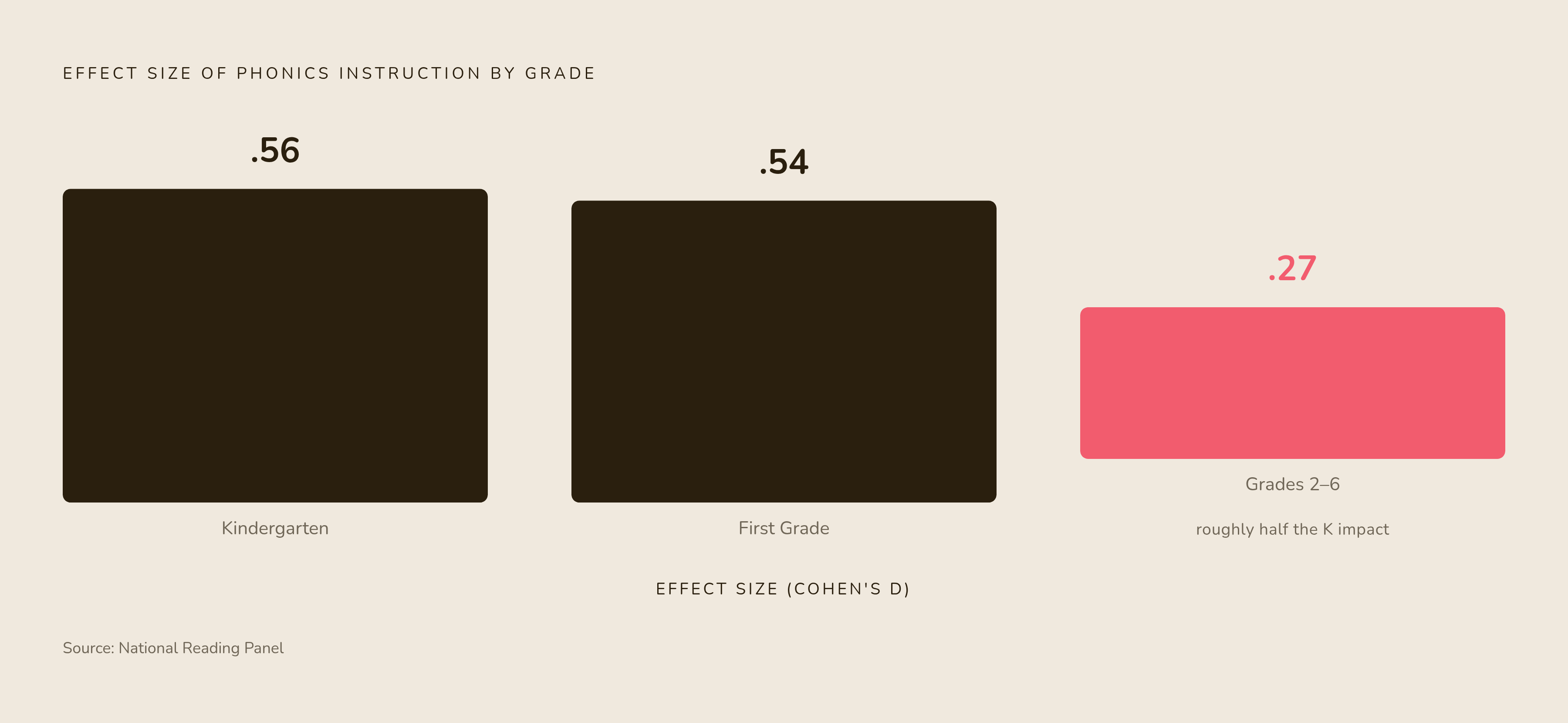
Timing determines how much impact phonics instruction has, and kindergarten is the single highest-impact window across the entire early-grades span. The National Reading Panel found the effect size of phonics instruction in kindergarten to be.56, as reported in Ms. Cotton's Corner. Slow, labored, sound-it-out-letter-by-letter reading in kindergarten is the whole point of the year. The child is still breaking the code, and fluency hasn't started yet. Its foundation is still being poured.
First grade: when decoding must become systematic and phonics instruction peaks
First grade keeps that window open, barely. The effect size of phonics instruction drops only slightly, to.54, nearly matching kindergarten's number. Taken together, kindergarten and first grade form the window where explicit decoding instruction does its heaviest lifting. Then the window narrows fast: by grades 2 through 6, the effect size falls to.27. That's still meaningful, but it's a fraction of what it was, and that drop is the whole argument against letting phonics instruction slide into third grade. Code-breaking work needs to be substantially finished before third grade starts, not started there.
One research body puts a specific clock on it: if phonics instruction begins early in first grade, it should wrap up by the end of second grade. That's the target, and it isn't a soft one.
Synthetic phonics, the method that teaches kids to blend individual letter sounds into whole words, carries an overall effect size of.45 across the National Reading Panel's 2000 review, a solid, moderate impact. The practice vehicle for all of this is the decodable text: a book built entirely from sound-spelling patterns students have already been taught and already practiced. A text only counts as decodable if the child actually has the tools to decode it. Otherwise it's a guessing exercise dressed up as reading, and handing a struggling first grader a leveled book that leans on picture clues undoes a lot of the phonics work already done. Leveled readers built around picture cues teach kids to guess, not decode, and guessing is the habit structured literacy is trying to break.
First-grade fluency, when it's on track, still looks effortful. Accuracy is climbing. Automaticity appears only in the most common, most-practiced patterns, while expression stays minimal, almost absent. That's normal. That's the process working.
How orthographic mapping turns decoded words into sight words
Somewhere in the middle of all that repeated decoding, something clicks, and it explains a lot of what parents call "sight words" without understanding why they exist. Orthographic mapping is the process where repeated, successful decoding of a word gets that word stored for instant, automatic recall. Once a word is mapped, the brain just knows it, the same way it knows a familiar face without working through a checklist of features.
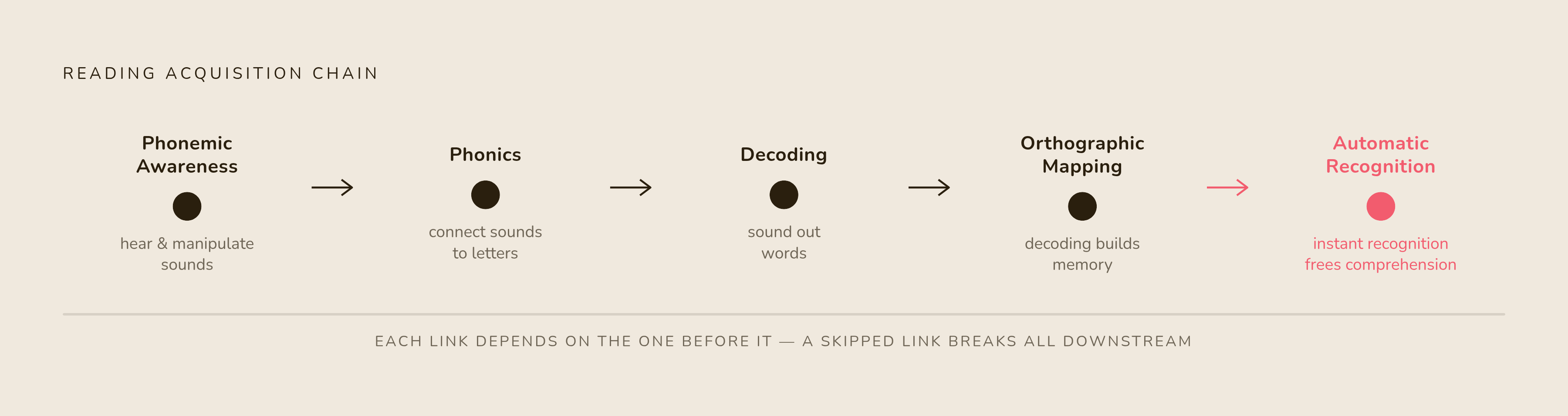
The full chain runs like this: phonemic awareness leads to phonics, phonics leads to decoding, decoding repeated enough times leads to orthographic mapping, and orthographic mapping produces automatic word recognition, which is fluency. Each link depends on the one before it. Skipping a link breaks the whole chain, no matter how much time gets poured into the links after it.
That reframes what a sight word actually is: a word decoded so many times, so successfully, that the brain stopped needing to decode it. Once a reader has fully processed a word through repeated decoding, that word becomes instantly retrievable, freeing up mental bandwidth for something else. That something else is comprehension, and it's the entire point of the exercise.
Flashcard drills that skip decoding practice might produce a kid who recognizes forty words by sight. Flashcard drills that skip decoding practice might produce a kid who recognizes forty words by sight, but that's memorization with an expiration date. It's memorization with an expiration date, and it collapses the moment the child hits a word not on the deck. Fluency is the output of phonics done well, and done often enough for the mapping to actually happen. There's no shortcut version that holds up past second grade.
Second grade: where fluency emerges and its three components become visible
Fluency is three components working together, not one, and that's the most common misunderstanding out there. Lexia Learning describes real fluency as accuracy, speed, and expression, all showing up at once. A child who reads fast but flat, or fast but wrong, isn't fluent. Missing any one of the three undercuts the other two.
Accuracy means recognizing and decoding words correctly, including irregular ones that resist pure phonics logic, words like "said" or "of." Speed, or rate, means processing words efficiently enough that decoding stops competing with understanding, and the signal to watch for is rate and comprehension climbing together, not one gaining at the other's expense. Prosody, the third piece, covers expression: tone, pitch, volume, emphasis, rhythm, the pauses and stresses that make reading aloud sound like speech instead of a robotic list of words.
The home test is simple. Fluent reading sounds like talking. Labored, word-by-word reading with a flat, monotone delivery means decoding is still eating up most of the child's attention, and there's nothing left over for prosody or meaning.
Schools measure this with Oral Reading Fluency, or ORF: a student reads a grade-level passage aloud, and the score comes back as words read correctly per minute plus an accuracy percentage. That gives parents a concrete number to track, one that most never think to ask for. Lexia Learning identifies three culprits that show up most often when ORF stalls. Slow decoding without automaticity means the child spends all available effort just getting words out, which often leads straight to reading avoidance. Limited vocabulary or background knowledge means a child can decode "photosynthesis" perfectly and still have no idea what the sentence around it means. And a lack of structured fluency instruction in classrooms means fluency goes underdeveloped even as phonics and comprehension receive more attention.
The payoff for getting fluency instruction right is measurable. Lexia Learning reports a study of kindergarten and first-grade students found that explicit instruction across all five pillars, fluency included, produced gains of nearly 20 points on standardized assessments compared to peers who didn't get that explicit fluency work.
Third grade: when fluency becomes the bridge to comprehension and meaning-making
By third grade, fluency stops functioning as a standalone skill and becomes infrastructure, because the demands placed on it change. NICHD explains that fluency is the bridge between word recognition and comprehension: a fluent reader isn't spending mental energy on decoding anymore, so that energy goes toward what the text actually means.
Fluent third-grade reading has a specific shape. Silent reading runs on automatic word recognition. Reading aloud happens with real expression, not effort, and words group naturally into meaningful phrases instead of getting read one at a time. The whole thing sounds like speech, not decoding.
When fluency lags, comprehension lags with it, and that's a mechanism, not a coincidence. Students who score lower on fluency measures also score lower on comprehension measures, and NICHD's research flags fluency specifically as a neglected skill in many American classrooms, with real downstream effects on comprehension. That neglect matters more at this age than any before it, because fourth grade and beyond expect students to use reading as the primary tool for learning everything else: math word problems, science texts, social studies chapters. A child still decoding laboriously at the start of third grade carries that disadvantage into every subject, not just reading class.
What fluency actually unlocks is higher-order thinking. Automaticity frees up cognitive energy for integrating new information with what a student already knows, applying reasoning, and drawing inferences: the things comprehension actually requires. This is the mechanism behind the four-times dropout statistic from the opening, and it isn't abstract. A third grader who hasn't crossed the fluency bridge is locked out of the reasoning work every later grade assumes is already in place.
How fluency is assessed in K–3
Universal screening is becoming the first line of defense, and it's happening at the state level now, not just in individual schools. NCEED and Morgan State report that starting in the 2025-2026 school year, Maryland's state education agency will release a list of vetted, approved screeners to be given three times a year, at the beginning, middle, and end, measuring phonological and phonemic awareness, sound-symbol recognition, decoding, fluency, and rapid automatic naming. That cadence signals a broader national shift toward catching reading problems early instead of waiting for them to surface as a fourth-grade crisis.
California has gone further. Undivided reports that all public schools in California must screen every student from kindergarten through second grade to identify those at risk for reading difficulties, with limited exemptions such as parental opt-out.
Screeners show where a child stands against grade-level benchmarks, but they don't say which specific skill is the problem, phonemic awareness, decoding, or something else. A deeper diagnostic assessment has to follow the screener to answer that, based on Brooke's research cited by NCEED. Classroom tools that show up across districts include continuous assessment programs like FastBridge and benchmarking tools like MAP Reading Fluency, where proficiency is defined as scoring at or above the benchmark line.
The single most useful number a parent can ask for is the ORF score: words read correctly per minute, plus the accuracy percentage. It's concrete, it's comparable across the year, and most teachers have it on hand even when nobody volunteers it. That last part matters. Ask for the number directly, rather than waiting for a report card to summarize it into a letter grade that hides the trend.
Summer gains or losses shape reading speed trajectories across the school year. Research published on NCBI/PubMed tracked students in grades 2 through 5 across the 2022-2024 window and found reading speed improved between the start and end of each school year, which sounds obvious until it becomes clear what it implies: the gaps widen during the breaks in between. That same research found children from low-income backgrounds showed notably lower reading scores following COVID-era remote learning, a reminder that access to practice and feedback outside school hours isn't distributed evenly. No screener catches that gap until it's already six months wide.
Put together, three screener checkpoints a year plus a tracked ORF score give a genuinely useful picture of where a child stands. Most parents never think to ask for either one, and that gap, not the screener design itself, is where a lot of kids fall through.
Building fluency on the right foundation at each stage
NICHD explains that fluency builds gradually, through a lot of practice, and none of that practice can be skipped or compressed. The practice has to match the stage the child is actually in. Pushing a kindergartner toward chapter books because a second grader down the street is reading them does more harm than good, and it's a common mistake.
In kindergarten, the work is entirely auditory. Nursery rhymes and rhyming games build phonological awareness and a sense of sound patterns before print ever enters the picture. Oral phonemic awareness games, segmenting a word into its individual sounds, blending sounds back into a word, done with eyes closed and no book in sight, build the foundation decoding will stand on later. None of this needs flashcards or worksheets. It needs a voice and a few minutes of attention.
In first grade, decodable texts become the main event: books built strictly from sound-spelling patterns the child has already been taught. Reading the same short decodable passage two or three times in a sitting is how orthographic mapping happens. It's how orthographic mapping happens, through repeated, successful decoding that eventually turns into instant recognition. Parents reinforce this at home simply by choosing decodable readers over leveled picture books that lean on guessing from illustrations, and that choice matters more than most parents realize.
In second grade, the focus shifts to the three fluency components directly. Reading aloud together, with a parent modeling expression and phrasing, teaches prosody in a way no worksheet can. Timed one-minute reads, tracked over weeks, give a rough sense of whether rate is climbing alongside accuracy, the sign that fluency is developing the right way instead of curdling into fast-but-sloppy reading.
By third grade, the goal is protecting fluency gains while stacking vocabulary and background knowledge on top of them, since comprehension now depends on both. Reading widely across nonfiction and fiction, talking through what a passage meant rather than just how it sounded, and asking a child to summarize or predict all put the fluency skill to its actual use. Across every stage, the same rule holds: a screener score or an ORF number is only useful when somebody asks for it, writes it down, and checks whether it's moving in the right direction over time.