Oral Language Development in Ages 3 Through 5 and Its Role in Reading
Conversation matters far more than flashcards in predicting how well children will read.
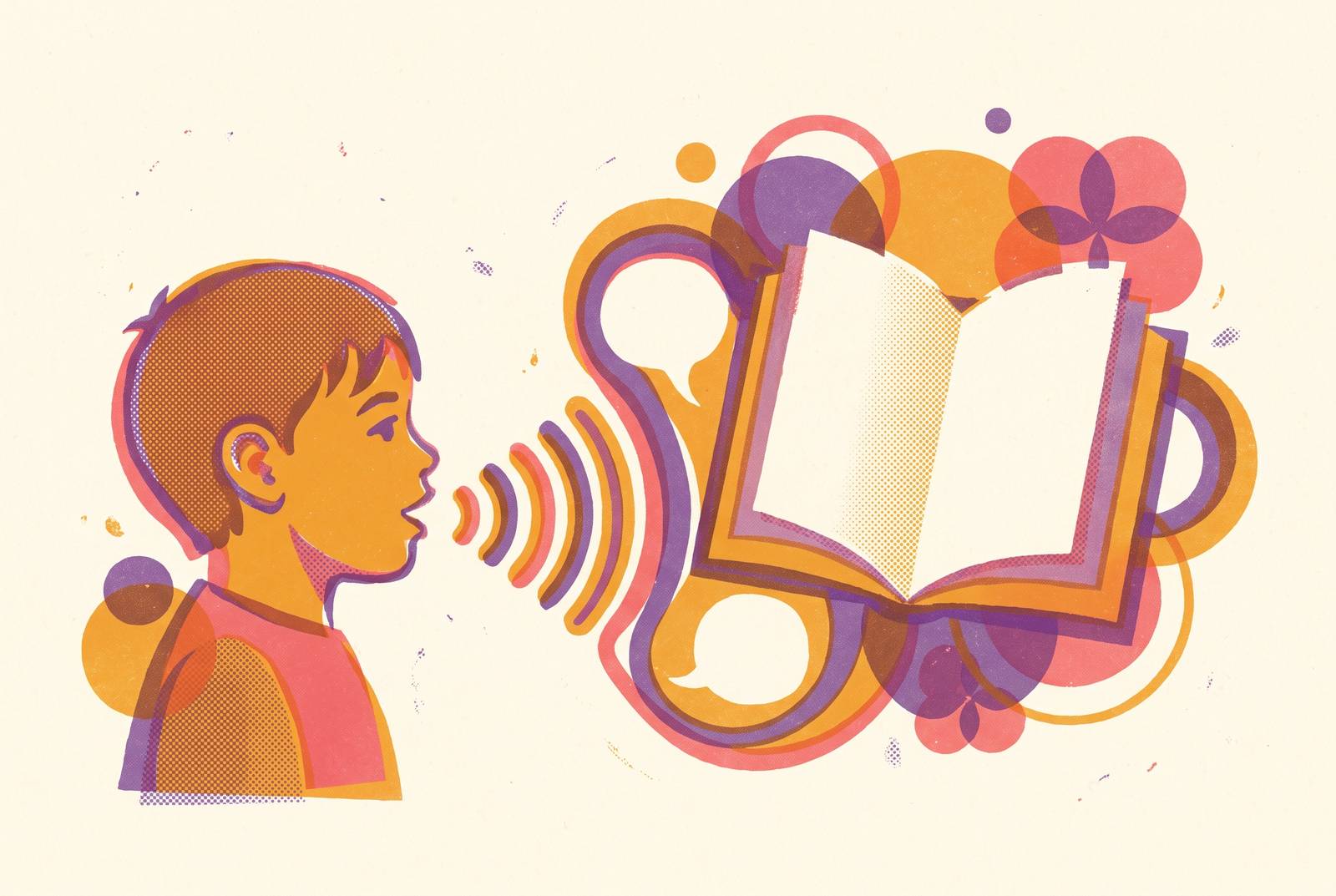
Oral language development between ages 3 and 5, not flashcards or worksheets, is the strongest predictor of how well a child will read. Vocabulary, listening comprehension, and the ability to tell a story out loud all build the mental scaffolding that later lets a child decode print and understand what it means. A child doesn't need to know the alphabet by age 4 nearly as much as they need rich, responsive conversation. That single distinction should shape how parents choose an app, a preschool, or a nightly routine before kindergarten.
Why ages 3 to 5 are structurally different from any other language-learning window
Something specific happens in a child's brain and mouth between ages 3 and 5. Vocabulary expands rapidly, auditory comprehension sharpens, and narrative ability, the capacity to hold a sequence of events in mind and retell it, consolidates at a pace that won't repeat later in childhood. This isn't a gentle ramp-up toward later learning. A 2026 Frontiers in Education study found this period to be a critical stage of linguistic development in its own right, with its own tempo and its own stakes.
Oral language at this age does more than let a child ask for a snack or narrate a game. It organizes thought. It supports a child's ability to regulate emotions and behavior. It forms the substrate that reading and writing will later depend on, a foundation laid down well before a child sees a single printed word in a classroom.
That foundation isn't built on the same schedule for every child. The same Frontiers research documented significant individual differences in linguistic acquisition among children of the same age, tied to the quality of the sociocultural environment, the amount of language stimulation a child receives, and the pedagogical support available at home or in care. The window carries enormous potential, but that potential doesn't realize itself automatically. It depends on what fills it.
Because the gap between children in the same classroom can be wide, instruction that notices and adjusts to each child in the moment carries real weight here. Ello's approach of responding in real time to each child's voice reflects the principle that even in this critical window, no two children follow the same path, and teaching has to meet them where they actually are.
Oral Language and the Precursors of Decoding
Oral language at ages 3 to 5 doesn't just sit alongside future reading skill as a nice-to-have. It seeds the specific precursors that decoding depends on, starting with phonological awareness, the ability to hear and manipulate the sounds inside words.
Phonics instruction asks a child to connect a sound to a printed letter. But a child can't make that connection until they can first hear the sound on its own, split a word into its parts, and notice that "cat" and "hat" share an ending. That hearing and splitting is phonological awareness, and it develops through oral language, through rhymes heard, syllables clapped out, and sounds played with long before a workbook enters the picture.
Collaborative Classroom (2025) identifies phonological skills, specifically syllables, rhyme, and phonemes, as one of five core components of oral language. The other four, syntax, vocabulary, pragmatics, and morphological skills, each feed their own downstream effect into reading. The National Early Literacy Panel's findings, as synthesized by Collaborative Classroom, placed vocabulary and oral language at the center of the "Big 5 Early Literacy Skills" for children ages 3 to 5, naming them important predictors of later literacy competence.
Snowling and Hulme (2025) describe phonological deficits as the proximal cognitive cause of dyslexia. Broader oral language skills set the stage for all of reading, so phonological awareness matters enormously without being the entire story.
The 2026 Frontiers study put a number on what builds these skills. Teacher-implemented interventions using rhymes, chants, and tongue twisters produced significant gains in verbal fluency, phonological development, pragmatic skills, and both receptive and expressive vocabulary, the exact dimensions that predict decoding ability later on.
Because responsive feedback drives phonological development most effectively, Ello's real-time listening and adaptive teaching approach mirrors the kind of interaction that builds these skills before formal reading instruction ever starts.
The Simple View of Reading
Reading researchers use a simple equation to describe what reading comprehension actually requires: Reading Comprehension equals Decoding multiplied by Language Comprehension. The multiplication, not addition, is the detail that makes this model so useful. A weakness in either side drags the whole product toward zero.
A child who can sound out every word on the page but doesn't understand enough spoken language to make sense of a sentence hits a hard ceiling on comprehension, no matter how fluently they decode. A child with rich vocabulary and strong listening comprehension but no decoding skill can't get into the print. Both halves have to hold up.
Oral language in the 3-to-5 window works on both halves at once. It builds language comprehension directly, the words a child knows, the sentences they can follow, the stories they can hold in mind. At the same time, it builds the phonological awareness that will enable decoding once formal instruction begins. Few other levers touch both sides of the equation this early and this directly.
Snowling and Hulme (2025) call oral language skills "the foundation for learning to read" and describe them as a critical context for every reading intervention that follows, the base layer underneath the entire enterprise.
The 3-to-5 window is exactly when targeted, personalized instruction can strengthen both sides of that equation before formal reading begins. Tools built to adapt to each child's emerging language abilities, Ello among them, ground their teaching in real-time listening and in the understanding that language development runs on an individual track for every child.
Language Gains and Kindergarten and Grade 3 Outcomes
Longitudinal research backs up the theory with numbers, and one finding in particular needs careful reading. Logan et al. (2024), published in Child Development, found that language gains during early childhood education significantly predicted kindergarten readiness when measured on their own. But that prediction weakened once gains in letter knowledge and phonological awareness were added to the model.
Oral language appears to work through those channels even as those other skills enter the picture, letter knowledge and phonological awareness acting as the transmission mechanism that carries language's effect forward into reading. Oral language is the upstream investment; letter knowledge and phonological awareness are the downstream pathway that investment travels through.
The practical result for parents and educators: building rich oral language and building letter knowledge and phonological awareness form a single investment with two visible outputs. A child gaining vocabulary and listening comprehension is, in the same moment, developing the phonological skills that later get measured as "readiness."
The stakes extend past kindergarten. Snowling and Hulme (2025) found that children who enter school with poor language face high risk of difficulty in both word reading and comprehension, and these difficulties tend to accumulate across grades, persisting by Grade 3.
Why Oral Language Gaps at This Age Compound
A child who starts school behind on oral language faces a particular kind of disadvantage: the same gap that makes early reading harder also makes it harder to pick up the vocabulary and language structures needed for later comprehension. Each year without intervention tends to widen the distance.
The reassuring half of this finding matters just as much as the warning. Snowling and Hulme (2025) reviewed randomized controlled trials showing that language screening, followed by structured pull-out intervention, improved oral language skills with measurable downstream effects on reading and classroom behavior. Caught early, the gap closes.
The PREVENIR study (2026) adds a durability finding to that picture. In a quasi-experimental trial with kindergarten children, a 10-week structured oral language intervention targeting vocabulary, phonological awareness, and morphosyntax produced gains that held up one year later and transferred into decoding and reading comprehension. Early, structured intervention doesn't just produce a short-term bump: its effects last and spread into the skills that matter most.
Snowling and Hulme (2025) note that fidelity of delivery depends on educators receiving proper training and support, since the existence of an intervention program isn't what closes the gap. The quality of its delivery is.
A 2026 Frontiers study found that spontaneous exposure to language, the kind that happens without any structure or intention behind it, isn't always enough on its own, particularly in under-resourced educational settings. The 3-to-5 window stays open and responsive to structured support. Parents and educators who act within it are working with biology, not against a closing door.
The five components of oral language and the daily interactions that build them
Oral language breaks down into five interdependent pieces, and each one grows through ordinary daily moments, as long as those moments carry some intention behind them.
Phonological skills cover syllables, rhyme, and individual phonemes, the building blocks a child needs to later connect sound to letter. Clapping out syllables in a child's name, finishing a rhyme in a favorite book, or playing "what sound does this word start with" in the car all build this piece directly.
Syntax covers word order and grammar, how words string together into meaning. A parent who expands a child's short sentence ("Dog run!" becomes "Yes, the dog is running fast!") is modeling syntax in real time, without a lesson plan in sight.
Vocabulary covers word meaning in context, and it grows fastest through exposure to new words used naturally, at dinner, on a walk, narrating what's happening at the grocery store.
Pragmatics covers the social rules of communication, when to speak, how to take turns, how to read what someone else means beyond their literal words. Pretend play, taking turns in a conversation, and group games at the park all build this.
Morphological skills cover root words, prefixes, suffixes, and bound roots, the pieces that let a child figure out an unfamiliar word from its parts. Noticing that "unhappy" is "happy" with "un" in front of it, out loud, in conversation, builds this skill well before a worksheet ever would.
Collaborative Classroom (2025) notes that quantity of words a child hears in these early years predicts later reading success, but quality matters just as much. Wider exposure to language across different methods and registers, stories, songs, questions, explanations, gives children a real advantage in both academic and social learning. None of this happens through passive exposure alone. Children acquire language through meaningful back-and-forth exchange with an adult, and the direction of that exchange, an adult asking an open-ended question and waiting for an answer, matters as much as how many words get spoken in a day.
Specific strategies that move oral language development in the 3-to-5 window
A small set of high-quality interactions, used consistently, moves the needle on exactly the oral language dimensions that predict later reading. Most need nothing more than attention and a few minutes.
Strive for Five conversations, a framework developed by Zucker and Cabell and described by Collaborative Classroom (2025) for preschool through Grade 1, call for at least five back-and-forth exchanges, questions, comments, and observations, in a one-on-one or small-group setting. The adult waits, watches, and listens before jumping in, turning the exchange into a genuine thinking loop with room for more than right and wrong answers. This costs nothing and fits into a car ride, a bath, or a walk to school.
Storytelling and reading aloud do double duty. Collaborative Classroom (2025) notes that encouraging a child to retell a story in their own words or act out a character builds vocabulary, narrative ability, and the mental modeling skills a reader will need later, all at the same time.
Rhymes, chants, and tongue twisters produce the largest measured gains when used systematically, not just occasionally. The 2026 Frontiers study found the biggest improvements in verbal fluency and phonological development came from structured, repeated use of exactly these tools with children ages 3 to 5. The word "systematic" carries real weight here: dosage and consistency matter as much as the activity itself.
Open-ended questions, themed units built around a topic of interest, and songs all count as language-rich environment strategies recommended by Collaborative Classroom (2025). Dr. Timothy Shanahan adds an important framing note: oral language should be supported all day long, woven into everything else a child does, rather than treated as a standalone subject with its own dedicated lesson block.
Because oral language weakness undermines both decoding and comprehension at once, the 3-to-5 window is where targeted, personalized instruction pays off on both sides of that equation before formal reading even starts. This is why tools built to adapt to a child's emerging language, like Ello, lean on real-time listening rather than a fixed script, treating each child's language development as its own individual track rather than a single path everyone walks at the same pace.
Identifying When a Child's Oral Language Development Needs More Support
Because oral language develops on different timelines even within the same age group, parents benefit from knowing what to watch for, not to diagnose anything on their own, but to act while the window for intervention is still wide open.
Snowling and Hulme (2025) name language difficulties as a major risk factor for dyslexia. Children who enter school with poor language are likely to struggle to become proficient readers, and the preschool years offer the most practical moment to notice this, precisely because language is changing so quickly and so visibly at this age. A child who struggles to follow a two-step instruction, who has a vocabulary noticeably smaller than peers, or who can't retell a simple story in order are all signals to bring to a pediatrician or early childhood specialist, gathered as useful information at the moment it's most actionable.
Snowling and Hulme (2025) found that dyslexia also frequently co-occurs with developmental language disorder. An oral language delay doesn't always stand alone. It can point to a broader set of needs that benefit from professional evaluation and support, caught early enough, while the 3-to-5 window is still open and still responsive to the right kind of help.
Sources
- Frontiers
- Early childhood language gains, kindergarten readiness, and Grade 3 reading achievement
- Developing Early Literacy Skills: Oral Language - Collaborative Classroom
- Risk Factors for Dyslexia: Addressing Oral Language Deficits - Snowling - 2025 - Mind, Brain, and Education - Wiley Online Library
- PREVENIR: An Oral Language Intervention for Preventing Reading Difficulties in Kindergarten Children—A Preliminary Effectiveness Study
- The Simple View of Reading