Red Flags in Pre-Reading Development at Ages 4 and 5
Missed sounds at four and five predict later reading struggles without targeted practice now.
Phonological awareness gaps at ages 4 and 5 are specific, checkable, and real. A child who cannot recognize rhymes, clap syllables, or isolate a starting sound by age 5 is showing a genuine early signal, not a quirk of personality or pace. The right response is targeted practice, matched to the specific skill that is missing, started now rather than later, because this is the age window when phonological awareness is most responsive to instruction.
What phonological awareness actually is, and why it must come before print
Phonological awareness is a listening skill, not a reading skill. It is the ability to hear and play with the sound structure of spoken language, separate from any letter on a page. A child demonstrates it by clapping out the two beats in "butter-fly," or by telling you that "cat" and "hat" sound the same at the end, or by breaking "cat" apart into /k/ /a/ /t/. None of that requires knowing what a letter is.
The Science of Reading, the body of research drawing on cognitive science, linguistics, and neuroscience, treats this skill as a prerequisite to phonics, not a nice-to-have alongside it. Before a child can connect a written letter to the sound it makes, that child has to already hear sounds as separate, movable units. Phonemic awareness, the most precise layer of this skill, is the bridge between spoken language and print. Without it, letters stay arbitrary shapes with no sound attached.
Real-time listening matters so much in how this skill gets taught that adaptive AI tools like Ello can hear whether a child is actually isolating and blending sounds correctly in the moment, rather than guessing from context or memorizing a pattern, and adjust what comes next based on that individual child's response. That kind of immediate feedback loop matters because phonological awareness is built through repeated, accurate practice, not through passive exposure.
What Children Ages 4 and 5 Are Typically Developing
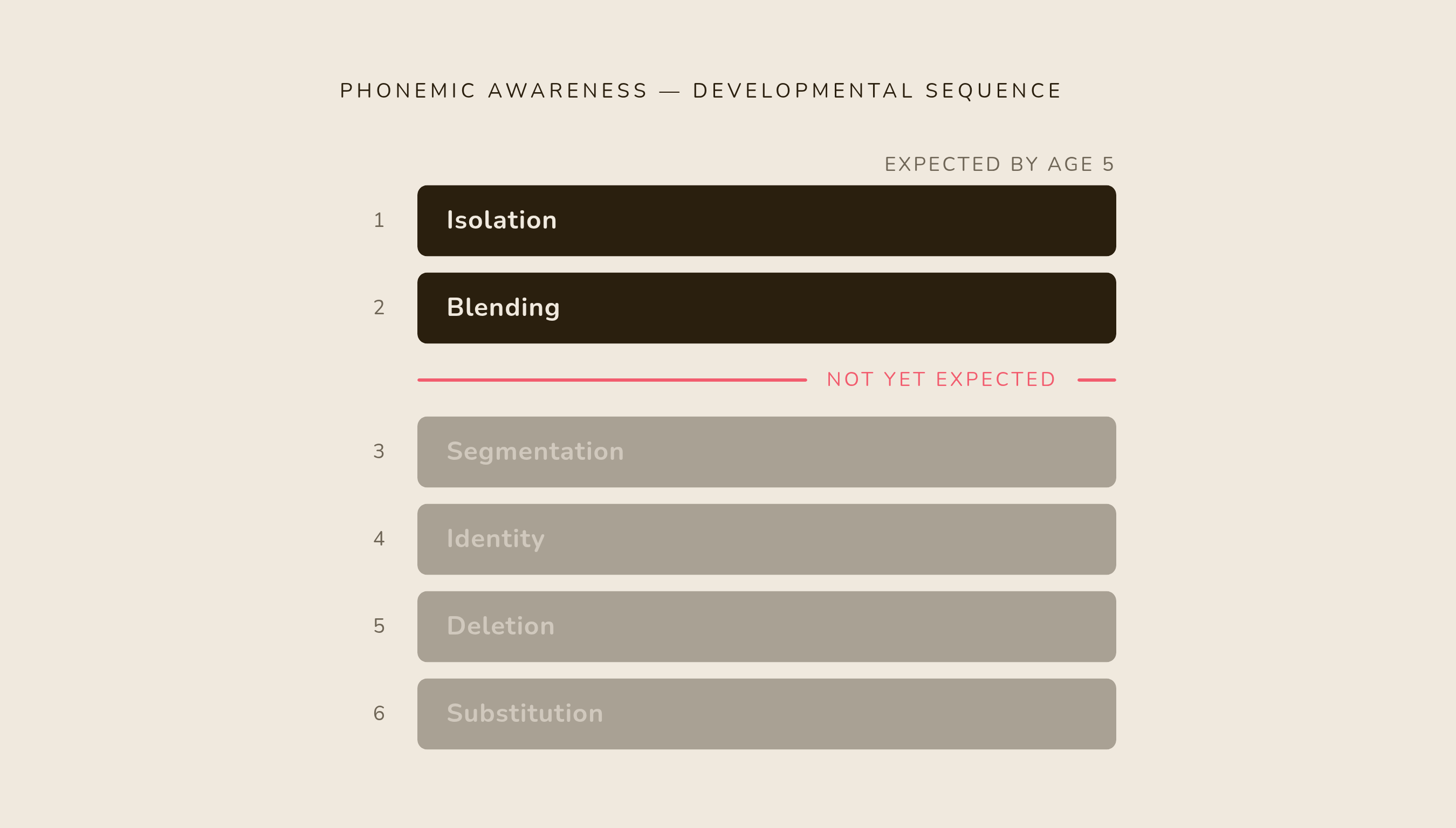
Knowing what counts as typical at this age is what makes a real gap visible. Without a baseline, every difference looks the same, whether it is meaningful or not. Phonemic awareness itself develops in a predictable order, moving from isolation, to blending, to segmentation, to identity, to deletion, and finally to substitution. At ages 4 and 5, children are working primarily on the earliest two rungs of that ladder: isolating a sound and blending simple word parts together.
In practice, a cluster of related skills develops together at this age. A 4- or 5-year-old is typically clapping or counting syllables in familiar spoken words, and recognizing and producing rhymes, so that a question like "Do 'cat' and 'hat' sound the same?" gets a confident answer. Most children this age can identify the beginning sound in a simple word, answering something like "What sound does 'sun' start with?" with at least a reasonable attempt. Blending onset and rime, combining a sound like "s" with "un" to produce "sun," is also emerging. On the print side, children are recognizing letters, especially the ones in their own name, and starting to connect some letters to their starting sounds.
Pace varies child to child, and that variation is normal. The point is not whether a given 4-year-old is ahead of a neighbor's child of the same age. What matters is whether the building blocks above are present and moving in the right direction, even if slowly. A child who rhymes inconsistently but is clearly catching on over a few weeks is on a different path than a child who shows no response to rhyme at all. The expected range is wide, but it is not infinite, and it does include the specific skills listed above showing up in some form by age 5.
The specific, observable gaps that are genuine red flags at age 4 and 5
A red flag at this age is a specific, observable behavior, not a general sense that a child seems behind. The first cluster involves phonological awareness itself. A child who cannot recognize or produce rhymes by age 4 or 5, drawing a blank or giving consistently wrong answers to a question like "Do 'dog' and 'log' rhyme?", is showing a real signal. The same is true of a child who cannot clap or count syllables in familiar two-syllable words, or who cannot identify the first sound in a simple word when asked directly, such as "What sound does 'fish' start with?" Blending is another marker: if a child is given two word parts separately, like /s/ and "un," and cannot combine them into "sun," that is worth attention. The inability to segment a simple three-sound word like "cat" into its separate sounds, /k/ /a/ /t/, instead of repeating the whole word back unchanged, is also a marker. At this age, the most telling signs cluster around rhyme, initial sounds, and basic blending. More advanced skills like phoneme deletion and substitution come later and are not yet expected.
A second cluster involves print and alphabet knowledge. A child with no letter-sound knowledge at all by age 5, unable to connect a single letter to its sound, is showing a flag worth watching. The same goes for a child with no sense of basic print concepts, such as the fact that text runs left to right, or that the words on a page, not the pictures, are what carry the story.
A third, less-discussed cluster involves oral language and vocabulary, which sit right alongside phonological awareness as part of the same foundation. A noticeably limited vocabulary for the child's age, trouble naming everyday objects or describing a recent event in a few words, and difficulty following multi-step directions or retelling a simple story in order all belong on this list. So does sentence structure that stays stuck at single words or two-word combinations well past age 2 or 3.
A final cluster is behavioral, and it often travels alongside the skill gaps above. Consistent frustration or avoidance when rhyming games, alphabet songs, or sound-play activities come up, not occasional disinterest but a repeated pattern of shutting down, is a signal. So is a clear, marked difficulty sitting through shared book reading compared to other children the same age. None of these signals, alone or together, amounts to a diagnosis. Each one is a reason to pay closer attention and track what is happening over time.
Why these gaps do not resolve on their own and compound over time if unaddressed
Gaps in phonological awareness and oral language at ages 4 and 5 do not fix themselves with time. They become the foundation that every later reading skill gets built on top of, and a weak foundation shapes everything stacked above it. A child who cannot hear that "cat" and "hat" share an ending sound at age 4 will also struggle to learn, a year or two later, that the letter pattern "-at" reliably makes one sound. The auditory piece that pattern depends on simply is not there yet.
This connection shows up in research comparing students with and without reading difficulties: students with reading difficulties scored lower on phonological awareness across every subscale measured, compared to students without those difficulties. That relationship is structural, reflecting a consistent pattern across the students measured. Weak phonological awareness leads to weak decoding. Weak decoding leads to slow, effortful reading. Slow reading means a child reads less overall, which slows vocabulary growth, which in turn lets comprehension fall further behind grade level with each passing year. Each stage feeds the next.
None of this means a gap identified at age 4 locks a child into permanent difficulty. It means that a gap left unaddressed at 4 or 5 does not sit still. It layers into every new skill demand that follows, and the longer it goes unsupported, the more time and effort remediation eventually requires. Phonemic awareness and alphabet knowledge are the two skills most predictive of later reading difficulty, making them the most actionable early screening targets available. Both are what the red flags above are pointing at.
Why Some Children Are More Likely to Show These Gaps
Some children face a higher likelihood of showing these gaps, and the reasons are identifiable. Understanding them helps a parent or caregiver respond to the actual cause behind the visible symptom.
Limited early language exposure is one of the most common and most addressable contributors. Children who have had fewer conversations, fewer books read aloud, and fewer rhyming games in their early years may simply not have had the chance to build the sound-awareness foundation that develops more naturally in richer language environments. Because this factor is about exposure rather than ability, it responds well to consistent practice once it is identified.
Dyslexia is another contributor, and a core feature of it is difficulty with phonological processing, phonemic awareness included. A child who shows persistent, consistent trouble with the red flags above, even with reasonable exposure and some instruction, may be showing signs of a learning difference that calls for evaluation by a reading specialist or educational psychologist. Auditory processing differences can produce a similar pattern: some children have genuine difficulty telling similar sounds apart, which makes isolating and manipulating phonemes harder regardless of how much language exposure or general ability they have.
Hearing loss shapes this risk in a more specific way. Children with significant hearing loss, including those using cochlear implants, generally perform within the normal range on syllable-counting tasks, but show deficits on tasks that require perceiving and manipulating sounds at the phoneme level. That makes targeted phonological awareness support especially important for this group specifically.
Children learning English as a second language face a different kind of challenge, and it deserves a careful distinction. Their difficulty is tied to the specific phoneme inventory of English, which may include sounds that do not exist at all in their home language. These children also face a second layer of difficulty: decoding a word they have never heard in English provides no comprehension, so vocabulary and oral language need to develop in English alongside decoding skill, not after it.
Finally, some children simply have not yet received explicit instruction in these skills. Phonemic awareness does not always emerge on its own through everyday exposure. Some children need direct, systematic teaching that, for one reason or another, has not happened yet.
What Parents Can Observe and Track at Home
Parents are often the first to notice these signals, simply because they spend more time with their child than anyone else does, and parental concern about a child's development is itself a meaningful predictor of a real developmental need, particularly around language. A handful of everyday checks can turn that instinct into something concrete.
Rhyme is one of the simplest to check. Asking "Does 'cat' rhyme with 'hat'?" should get a reliable answer from a 4- or 5-year-old, and that child should also be able to come up with a rhyme of their own when asked. Syllable clapping works the same way: clapping out the parts of "butter-fly" together and then asking the child to try it solo is something most children this age can do with familiar words. Initial sounds can be checked by asking a simple question like "What sound does 'sun' start with?", which a child approaching age 5 should be able to answer by isolating that first sound. Letter recognition is also worth checking, starting with the child's own name; by ages 3 and 4, most children recognize at least some of the letters in it. During shared reading, notice whether a child understands that the words on the page, not the pictures, are what is being read, and whether they can track print left to right with a finger.
A single off moment does not mean much. A tired afternoon, a distracted evening, one missed rhyme, none of that is a red flag on its own. A consistent pattern across many different days, activities, and settings is what carries weight. Tracking these moments informally over several weeks, rather than days, gives a parent something concrete and specific to bring to a pediatrician, a preschool teacher, or a specialist. Parental concern backed by specific, repeated observation is information a professional can act on. Dismissing a consistent pattern as just normal variation carries its own risk, since the compounding effects described earlier begin quietly, long before they become obvious.
Targeted Support at This Age
Phonological awareness responds to direct, structured teaching, and that is true even for a child who has already fallen behind peers. The instruction has to match the specific skill that is missing. A child who cannot rhyme needs focused rhyming practice, not exercises in deleting phonemes, a skill that is not even expected yet at this age. A child who struggles to blend onset and rime needs blending games, not segmentation drills aimed at a more advanced stage of the sequence. Because phonemic awareness develops in a known order, from isolation through blending through segmentation and on to identity, deletion, and substitution, identifying exactly where a child's development has stalled makes it possible to target practice at that exact point.
Structured literacy instruction, meaning instruction that is explicit, sequential, systematic, and cumulative, is grounded in the same Science of Reading research that identifies phonological awareness as foundational. The Orton-Gillingham approach is one well-established example of this kind of framework, used especially for children who need more intensive, individualized support.
At home, consistency matters more than duration. A short daily routine of rhyming books, songs, sound games, and read-alouds builds the auditory foundation in a way that occasional, longer bursts of enrichment activity does not match. For children who need more structured help than a home routine can provide, a reading specialist or speech-language pathologist can pinpoint which specific phonological awareness skills are lagging and build a sequence of instruction around those exact gaps.
Spotting these gaps early carries real weight precisely because intervention between ages 4 and 5 works better than waiting to see whether a child catches up on their own. This is the stretch of development when these specific skills are most responsive to teaching. Tools built for this exact age range, AI-powered apps that adapt one-on-one to a child's current phonological awareness level, can supply the kind of immediate, individualized feedback that turns a noticed gap into real, measurable progress, rather than a concern that just gets revisited every few months. When evaluating any digital tool for this purpose, the relevant question is whether it combines explicit phonics instruction, learning that adapts to the child's actual current skill level, and a way to track progress over time. That combination, not any single feature on its own, is what separates a tool that moves a child's skill forward from one that simply keeps a child occupied.
Sources
- Phonological Awareness as the Foundation of Reading Acquisition in Students Reading in Transparent Orthography
- Phonological and Phonemic Awareness: Activities for Your Pre-K Child
- Skills for Early Reading: Phonological Awareness - Evidence Based Early Literacy
- Phonological and Phonemic Awareness: Introduction
- Early "Red Flags" of Learning Disabilities: Warning Signs and Other Indicators - eHealth Connection
- Is Your Child Having Trouble Reading? Warning Signs and a Checklist - NCIL
- Early Warning Signs of Learning Disabilities
- Top 8 Risk Factors for Reading Difficulties