What Kindergarten Reading Instruction Looks Like in a Science of Reading Classroom
Explicit phonics instruction replaces guessing in early reading classrooms.
A kindergarten classroom built on the Science of Reading looks and sounds deliberately different from the one most parents sat in decades ago. Most parents learned to read in classrooms built on Balanced Literacy, where guessing a word from the picture on the page or the shape of the sentence around it was treated as a legitimate reading strategy. A Science of Reading classroom treats that same guessing habit as something to prevent.
The change runs deeper than swapping one set of worksheets for another. Balanced Literacy relied on what's called the three-cueing system: children were prompted to use pictures, sentence structure, and context clues to guess at unfamiliar words. IMSE's 2025 overview of structured literacy identifies that exact habit as the problem. Three-cueing trains children to bypass the sound-symbol system rather than use it. A child can look fluent while never actually learning to decode.
The Simple View of Reading explains why this matters so much. Reading comprehension is the product of two things: decoding and language comprehension. Skipping the building of one to lean on the other causes the whole system to break down later, usually around third or fourth grade, when the words get too hard to guess. A kindergarten classroom following the Science of Reading builds both skills on purpose, every day, rather than hoping one covers for the other.
The Five Components of SoR Instruction
Five components hold up a Science of Reading kindergarten classroom: phonemic awareness, phonics, fluency, vocabulary, and comprehension. Instruction addresses all five every week, not phonics alone with the rest left to chance.
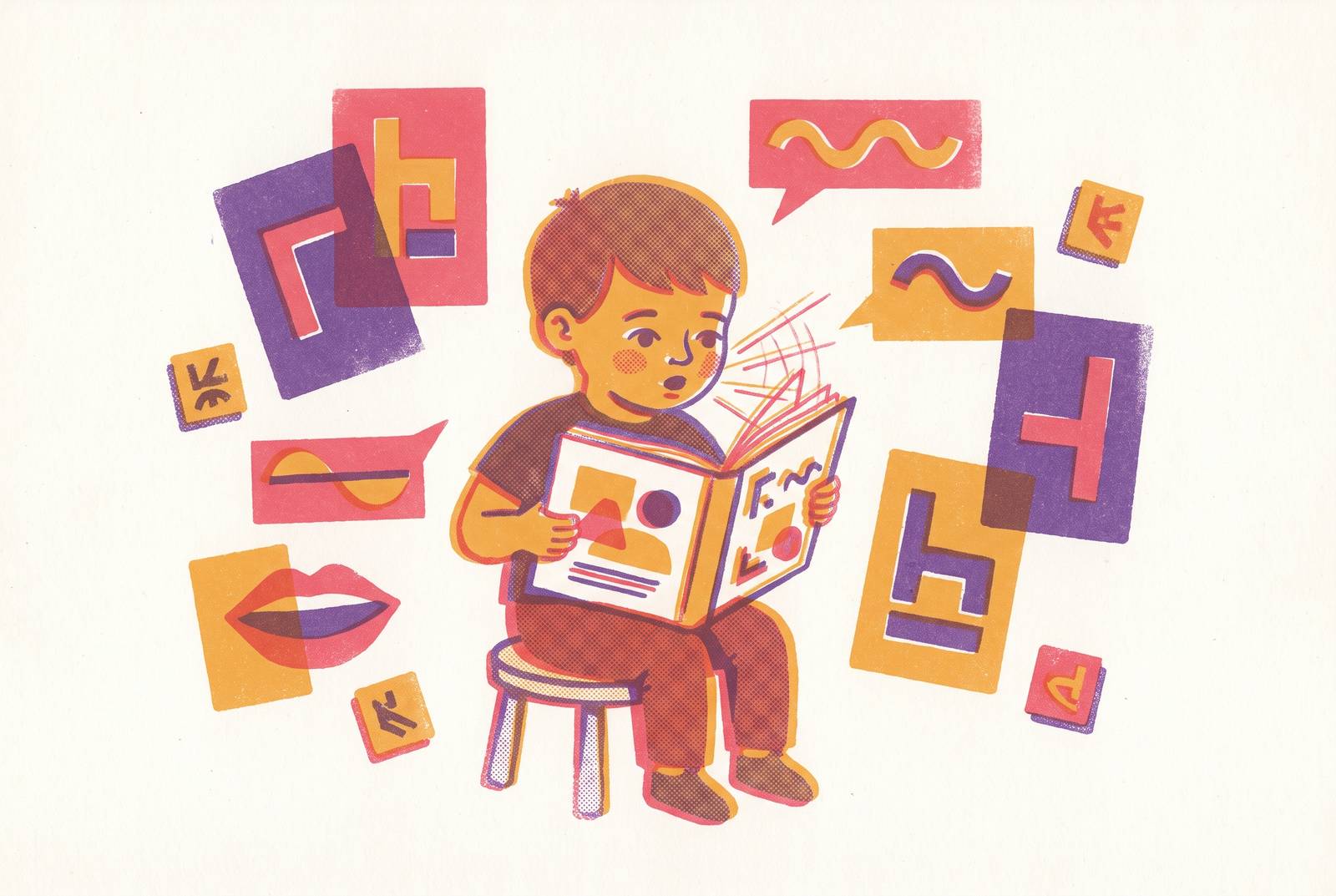
Phonological awareness comes first in the building sequence. Children learn to hear and play with sounds inside words, starting with syllables and narrowing down to individual phonemes, before anyone asks them to connect those sounds to printed letters. Phonics and word recognition build directly on top of that auditory base, pairing sounds with spelling patterns through explicit, planned teaching rather than waiting for a "teachable moment" to come up in a story.
The Simple View equation also depends on vocabulary and oral language comprehension. Rich conversation, read-alouds, and unpacking the meaning of academic words all build the capacity to make sense of language, something decoding by itself cannot do. Text comprehension gets taught even to children who can't yet read a page independently, through teacher read-alouds and guided discussion that build habits like setting a purpose for reading, noticing when something doesn't make sense, and drawing inferences from what's been said.
These five pieces interlock rather than stack in order. A single twenty-minute kindergarten lesson might move from a sound-isolation game into a phonics pattern, then into a short discussion of a new vocabulary word, all before the lesson ends. The classroom day ahead shows what that interlocking actually looks like in practice.
The Phonological Awareness Warm-Up
The literacy block in a Science of Reading kindergarten classroom typically opens with sound, not print. Children's ears need to process spoken sounds reliably before their eyes can map those sounds onto letters, so the warm-up strengthens that auditory system first and keeps reinforcing it alongside phonics instruction as the year goes on.
A typical warm-up might have children clapping out the syllables in their own names, or rhyming a string of words out loud, or blending spoken parts like "sun" and "shine" into "sunshine" without seeing a single letter. Later in the year, the task narrows to isolating or segmenting individual phonemes, pulling apart a word like "cat" into its three separate sounds. None of this involves a book or a worksheet. It's entirely oral.
That sequencing from syllables down to individual phonemes, and only then connecting those phonemes to letters, follows the developmental order laid out in NWEA's guidance on Science of Reading instruction. The warm-up does the auditory groundwork; the phonics lesson that follows formalizes it in print. These warm-ups stay short by design, because kindergartners lose focus fast, so teachers keep the pace quick rather than stretching the activity into a long lesson.
A Balanced Literacy classroom block might instead open with a story and the expectation that children decode some of it using pictures and prediction. A Science of Reading warm-up holds off on text entirely at this stage, building the ear first so the eye has something reliable to work with once print appears.
An Explicit, Systematic Phonics Lesson in Kindergarten
Once the warm-up ends, the teacher introduces one specific sound-spelling pattern for the day, names it out loud, models how it works, and walks the class through structured practice together. Nothing about this lesson is left for a child to stumble onto while reading something else. If the pattern is silent-E, the teacher teaches silent-E directly, on the day it appears in the sequence, to the whole class, by name.
NWEA's explainer describes the shape of this kind of lesson clearly: a dedicated chunk of the literacy block, drawn from an identifiable curriculum sequence, followed by word work that often looks like play but is quietly reinforcing the pattern, and then both reading and writing practice that puts the new pattern to use. Children don't just read words with the pattern. They write them too.
The order in which patterns get introduced isn't random. Simpler sound-symbol correspondences come first, and each new lesson builds on what the last one established. Ms. Ms. Cotton's Corner's overview of decoding makes a related point: decoding and encoding are opposite processes that work together to strengthen a child's literacy. Programs like UFLI Foundations, developed by Holly B. Lane and Valentina Contesse at the University of Florida Literacy Institute, give teachers that exact kind of sequenced scope, along with scripted instructional moves that make the lesson repeatable across classrooms and across teachers.
Even supporters of this approach acknowledge a real gap: there's no single sequence that every program agrees on for introducing sound-symbol patterns. Programs order things differently, and critics have used that disagreement to argue the Science of Reading gets oversold as a complete, settled system. The field does agree on two things regardless of sequence: these patterns need explicit teaching, and that teaching needs to be systematic. The evidence advantage over implicit, unsequenced instruction holds no matter which specific order a program chooses.
Timing turns out to matter as much as sequence. Research summarized at Ms. Cotton's Corner shows the effect size of phonics instruction is substantially higher in kindergarten and first grade than it is in grades two through six. Early decoding instruction also raises text comprehension, but that comprehension benefit drops sharply once a child moves past first grade. Waiting to introduce explicit phonics until a child is "struggling" in second or third grade is a missed window.
Decodable Texts as the Practice Vehicle of a SoR Classroom
After the phonics lesson, children pick up a decodable text, a book written specifically to use the sound-spelling patterns already taught in class. Every word on the page is one a child can sound out using what they already know, rather than one they need to guess from a picture or a surrounding sentence.
This is the single most visible difference from a Balanced Literacy classroom. Balanced Literacy relied on leveled readers, chosen to match a child's so-called instructional level, but those books frequently contained words well beyond what the child could actually decode. That mismatch quietly forced kids to rely on pictures and context to get through the page, the exact habit a Science of Reading classroom is trying to build away from.
Scarborough's Reading Rope, which Ms. Cotton's Corner uses to frame decoding instruction, maps word recognition as one strand that has to be woven together with language comprehension, not substituted for it. Decodable texts handle the word recognition strand. The read-aloud later in the block handles language comprehension. Neither one does the other's job.
It's fair to say decodable texts aren't going to win any literary awards. The sentences are often plain and repetitive by necessity, since every word has to match a limited set of taught patterns. Decodables exist for practice, not for literary richness, and they're one part of a child's reading diet rather than the whole of it. The complex, vocabulary-rich texts a teacher reads aloud later in the day are where story, language, and ideas get to stretch out. That division of labor, not any single text, is what makes the system work.
How the teacher read-aloud builds the oral language and knowledge that decoding alone cannot
A kindergartner's listening comprehension outpaces their decoding ability by a wide margin. A child who can only sound out three-letter words can still understand a complex story read aloud, full of ideas and vocabulary far beyond what they could read on their own. The teacher read-aloud is how a Science of Reading classroom delivers that richer language and content, and it's where academic vocabulary, story structure, and inferential reasoning get taught directly.
NWEA's guidance describes multiple reads of the same text across several days: the teacher models fluent reading first, students take over some of the reading as they get more familiar with it, and discussion along the way focuses on language, structure, and deepening understanding. Teachers unpack academic and inferential language explicitly and point out how the text itself is organized, rather than assuming children will absorb that structure on their own.
Vocabulary instruction lives largely in this part of the day. Rather than memorizing word lists, children meet new words inside a meaningful story, hear the teacher name and explain them on the spot, and return to that same text more than once to deepen their grasp of it. That repetition builds background knowledge too: children who know more about the world generally understand more of what they read once they can decode it, which is part of why the choice of read-aloud text carries real weight, and why many Science of Reading curricula organize their read-alouds around a content theme rather than a random rotation of stories.
A 2025 volume from Indiana University's School of Education, Teaching Science with Reading Strategies, written by Valarie Akerson, Gayle Buck, Adam Scribner, and Kristen Poindexter, shows one way this plays out beyond literacy class itself. The book, announced in November 2025 and published that December, gives teachers ways to use read-aloud time to build literacy skills and deliver science content at the same time, addressing a real scheduling problem: science often gets squeezed out of elementary school days in favor of literacy instruction. The read-aloud, in other words, isn't a separate island in the schedule. It connects to the rest of what a school day is trying to teach.
This kind of real-time shifting across all five components, moving between oral language practice, sound work, and decodable text depending on how a child is actually progressing, is the kind of thing an AI teacher built specifically for early literacy can do well, adjusting its instruction moment to moment rather than following a single fixed script for every child in the room.
The Gap Between SoR Intent and Classroom Reality
Strong evidence for an instructional approach doesn't guarantee that approach reaches classrooms. The RAND Corporation's 2025 report on foundational reading instruction, built on nationally representative data from the Spring 2024 American Instructional Resources Survey, found that more than half of early elementary teachers use instructional materials that don't meet the foundational reading skill standards research has shown to be effective.
That finding matters for a simple reason: a school can describe itself as aligned with the Science of Reading while still handing teachers materials that don't actually reflect it. The gap isn't about individual teachers failing their students. Curriculum adoption, district budgets, training timelines, and state policy all move slower than research does, and that mismatch is a structural problem, not a judgment on the people standing in front of the classroom each day.
For parents, the useful takeaway is that knowing what this instruction should look like is itself a tool. It gives parents specific questions to ask a child's teacher, about the curriculum's sequence, about whether children practice with decodable texts or leveled readers, about how phonological awareness gets taught before phonics begins, rather than taking a school's general claim of "Science of Reading alignment" at face value.
Reinforcing a SoR Kindergarten Classroom at Home
Home practice works best when it mirrors the same three layers the classroom is building: the auditory layer, the decoding layer, and the language and knowledge layer. Trying to do all three at once isn't necessary. Supporting each one, even briefly and separately, reinforces what's happening at school.
On the auditory side, rhyming games, clapping out syllables in a name, or playing with blending sounds together in the car all strengthen the same skills a classroom warm-up targets. Because this is auditory work that happens before print ever enters the picture, apps like Ello that listen to a child's voice in real time can reinforce and extend these sound-based skills during independent practice, giving a child one-on-one feedback a classroom teacher managing twenty students at once simply can't deliver in the moment.
On the decoding side, choosing books at home that match a child's actual taught sound-patterns, the same decodable or phonics-aligned logic a classroom uses, keeps practice consistent instead of accidentally reintroducing guessing habits through a mismatched book.
On the language and knowledge side, reading aloud at home from books well above a child's own reading level, the same way a teacher does, builds vocabulary and background knowledge no decodable text is designed to carry. Talking through a story, naming new words, and asking a child what they think happens next all do real work here.
Understanding this shift, from guessing based on pictures to systematically decoding based on sound-symbol relationships, matters for any parent evaluating a learning tool for their child, whether it's a classroom curriculum or something used at home. Tools grounded in the Science of Reading make that same systematic, sequential approach the foundation of how they teach, rather than an afterthought layered on top of guessing games dressed up as learning.
Sources
- New resource to help science teachers integrate science of reading into their classrooms: : 2025: News: School of Education: Indiana University Bloomington
- Science of Reading Professional Development for Teachers in 2025
- Translating Reading Science into Practice—Foundational Reading Instruction in Public Elementary Schools: Findings from the Spring 2024 American Instructional Resources Survey
- Decoding in Kindergarten- The Science of Reading - Ms. Cotton's Corner - education resources
- What the science of reading tells us about how to teach decoding—including phonics - Teach. Learn. Grow.
- Ello: Reading & Math Built Around Your Child | Ages 4–9