Sight Words vs Phonics Instruction for Young Readers
Phonics instruction builds reading skills more reliably than memorizing sight words.
What systematic phonics is and how it builds reading from the ground up
Sight words versus phonics has been argued over for decades, and it still trips up parents scanning curriculum options at back-to-school night. Here's the actual answer: phonics wins, and it isn't close. The research treats these as two methods competing for the same job, but they do different jobs, one foundational and one supplementary at best. Confusing the two, or worse, treating them as equal partners, is where most reading programs go wrong before a kid has even opened a book.
Part of the confusion starts with the term itself. "Sight word" means two different things depending on who's talking. In most classrooms, a sight word is an entry on a list like Dolch (220 words) or Fry (1,000 words), taught by flashing a card until a kid memorizes the shape of the word. In reading science, a sight word means something else entirely: any word a reader has decoded so many times that recognition becomes automatic. Under that second definition, every word a fluent reader knows counts as a sight word, including "elephant" for an adult who hasn't sounded it out syllable by syllable since second grade. Those are not the same claim, and mixing them up is where the argument usually falls apart.
The flashcard version of sight words earned its bad reputation honestly, through its association with whole language, an approach that treated high-frequency words as too irregular to bother decoding and taught them instead as visual wholes, like little pictures to memorize. That approach has not held up under the evidence collected since. Systematic phonics has.
Phonics, done systematically, teaches the relationship between letters (graphemes) and the sounds they make (phonemes) in a deliberate, planned order. Not random exposure. Not "kids will pick it up eventually." A real scope and sequence, built stage by stage.
The typical sequence runs single consonant sounds and short vowels first, then simple CVC words (cat, sit, dog), then consonant blends and digraphs (bl, st, sh, th, ch), then long vowel patterns and vowel teams, and eventually multi-syllable words with the trickier advanced patterns. Each stage assumes mastery of the one before it. Skipping a stage causes a gap that tends to surface later, when texts get harder and a child who has been guessing at words instead of decoding them hits a wall he can't guess his way past.
The National Reading Panel named systematic phonics one of five essential components of reading instruction, alongside phonemic awareness, fluency, vocabulary, and comprehension. None of the five stands alone, but phonics is the one that turns print into sound in a reliable, transferable way. Memorization can't do that, no matter how many flashcards get flipped.
Orton-Gillingham is one of the better-researched systematic phonics methods, and it layers in multisensory technique, engaging multiple senses simultaneously to reinforce letter-sound connections. It is commonly used with struggling readers and kids with dyslexia, with the multisensory approach intended to reinforce learning through more than one channel at once.
What the research found when phonics and sight word memorization were put head to head
The National Reading Panel reviewed 38 controlled studies before landing on its conclusion, and the finding was consistent: systematic phonics produces significant, measurable gains in reading and spelling, especially for early readers and for kids already struggling. That result held up across different study designs, a consistency that's hard to argue with.
The Clackmannanshire study out of Scotland ran for seven years and found something striking: children taught with synthetic phonics ended up 3.5 years ahead in reading by the study's end, compared to children taught with an analytic approach that folded in sight word memorization. Spelling and comprehension scores followed the same pattern. That is a substantial gap to open up over the course of a single longitudinal study.
Castles, Rastle, and Nation ran a landmark review of the literature and didn't hedge: systematic phonics beats approaches that teach it incidentally or lean on whole-word memorization, calling the evidence "beyond reasonable doubt." Subsequent reviews of the decade following the National Reading Panel's report reached the same place: explicit, systematic code instruction outperforms less structured approaches across the board, for average students, at-risk students, and struggling readers alike.
None of this means sight word training does nothing. One randomized controlled trial on poor readers found that both phonics training and sight word training produced large, significant effects on trained irregular words and on word reading fluency, and combined training even helped with nonword reading accuracy. That's a real nuance, and it matters for struggling readers specifically. It is not an argument for leading with memorization. It says struggling readers can benefit from both, not that both belong at the center of instruction.
Where the decoding-to-fluency-to-comprehension pipeline can break
Decoding is a necessary but not sufficient condition for reading; sounding out every word on a page and understanding what the page means are two separate cognitive tasks, and the first one has to become automatic be... It's a necessary condition, not a sufficient one. Sounding out every word on a page and understanding what the page means are two separate cognitive tasks, and the first one has to become automatic before the second gets any real attention from the brain.
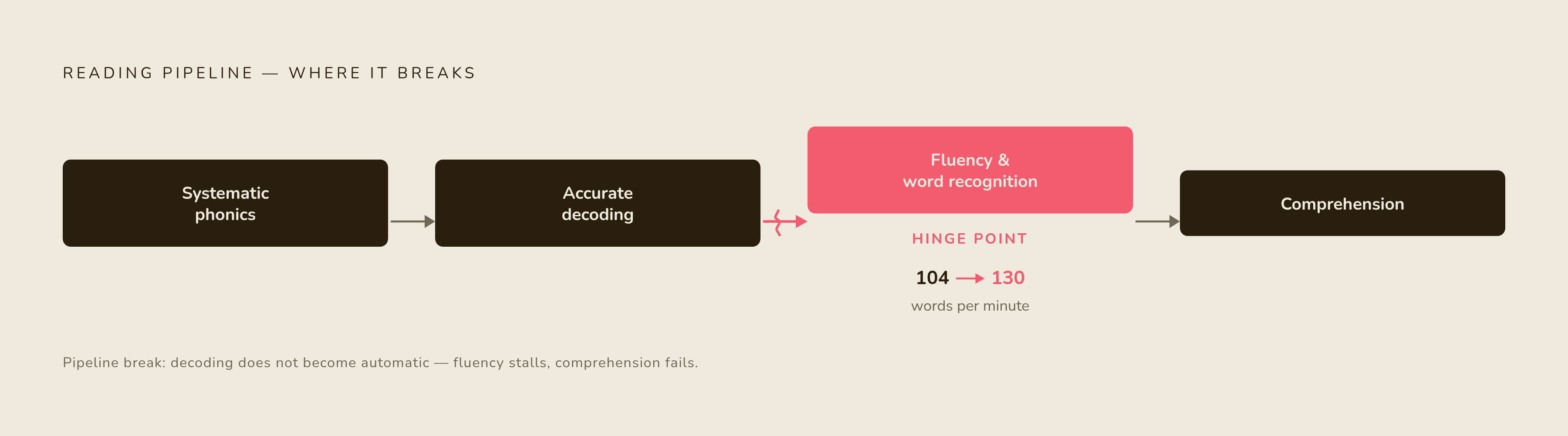
The pipeline runs in sequence: systematic phonics instruction builds accurate decoding, accurate decoding repeated enough times becomes automatic word recognition, automatic recognition produces fluency, and fluency frees up the mental bandwidth a reader needs for comprehension. A child still burning effort sounding out "because" letter by letter has nothing left over to track what the rest of the sentence actually means.
Fluency is the hinge in that chain, and it's where most breakdowns happen. A fluent reader isn't consciously decoding each word anymore, so attention shifts from mechanics to meaning. One study following pupils through phonics instruction found fluency rates climb from 104 to 130 words per minute as decoding improved, which is a concrete illustration of the mechanism, not an abstract claim about it. When the pipeline breaks, it breaks almost always at the decoding-to-fluency junction: a child who never fully automates letter-sound patterns stays stuck sounding out words long past the point where classmates have moved on to reading for meaning.
The legitimate, narrower role sight words play in early reading instruction
Sight words aren't useless, they're just overused. Researchers at the University of Illinois at Chicago point out that waiting until a child can fully decode every word in English before letting her read a sentence would mean waiting years, and that's not workable. Some high-frequency words have to show up early, just so kids can engage with connected text instead of grinding through isolated CVC drills indefinitely.
About 300 high-frequency words make up roughly three-quarters of everything printed in English, and most of them are grammatical glue, articles and prepositions like "the," "of," "was," and "said," rather than words carrying content. Many are also phonetically irregular, so they don't cleanly follow the sound-spelling patterns a beginning reader is learning yet. Others, like "her," actually do follow regular rules, they just show up in early readers before a child has reached that pattern in the program's sequence.
Researchers disagree on how to handle the irregular ones, and Education Week has covered the split. One approach teaches the decodable part of the word first: the "th" in "the" follows a rule the child already knows, and only the leftover "e" sound gets flagged as the exception. That keeps the child in decoding mode instead of flipping over to pure memorization. Kari Kurto of the Reading League put it simply: kids working through irregular words this way are "still decoding." The goal isn't memorization dressed up differently, it's phonics logic stretched to cover the exceptions.
Why some programs still lead with memorization and what parents should watch for
Flashcard drills and sight word lists haven't disappeared from classrooms, and that includes programs that score well with independent curriculum ratings organizations. Search any lesson-sharing site for sight word flashcards and the results run into the thousands. That says something uncomfortable: the practice is baked into classroom culture at a depth that has little to do with what the research actually recommends.
The Reading League has built curriculum evaluation guidelines that specifically penalize programs teaching high-frequency words as whole units meant to be memorized rather than decoded. That's a meaningful signal. Professional standards are shifting even where day-to-day classroom habits haven't caught up yet, and the gap between the two is exactly where a lot of kids fall through.
Parents evaluating a reading program have a short, practical checklist to run through:
- Does the program teach letter-sound relationships in a planned, sequential order, rather than scattershot?
- Are high-frequency words folded into phonics patterns as they come up, or split off into a separate memorize-this-list track?
- Is instruction explicit, with a teacher actively naming the pattern, or does the program just hope kids absorb it through exposure?
- Is there decodable text involved, meaning books built only from the phonics patterns a child has already learned, so reading practice reinforces the instruction instead of running ahead of it?
The Science of Reading policy shift's effect on what happens in your child's classroom
The policy landscape has moved fast, faster than public education usually moves on anything. As of the end of 2024, 40 states plus the District of Columbia have passed laws or put policies in place tied to evidence-based reading instruction, and more than 20 states passed new Science of Reading legislation in 2023 and 2024 alone.
The specifics vary by state, but they add up to real money and real requirements. Massachusetts Governor Maura Healey proposed a five-year early literacy plan aligned to evidence-based practice through third grade, with $30 million allocated in the 2025 budget proposal. New York City launched its "New York City Reads" initiative in May 2023, putting $35 million into teacher training and coaching, with Phase One covering 15 of the city's 32 community school districts adopting standardized reading curricula. Indiana passed a law requiring all elementary teachers to acquire a literacy endorsement, a requirement involving 80 hours of professional learning and a written exam. Other states have similarly moved to strengthen teacher requirements around evidence-based reading instruction.
Not everyone's applauding the rollout. Critics have raised concerns that scripted curricula, the kind many states are now mandating, narrow the diversity of texts kids read and reduce the professional judgment teachers can exercise. Researchers affiliated with universities like Furman have drawn useful distinctions between the science itself, the political movement built around it, and the commercial market selling curricula under its name. Those are three different things, and a parent trying to make sense of a school district's new reading program should keep them separate rather than assume the label on the box guarantees the substance inside it.
Supporting reading at home when you understand what good instruction looks like
The home version of good phonics instruction is simple to state, even if it takes patience to practice night after night. Teach most words through phonics first, and only flag the unusual sound-spelling part in a word a child can't yet fully decode. Sight-word practice, at home or at school, should build speed on words a kid basically already knows how to read. It should support, not replace, learning to decode.
If a child's classroom already uses a phonics-based program, home reading time works best when it reinforces the same patterns: decodable books built from sounds the child has actually learned. If a child bumps into high-frequency words that don't decode cleanly, skip the flashcard-only route and point out the parts that do make sense: the "th" in "the" makes the sound she already knows, and the "e" at the end is the one tricky bit worth just remembering.
For children who are struggling, phonics-based intervention has the stronger evidence behind it. That doesn't erase the RCT findings mentioned earlier, both phonics and sight word training showed real effects for poor readers, so neither approach is worthless on its own. But phonics builds something sight-word memorization structurally cannot: a transferable skill that lets a child sound out a brand-new word he's never seen printed before in his life. That's the entire point of learning to read, so build the habit at home well before a report card comes home saying otherwise.