Science of Reading vs Whole Language: What the Research Actually Shows
Decades of reading research show phonics instruction, not guessing, builds skilled readers.
Only 31% of fourth-graders in one national assessment scored proficient or above in reading on the 2024 survey. Forty percent scored below basic, unable to reliably pull the main idea out of a grade-level text. From 2019 to 2024, 48 states saw their average fourth-grade reading scores drop. That's not a blip in one district or a symptom of one bad curriculum vendor. That's a national pattern, and it's been building for decades.
The 2025 NAEP results gave a little room to breathe: fourth-graders posted a 4-point gain over 2022. But 13-year-olds stayed flat. Whatever's working is not reaching older kids yet, and it's certainly not reaching them fast enough. None of this is new, either. Literacy scores in that national school system. have been stuck for a long time, which is exactly why the question of how kids are taught to read matters so much right now. Something in the instructional model has been broken for a while. The rest of this piece is about figuring out what, without rushing to point fingers before laying out the evidence.
What whole language claimed, and why it dominated for so long
Whole language rests on a simple, appealing idea: reading is natural, like talking. Kids pick up spoken language just by being around it, without anyone drilling them on grammar rules. Whole language argued reading should work the same way. Surround a child with good books, meaningful stories, real language, and reading will click into place on its own.
That belief has deep roots. Horace Mann was warning against sounding out letters one by one back in the 1800s, worried it would sever kids from the meaning of what they were reading. By the 1930s, that concern had hardened into the "look-say" method, best known through the Dick and Jane readers, and it stayed the dominant approach into the early 1970s. By the 1950s, whole-word instruction wasn't just common. It was the conventional wisdom, the water everyone swam in.
Kenneth Goodman gave the philosophy a name that stuck: the "psycholinguistic guessing game." Frank Smith added the claim that phonics rules were too numerous and too inconsistent to teach directly. Together, beginning in the 1960s and continuing through the 1980s, they gave whole language academic legitimacy and a vocabulary teachers could cite with confidence.
A child hits a word she doesn't know, and that's where three-cueing came from. A child hits a word she doesn't know. Instead of sounding it out, the teacher prompts her: look at the picture, think about what would make sense here, consider what a word could be, given the sentence so far. The child guesses. If the guess is plausible, the teacher moves on. No decoding required.
Balanced literacy showed up in the 1990s as a kind of course correction, adding a little phonics instruction on top of the whole language foundation. But the core belief didn't change. Reading was still treated as mostly natural and mostly driven by context, with phonics bolted on as a minor supplement rather than the foundation. This matters because most parents and teachers under 45 didn't experience pure whole language in school. They experienced balanced literacy, and many assume it was already the fix.
Whole language didn't survive because it worked. It survived because it had persuasive champions, because "child-centered" and "meaning-first" sound humane and progressive, and because teacher-training programs kept producing new teachers steeped in the same assumptions. Call it institutional inertia rather than conspiracy. Once a belief gets built into how teachers are trained, it doesn't need new evidence to keep going. It just needs nobody to interrupt the pipeline.
It's fair to note that some scholars push back on how this debate gets framed. Some researchers have argued the whole thing gets set up as a false binary, phonics against comprehension, as if a teacher has to pick a side. Whole language advocates have long said the same: nobody's against comprehension, so why is this a fight? The research answers that question directly, and not in whole language's favor.
What the research shows about how the brain learns to decode print
Spoken language is wired in. Babies absorb it just from being around it, no instruction needed, because human brains evolved for spoken communication over hundreds of thousands of years. Written text is different. Writing is only a tiny fraction of the age of spoken language, far too recent for the brain to have a naturally dedicated reading circuit. Every child has to be explicitly taught to turn marks on a page into sound and meaning. Reading isn't natural, and treating it as if it were natural is where whole language went wrong.
The Science of Reading is a body of evidence pulled together from cognitive science, linguistics, neuroscience, and developmental psychology, all converging on the same picture of how decoding actually happens in the brain." It's a body of evidence pulled together from cognitive science, linguistics, neuroscience, and developmental psychology, all converging on the same picture of how decoding actually happens in the brain. The National Reading Panel organized this into five core components: phonemic awareness, phonics, fluency, vocabulary, and comprehension. Leave one out and the whole structure gets shakier.
Gough and Tunmer's Simple View of Reading, from 1986, put it in a formula that's held up remarkably well: reading comprehension depends on both decoding and language comprehension together. Not one or the other. Both. A kid with strong vocabulary and rich background knowledge still can't read a word she can't decode. A kid who can sound out anything but doesn't understand what the words mean isn't reading either, not in any way that counts. Phonics and comprehension were never actually in competition. The Simple View shows why.
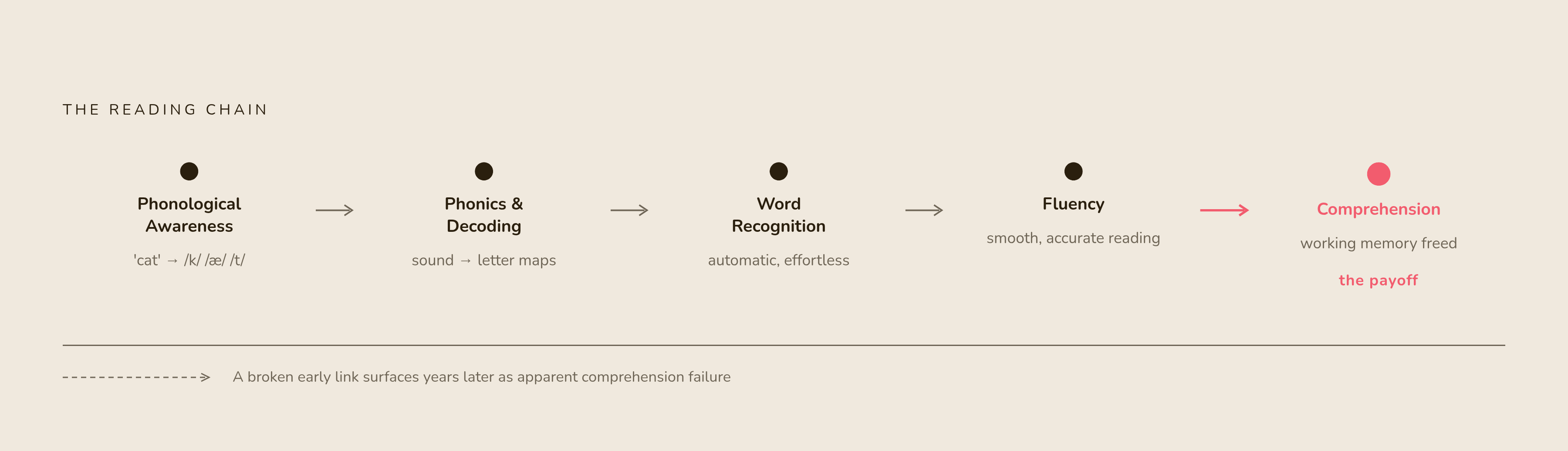
The mechanics run in a chain. Phonological awareness (hearing that "cat" breaks into three sounds) leads into phonics and decoding (mapping those sounds to letters). That leads to automatic word recognition, then fluency, then, finally, room in working memory to focus on comprehension. Skip a link early and the kid pays for it later, usually years later, in ways that look like a comprehension problem but actually trace back to shaky decoding.
Phonics instruction delivered in kindergarten and first grade produces better outcomes than the same instruction delivered later. Miss that window and catching up takes real work.
Research from the 1970s found that it was the poor readers who leaned on guessing and context clues. Strong readers weren't doing that. They were decoding automatically and barely noticing. Whole language, in effect, took the coping strategy of struggling readers and taught it to every child as if it were the goal.
Scarborough's Reading Rope gives this a shape people can actually picture: word recognition strands (phonological awareness, decoding, sight recognition) braided together with language comprehension strands (vocabulary, background knowledge, verbal reasoning), all weaving into skilled reading. Neither side of the old debate was wrong about what mattered. Both were incomplete on their own.
Brain imaging backs this up. Skilled readers build what's called an orthographic lexicon, a mental store of word patterns that lets the brain recognize a word visually within milliseconds, without sounding it out letter by letter. Fluency is the outcome of enough phonological decoding practice that the brain no longer needs to do it consciously. It's the outcome of enough phonological decoding practice that the brain no longer needs to do it consciously.
Multidisciplinary research puts the number at 95% or more of students capable of learning to read, given instruction aligned with this evidence, and that figure should reframe the entire policy conversation. Mass reading failure is a mass pedagogy problem. It's a mass pedagogy problem.
Why three-cueing failed and what structured literacy does differently
Three-cueing asks kids to look at the picture, guess from context, and check if the guess sounds right. Skilled reading asks something completely different: decode the word, fast, automatically, without needing a picture at all. Those are not two paths to the same destination. One of them dead-ends.
Emily Hanford's reporting, particularly "At a Loss for Words," did more than almost anything else to put a name to the damage: three-cueing trains kids to guess instead of decode, and it does so systematically, one prompt at a time, across years of instruction. That's not a minor inefficiency. It's teaching the habits of struggling readers to kids who might otherwise have become strong ones.
Structured literacy is the term the International Dyslexia Association coined in 2016, specifically to draw a line between programs actually built on the Science of Reading and programs merely claiming the label. It means explicit instruction: phonological awareness, phonics, and fluency taught directly and in a set order, alongside vocabulary and comprehension work, not instead of it.
A teacher demonstrates a sound-letter pattern, students practice it with immediate feedback, and independence builds gradually from there, and that sequence is the instructional difference. A teacher demonstrates a sound-letter pattern, students practice it with immediate feedback, and independence builds gradually from there. Compare that to whole language's discovery model, where kids are expected to infer the pattern themselves from exposure. One approach checks understanding at every step. The other approach hopes understanding emerges from exposure on its own.
Structured literacy is the approach the research supports for every learner, including kids who seem to pick up reading easily and get labeled "natural readers." It's not a niche approach reserved for kids with dyslexia. It's the approach the research supports for every learner, including kids who seem to pick up reading easily and get labeled "natural readers." Those kids are still building the same orthographic lexicon underneath. They're just building it faster.
Two features matter for anyone actually trying to judge a classroom or a program. First, scope and sequence: concepts get taught in a defined, cumulative order, so no child has a gap nobody noticed. Second, ongoing diagnostic assessment, finer-grained than a single beginning-of-year or end-of-year screener, catches a struggling reader in October instead of March. Both features exist specifically to catch kids before they fall behind, not after.
Tim Shanahan's 2025 review found no strong evidence that small-group phonics instruction beats whole-class instruction followed by small-group support. Some programs market themselves as "Science of Reading" purely on the basis of small-group delivery, without the evidence to back that specific claim. The label gets attached to structure sometimes, not substance.
How the teacher-preparation pipeline kept whole language alive in classrooms
As of 2019, 68% of early-elementary and special education teachers reported they were still using whole language methods in their classrooms, trained in programs that never told them otherwise. That's not defiance. That's what they were trained to do, in programs that never told them otherwise.
A National Council on Teacher Quality review found that 25% of teacher-preparation programs failed to adequately cover even a single component of scientifically based reading instruction. Ten percent were explicitly teaching whole language methods to future teachers, years after the research had settled the question. The classroom and the research were operating on two completely separate tracks. Fixing curriculum on paper does nothing if the people delivering it were never trained to teach it differently.
English adds a wrinkle. English is what linguists call an opaque language: the mapping between letters and sounds is inconsistent. "Freight" has seven letters and four sounds. Compare that to a transparent language like Spanish or Italian, where a letter almost always makes the same sound. Whole language advocates leaned on this irregularity to argue phonics rules in English were too messy to teach systematically. The research says otherwise: English phonics is more complex than Spanish phonics, sure, but it's still teachable, systematically, with the right scope and sequence. Complexity isn't the same as chaos.
For English language learners specifically, there's a genuine and unresolved tension in the bilingual education world. Some advocates worry that Science of Reading policy, in its push for early, direct English phonics instruction, comes at the expense of letting kids build first in their home language, a method some research suggests strengthens long-term literacy in both languages. That's not a settled argument, and it deserves to be treated as contested rather than waved away.
Research suggests 80% of children who aren't reading proficiently by third grade never fully catch up. Research suggests 80% of children who aren't reading proficiently by third grade never fully catch up. Teacher preparation is a central lever in whether children learn to read. It's the thing standing between a five-year-old and whether she reads on grade level for the rest of her schooling.
What state-level policy reform looks like when it follows the evidence
As of March 30, 2026, 42 states plus the District of Columbia have passed laws or adopted policies requiring evidence-based reading instruction since 2013. Colorado, Mississippi, Tennessee, and Connecticut have built out some of the most comprehensive early literacy plans among them. California's 2025 law requires instructional materials aligned with evidence-based reading methods and comes with $200 million in state funding, though that money covers teacher professional development only. The instructional materials mandate itself is a separate obligation from that professional development funding, a distinction that matters when a state this large is trying to move.
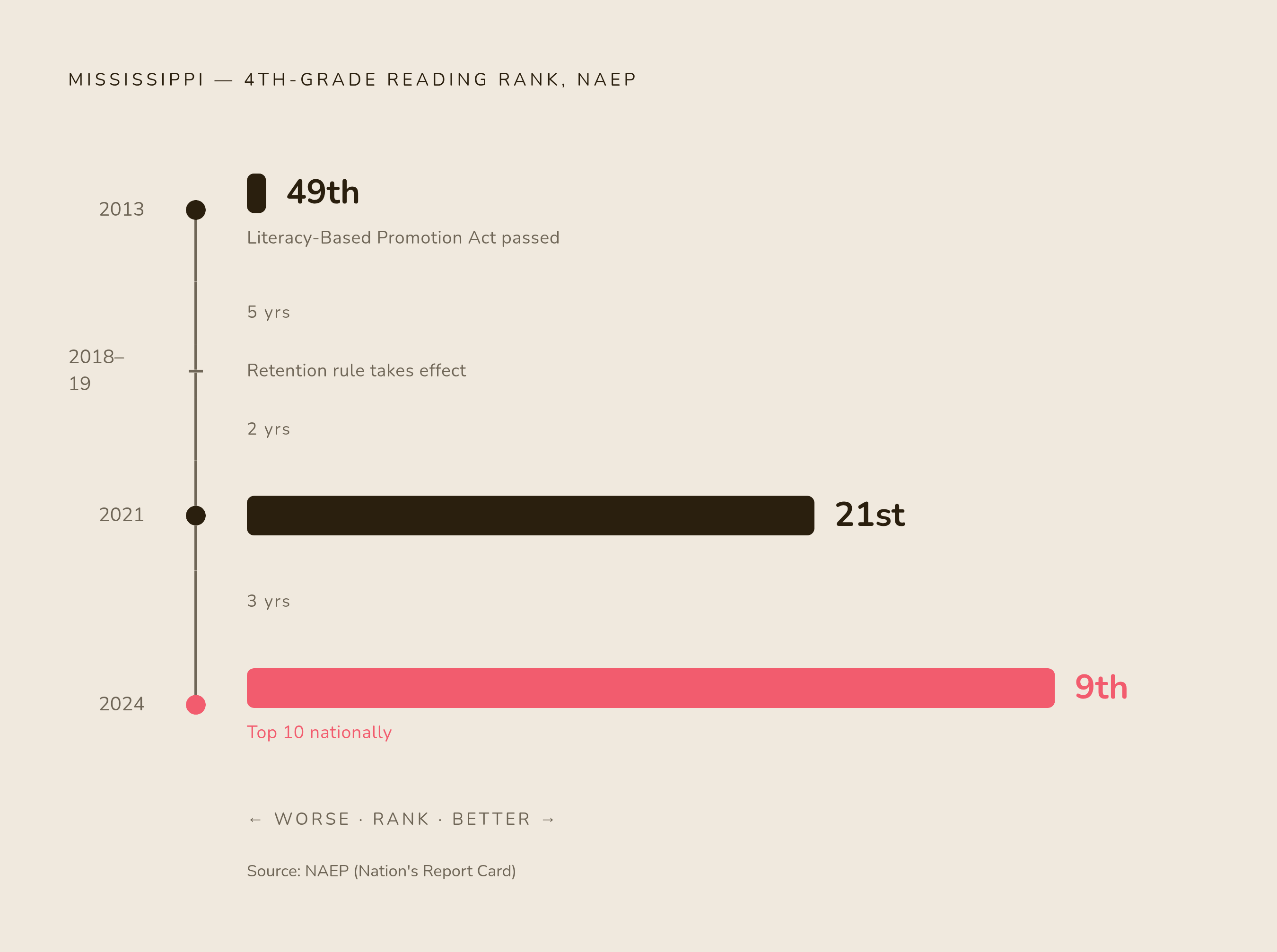
Mississippi is the case everyone points to, and it deserves both the credit and the scrutiny in equal measure. In 2013, Mississippi ranked 49th in the country for fourth-grade reading. By 2021, it had climbed to 21st. By 2024, it hit 9th. The Literacy-Based Promotion Act, passed in 2013, mandated scientifically research-based reading instruction and phased out automatic promotion for struggling early readers, with the retention rule taking effect in the 2018-2019 school year. Mississippi's Black fourth-graders rose to 3rd in the nation in reading. Hispanic and low-income students in the state reached the top nationally in reading. All of that for roughly $15 million a year, about 0.2% of the state budget in 2023, or $32 per student, projected to raise lifetime earnings by about 2.25% a year per student from what amounts to a quarter-year's worth of extra learning gain.
That's the case for the defense. Here's the case that complicates it. A piece in The Conversation pointed out that Mississippi's gains started showing up before the current national wave of Science of Reading attention, which muddies any simple cause-and-effect story. Starting in 2017, the share of Mississippi students receiving testing accommodations rose and, with them, the share of students receiving NAEP testing accommodations: 8% in 2017, 9% in 2019, 11% in 2022. Statisticians at Columbia University have flagged this as a possible source of selection bias in how the score gains get interpreted. None of that erases Mississippi's progress. It just means the full story is more tangled than the headline version.
Louisiana offers a cleaner second data point. Fourth-grade reading rankings there jumped to 15th nationally on the 2024 NAEP, up from 41st in 2022 and 49th in 2019. That kind of movement, in that short a window, is harder to wave off as measurement noise.
Alabama shows exactly why parents need to ask what a number actually means before trusting it. The state's own 2025 assessments reported 81% to 88% of second and third graders reading "on grade level." The 2024 NAEP put Alabama fourth-grade proficiency at around 30%. Both figures can be true at once, because they're measuring against completely different standards. If a school reports "grade-level" performance, the question is: grade-level according to what test, set against what benchmark?
What "Science of Reading" reform means for how individual children are taught today
Science of Reading is a framework, and good instruction inside that framework starts with systematic phonics and phonemic awareness, then layers in fluency practice, vocabulary building, and comprehension of substantive text. It's a framework, and good instruction inside that framework starts with systematic phonics and phonemic awareness, then layers in fluency practice, vocabulary building, and comprehension of substantive content, nonfiction included, all through the school day rather than boxed into one reading block.
Parents evaluating a classroom have a few concrete things to check. Does the phonics instruction follow an explicit, defined scope and sequence, or does it feel improvised? When a child hits an unfamiliar word, is she asked to guess from the picture, or to decode it? Is there assessment happening regularly enough to catch a struggling reader within weeks, not months? And does the teacher talk in terms of phonemes, graphemes, and decoding, or only in vague "reading levels" that don't say much about what's actually happening in the child's brain?
For parents trying to help at home, the research base is thin, almost strikingly so. Only one peer-reviewed study in the past 15 years has evaluated a family-implemented, home-based intervention for building phonics knowledge in kindergartners, leaving parents picking tools or apps for home reading support largely without strong evidence behind any specific option. That's not a lot to go on. It means parents picking tools or apps for home reading support are largely choosing without strong evidence behind any specific option, which raises the stakes on picking something grounded in the actual mechanics of decoding rather than something that just feels engaging.
A child who's behind, who resists reading, or who learns differently from her peers isn't failing because reading is uniquely hard for her. The research consensus says explicit, adaptive instruction reaches nearly all kids. The barrier is access to that instruction, not some fixed ceiling on the child's ability.
And for kids already meeting benchmarks, the same framework still applies. Being on grade level isn't a finish line. The same principles, phonological sophistication, fluency, vocabulary depth, keep paying off well past the point where a child can technically "read." Structured literacy is the foundation, and it keeps being the foundation long after the early grades are over. It's the foundation, and it keeps being the foundation long after the early grades are over.
Sources
- Balanced literacy vs. Science of reading and structured literacy
- Whole Class vs. Small Group Reading: Research Insights | Shanahan on Literacy
- Is the Whole Language Approach Lingering in Your Classrooms? Here’s What to Look For - Ignite Reading
- Kenneth S. Goodman, 'Founding Father' of Whole Language, Dead at 92
- news.stanford.edu