Science of Reading vs Whole Language Approach
Neuroscience settled the reading wars—and whole language lost.

For decades, parents have been told the "reading wars" are still an open argument, two reasonable camps duking it out over the best way to teach kids to read. That framing is outdated. The science has closed the debate: cognitive psychology, neuroscience, and linguistics all point the same direction, and it isn't the direction most American classrooms have taught in for the last 40 years. Understanding what actually settled this argument, and what got lost along the way, matters for any parent trying to figure out whether their kid's classroom is doing right by them.
The story starts further back than most people realize. Horace Mann was pushing "whole word" ideas as early as the 19th century, and by the 1940s, the "look-say" method (think Dick and Jane) had taken over American classrooms. Kids memorized words as whole shapes, the way you'd recognize a stop sign. In 1967, linguist Kenneth Goodman gave the movement its modern intellectual backbone with a paper describing reading as a "psycholinguistic guessing game," the idea that skilled readers sample text, predict, and confirm rather than decode letter by letter. Marie Clay's Reading Recovery program later became the delivery vehicle that carried whole-language principles into thousands of elementary schools as an intervention model. Then, in the 1990s, balanced literacy emerged as a kind of peace treaty: keep the meaning-first, engagement-first philosophy of whole language, but bolt on a bit of phonics. It sounded reasonable. It wasn't enough, and the evidence on why is now overwhelming.
None of this is a knock on the teachers who built their careers around these methods. Whole language asked kids to fall in love with books, to read for meaning, to see reading as joyful rather than mechanical. Those instincts are good ones. The problem was never the goal. It was the theory of how a child's brain actually gets from squiggles on a page to meaning in the mind, and on that question, whole language guessed wrong.
What reading is, neurologically, and why it isn't natural
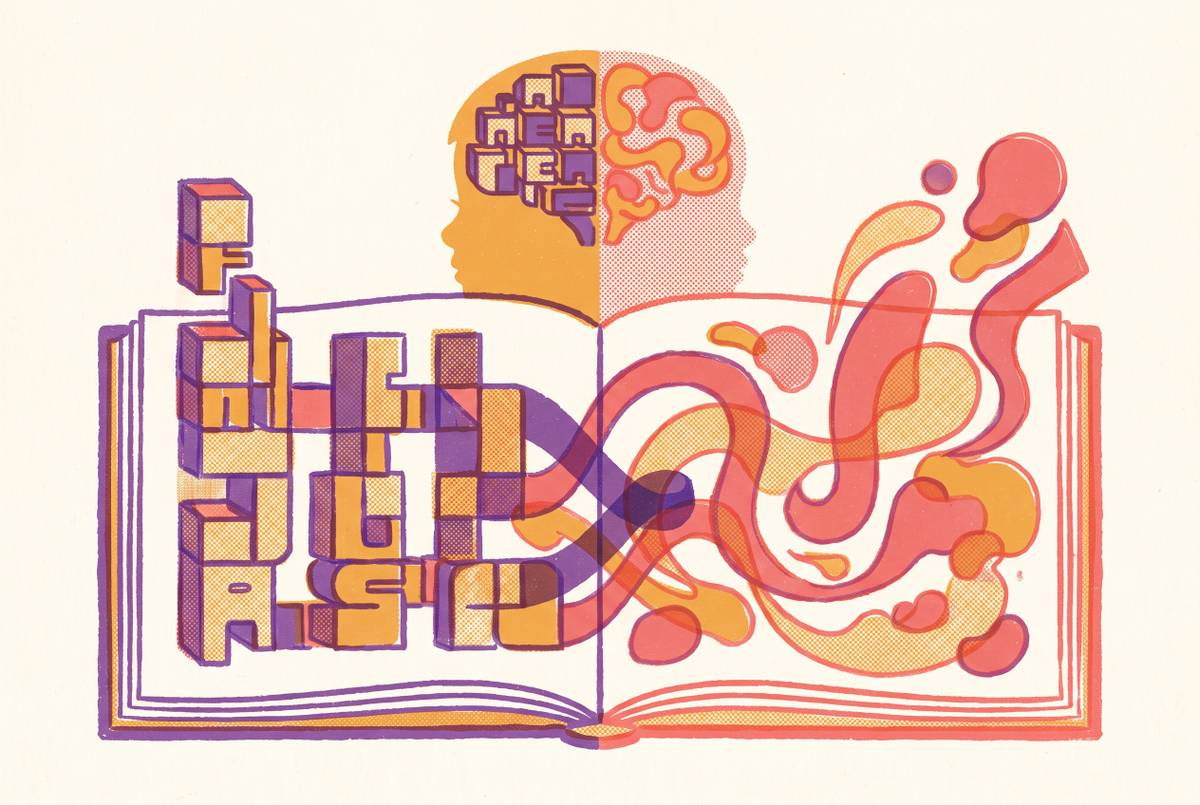
Speech is wired into the human brain. Babies babble, then talk, without anyone running them through a curriculum. Reading is different. No child on earth learns to read just by being surrounded by books, the way they learn to talk by being surrounded by talking. The brain has to take language circuits that evolved for speech and physically wire them together with the visual system, the part that processes shapes and symbols. That connection doesn't happen on its own. It gets built, deliberately, through instruction.
This is the exact spot where whole language got its founding assumption wrong. Goodman's theory treated reading as an extension of natural language processing, something a child could pick up through exposure and prediction, the same way they picked up spoken words. Neuroscience says otherwise. Reading is a bolt-on skill, and the brain needs explicit help installing it.
There's a useful framework here called the Simple View of Reading, which holds that skilled reading depends on both word recognition and language comprehension working together. Not one or the other. Both. A kid can have a huge vocabulary and understand every idea in a story read aloud to them, but if they can't decode the words on the page, none of that comprehension does them any good. Scarborough's Reading Rope visual captures this well, showing multiple strands (word recognition skills on one side, language comprehension skills on the other) braiding together into skilled reading.
The specific mechanism that makes decoding possible is called orthographic mapping. Every time a child sounds out a word, phoneme by phoneme, and connects those sounds to the letters on the page, the brain builds a tiny permanent record of that mapping. Do this enough times with enough words, and eventually the brain recognizes those words almost instantly, in a fraction of a second, without sounding them out anymore. That instant recognition looks like memorization from the outside. It is instead the end product of a decoding process that happened dozens of times before. It's the end product of a decoding process that happened dozens of times before.
This is why guessing strategies, using a picture, or the shape of a sentence to figure out a word, undermine the entire system. They let a kid arrive at a word without ever building the phoneme-grapheme connection that orthographic mapping depends on. The kid gets the word right in the moment, and the teacher moves on, but nothing durable got built. Next time that word (or a similar one) appears, the same guessing has to happen all over again.
The five pillars the research converges on
The Science of Reading is a body of evidence, pulled from cognitive psychology, neuroscience, linguistics, and developmental psychology, that all points to the same five components mattering for how kids learn to read. It's a body of evidence, pulled from cognitive psychology, neuroscience, linguistics, and developmental psychology, that all points to the same five components mattering for how kids learn to read.
Hearing and manipulating individual sounds in spoken words, before letters even enter the picture. Can a kid tell you that "cat" has three sounds? Can they swap the first sound to make "bat"? That's phonemic awareness, and it has to come first. Mapping those sounds to the letters that represent them, taught systematically and explicitly. This is the pivot point of the entire debate. Get phonics instruction right, in kindergarten and first grade specifically, and outcomes improve substantially compared to introducing it later. Reading with accuracy, speed, and expression. Fluency is the signal that a kid has crossed over from laborious sound-by-sound decoding to fast, automatic recognition, the orthographic lexicon expanding in real time. Word meanings, built alongside decoding, not instead of it. The actual point of reading. But comprehension is a ceiling, not a floor: a kid can't comprehend text they can't decode.
Pairing a sound with its written letter during instruction actually sharpens a kid's ability to hear that sound clearly in spoken words. Pairing a sound with its written letter during instruction actually sharpens a kid's ability to hear that sound clearly in spoken words. The two pillars aren't sequential so much as intertwined.
Structured literacy is the term for what happens when a classroom actually implements these five pillars. The International Dyslexia Association coined the term, and it means instruction that's explicit (nothing left to guesswork), systematic (a deliberate sequence), cumulative (new skills build on mastered ones), and diagnostic (responsive to what each kid actually needs). It is, in a sense, the opposite of "figure it out as you go."
Where whole language and balanced literacy fall short in practice
Whole language teaches top-down: whole words first, letter sounds later, if at all. Orthographic mapping works bottom-up: sounds and letters first, whole-word recognition as the eventual output. Those two are running in opposite directions, and only one of them matches what the brain is actually doing.
The clearest classroom fingerprint of whole language is something called three-cueing: prompting a kid to guess an unfamiliar word using context clues, sentence structure, or the picture on the page, rather than sounding it out. It feels helpful in the moment. The kid gets the word, the sentence keeps flowing, everyone moves on. Research shows three-cueing actually reinforces the habits of unskilled readers, training kids to guess rather than decode. It has come under sustained scrutiny, though as later sections show, it hasn't disappeared.
Sight-word memorization has a similar flaw. Teaching a child to recognize a fixed list of whole words, without ever connecting those words back to their individual sounds and letters, bypasses orthographic mapping completely. The kid ends up with a finite bank of memorized shapes instead of a generative system that can decode any new word they encounter. That's a real ceiling, and kids hit it.
Balanced literacy tried to fix this by adding phonics back in, but the fix was cosmetic more than structural. Phonics got treated as one tool in a toolbox, alongside guessing strategies and sight words, rather than the non-negotiable foundation everything else depends on. Some pieces of balanced literacy were genuinely good, read-alouds, shared reading, independent reading time all have real value. Three-cueing and memorization crowded out systematic decoding instruction because the underlying architecture still allowed it.
The sharpest data point in this entire debate is empirical. It's a 2022 study on Reading Recovery, the first-grade intervention built on whole-language principles, that found kids who went through the program had lower reading scores in third and fourth grade than kids who never received the intervention at all. Not "no better." Worse. That's a measured outcome, not a difference of opinion about pedagogy. That's a measured outcome.
What the evidence base looks like: scale and convergence
The National Reading Panel conducted a landmark review of research on how children learn to read, and the conclusion held consistent across a vast body of studies. That's convergence at a scale most areas of education research never approach. That's convergence at a scale most areas of education research never approach.
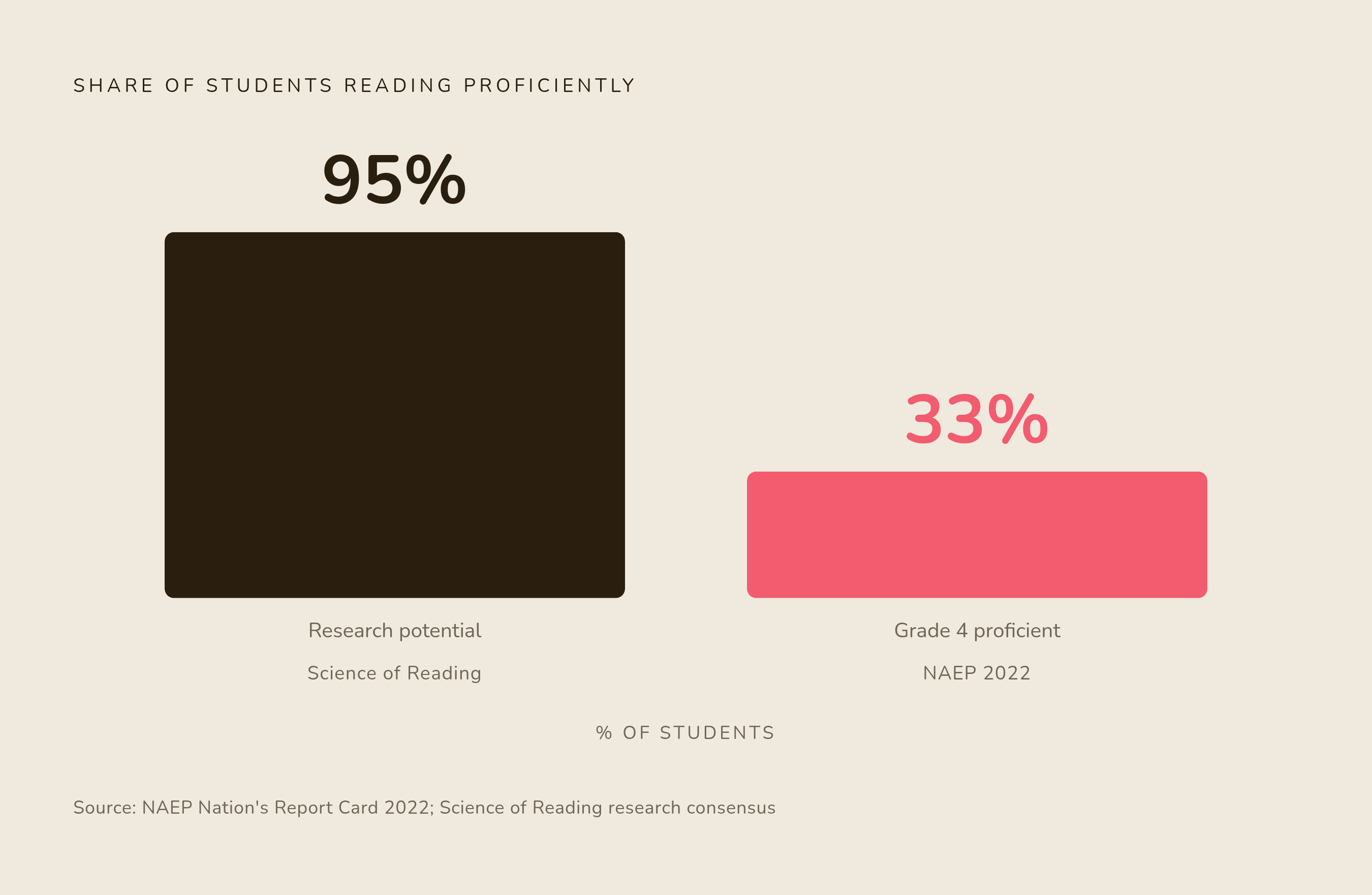
When instruction is aligned with the Science of Reading, over 95 percent of students can learn to read. That's what the studies show is achievable. That's what the studies show is achievable.
Now compare that to where American classrooms actually stand. Roughly two-thirds of fourth- and eighth-grade students are not proficient readers. Only about 35 percent of American kids read proficiently or better. The 2022 NAEP Nation's Report Card put fourth-grade proficiency at 33 percent, and while the 2025 NAEP showed a four-point improvement among fourth graders, a real signal, a four-point gain doesn't close a gap this size.
Only 5 to 10 percent of kids will learn to read on their own, almost no matter how they're taught, the way some kids pick up speech faster than others. The remaining 90-plus percent need systematic, code-based instruction to get there. That's the entire ballgame. A method that works fine for the naturally gifted 5 to 10 percent but fails the other 90 isn't a method that scales, and reading instruction has to scale, because every classroom has both kinds of learners sitting next to each other.
Why disproven methods have persisted in classrooms
If the science is this settled, why hasn't it shown up in every classroom already? Institutional inertia, mostly, plus a training pipeline that hasn't caught up.
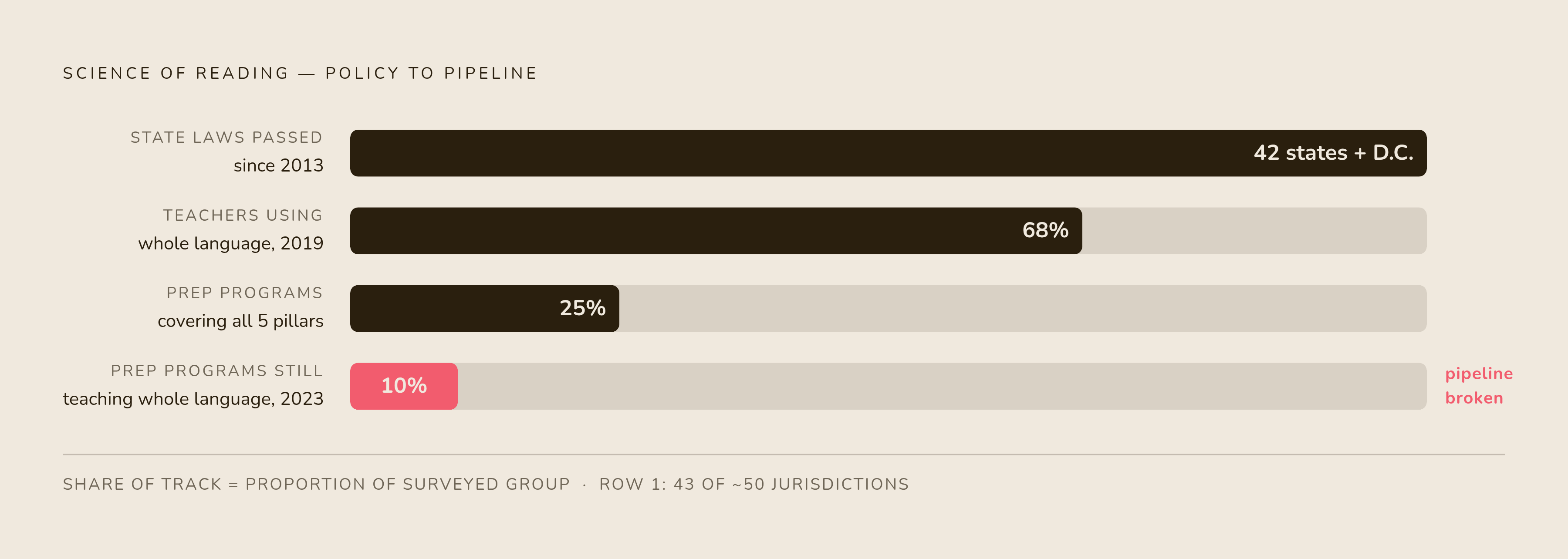
As of 2019, 68 percent of early elementary and special education teachers reported still using whole-language approaches. That's most of the field, years after the evidence had already converged. That's most of the field, years after the evidence had already converged.
Part of the problem traces straight back to teacher preparation. A review of teacher preparation programs found that only 25 percent adequately covered all five pillars of the Science of Reading, with a substantial share not adequately covering even a single component. And 10 percent of programs were explicitly still teaching whole-language methods to new teachers, as current practice, in 2023. Teachers can't apply a framework they were never taught, so the gap isn't really about willingness.
There's also a supplemental-materials problem hiding in plain sight. Even in districts that have formally adopted Science of Reading curricula, the teaching resource sites and worksheet libraries individual teachers pull from day to day are still stuffed with whole-language material. A district can approve the right core curriculum and still have whole-language habits sneaking in through the side door, one downloaded worksheet at a time.
Balanced literacy made this harder to spot, not easier. By rebranding under a name that sounded moderate and evidence-friendly, it let a lot of whole-language substance keep operating under cover of a more defensible label. The clearest way to tell what's actually happening in a classroom, regardless of what the curriculum calls itself, is to watch for three-cueing directly: if a kid gets stuck on a word and the teacher's first move is "look at the picture" or "what would make sense here," that's whole language in practice, whatever the binder on the shelf says.
None of this is a story about bad-faith teachers. Most of them were trained this way, in good faith, by institutions that hadn't caught up to the research either.
The policy shift now underway, and what it means in practice
The legal and legislative response has moved fast. As of March 30, 2026, 42 states plus the District of Columbia have passed laws or rolled out new policies requiring evidence-based reading instruction since 2013. Colorado, Mississippi, Tennessee, and Connecticut are among the states that have built out early literacy plans tied to Science of Reading-aligned materials and teacher training.
California moved in 2025 with AB 1454, a law requiring the state to adopt instructional materials aligned to evidence-based reading methods, backed by a separate budget bill, AB 121, that put $200 million toward professional development in evidence-based literacy instruction for TK through 5th grade teachers. That's real money, aimed directly at the teacher-training gap described above.
Most of these laws share a common shape: retrain teachers, adopt high-quality instructional materials, add early screening tools to catch struggling readers sooner, and in several states, explicitly address three-cueing as a teaching practice.
None of that means the problem is solved the moment a governor signs a bill. Passing a law doesn't rewrite what happens Tuesday morning in a specific classroom. The teacher-preparation gaps and the whole-language worksheets floating around online don't disappear because a state legislature acted, they persist right alongside the new mandates, at least for a while. Mississippi is often held up as the state that shows this can work, given its early and sustained commitment to structured literacy, though the specific figures behind that reputation vary by source. Either way, a state having the right policy on paper says nothing certain about whether a specific classroom has actually changed. The only way to know is to ask.
What good Science of Reading instruction looks like for a child ages 4 to 9
Four traits define it, and none of them are complicated to check for.
Instruction is explicit: the teacher directly teaches the sound-letter connection, nothing is left for the kid to infer on their own. It's systematic and sequential: sounds and letters get introduced in a deliberate order, moving from simple and common patterns to more complex ones, never left to chance. It's cumulative: today's lesson builds on yesterday's, with review baked into every session rather than treated as an afterthought. And it's diagnostic and responsive: ongoing, fine-grained assessment, more detailed than a once-a-year screener, catches specific gaps and adjusts pacing before a kid falls behind.
What does that actually look like in the room, or on a screen? A few concrete signs to watch for:
- The child segments and blends sounds out loud before ever seeing a new word in print.
- When a word gets misread, the correction points to the specific sound or letter pattern involved, not "does that sound right in the sentence?"
- New word lists follow a taught pattern (short vowels, then blends, then digraphs, and so on), not just how often the word shows up in a book.
- Fluency practice comes after decoding is solid.
And the warning signs run the opposite direction: sight-word memorization treated as the primary strategy, "just right" leveled books that quietly cap a kid below their real decoding ability, and any prompt that points to a picture or a guess instead of the letters themselves.
Parents looking to reinforce this at home have some real evidence to lean on. A study by researchers McConnell and Kubina in 2016 tested a family-run phonics program, just 15 minutes a night, five nights a week, and found early gains, though the results depended heavily on how consistently the program was actually followed. Consistency produces more reliable gains than intensity does.
The diagnostic piece is where things get interesting for how reading gets taught going forward. One-on-one tutoring has always outperformed classroom instruction specifically because a tutor can adjust in real time to exactly what one kid needs, moment to moment, rather than teaching to an average. That kind of responsiveness is hard to deliver at scale with a single teacher and 25 students. It's also exactly where adaptive technology has started to show promise. Meta-analyses of AI tutoring systems have found effect sizes in the range of 0.45 to 0.70 for mathematics learning, the kind of step-by-step, practice-heavy learning that phonics also depends on. A 2026 German study, involving about 500 children with an average age of roughly 61 months, found that kids using a literacy app intervention showed greater gains than every other comparison group, including a standard, business-as-usual classroom control. The OECD's 2025 review of interactive learning platforms reached a similar conclusion: the tools that actually move a child's understanding forward are the ones built around action, feedback, and repetition, not the ones that just hand a kid content to passively watch.
A Science of Reading-aligned tool actually teaches, rather than serving as a passive library of reading content. A Science of Reading-aligned app should be built on phonemic awareness, phonics, and fluency, not sight words or context-guessing. It should respond to what a child actually says, out loud, in real time, not just mark an answer right or wrong. Instruction should shift moment to moment based on what the child demonstrates they understand. And because structured literacy is diagnostic by nature, a parent should be able to see the child's actual progress, not guess at it from a report card months later.
The sources checked for this guide are listed below.