Best AI Tools That Listen to Children Read Aloud and Give Instant Feedback
These tools vary widely in how they respond to reading mistakes.
AI tools that listen to children read aloud differ most in what happens after a mistake. Microsoft Reading Coach gives children free targeted practice, while Google Read Along gently corrects children who are starting to read on their own, also for free. The best fit depends on whether a child needs more practice or instruction that addresses why they stumble. Error detection alone is not the same as teaching.
Why listening-based AI feedback is a fundamentally different kind of reading support
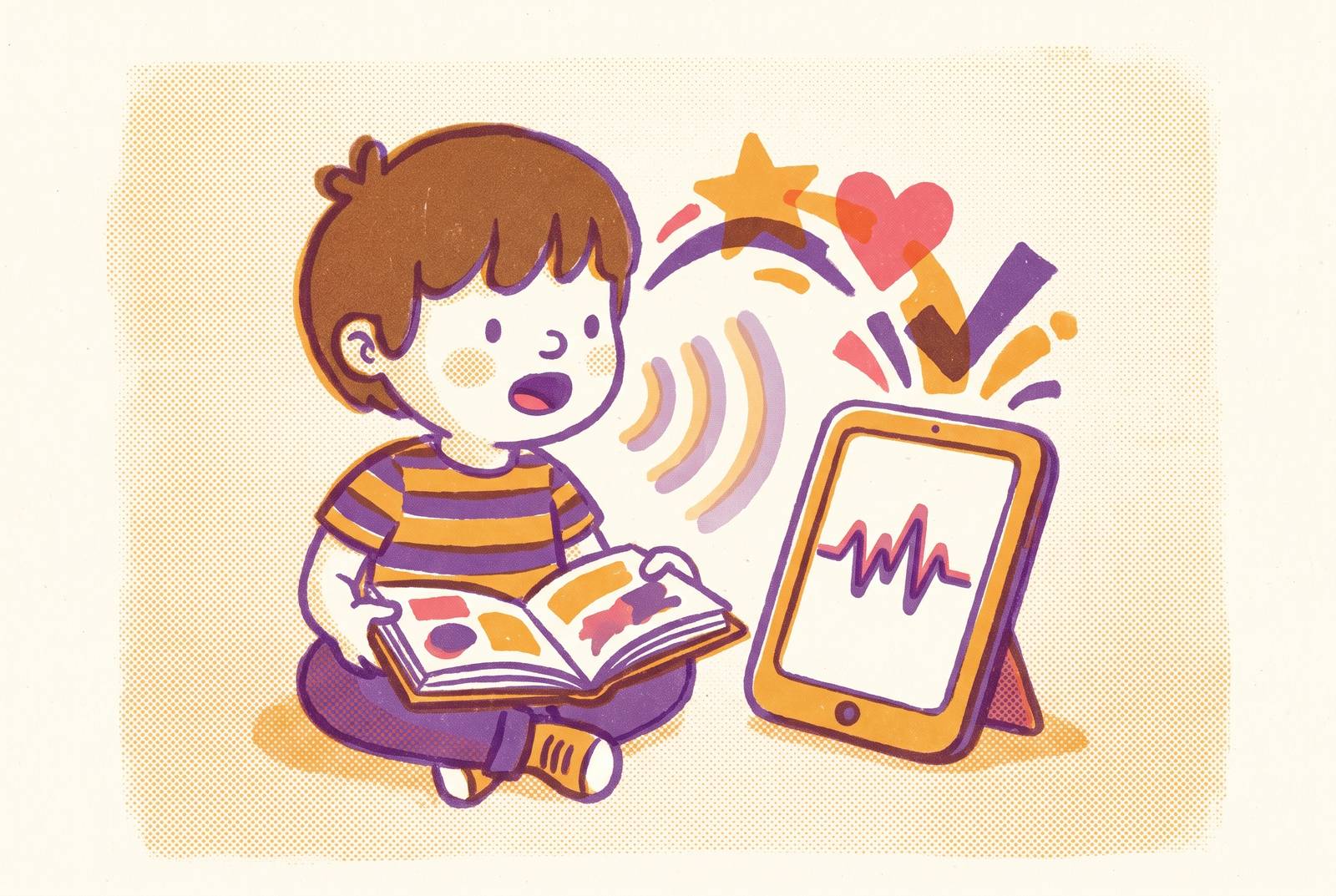
Speech recognition detects a mispronunciation, skipped word, or hesitation as the child reads, and the tool responds at that moment. That timing separates it from a quiz app, flashcard tool, or audiobook library. Instead of checking an answer after reading, it can intervene while the child is trying to turn print into speech.
This creates room for more individual oral reading practice than classroom time alone can provide. A teacher cannot sit beside every child for that practice every day, while AI can support repetition without an adult present for every session. There is an emotional benefit, too. Children who struggle to read may be afraid of making mistakes aloud in front of other people, and a patient, non-judgmental listener can make practice feel less scary. That makes the tool useful, but the quality of its response still determines what the child learns.
What the Science of Reading says fluency actually requires
Fluency connects decoding with understanding what a text means. It takes more than reading faster or making fewer mistakes that others can spot for a child to build this skill. The Simple View of Reading frames reading comprehension as the product of decoding and language comprehension. Both are needed. Children need to understand language as well as recognize printed words, and those who understand spoken language still need to be able to decode print.
Catching a wrong word is a start. Identifying the phonics pattern behind the error and directing instruction toward it is a different, harder task. If a child does not know that pattern, flagging the word without teaching the pattern leaves the child with the same problem.
Children also arrive with different foundations, even when they are in the same grade. Teacher knowledge of reading science has improved sharply, but classroom practice has not fully caught up. A substantial share of K-3 teachers still mix phonics with cueing approaches that experts say slow fluency development. This is a reason for tools to assess what a child can actually decode rather than assume that earlier instruction has covered every necessary skill.
The spectrum of what "AI feedback" actually means in practice
Tier 1 is error flagging. The tool detects a mispronunciation or hesitation, marks it, and moves on, giving the child a signal about correctness without instruction about the cause. This can support practice and engagement, especially when feedback is gentle. But the response has a narrow job. A highlighted word does not establish whether the child needs help with a particular sound pattern or simply another chance to read it.
Tier 2 adds targeted practice that draws on the mistakes the child makes. Instead of treating a mistake as the end of the exchange, the tool uses it to select follow-up words or passages. That creates a feedback loop. The loop can run directly through the app or through a teacher who uses the recorded errors to guide instruction. Targeted practice goes beyond detection, although selecting troublesome words does not by itself prove that a tool has diagnosed the phonics cause.
Tier 3 is real-time adaptive instruction. At this level, the tool assesses fluency, decoding, vocabulary, and comprehension as the child reads, gives brief interventions at the point of difficulty, and develops its understanding of the child across sessions. The instructional sequence changes along with the text difficulty. That distinction exposes the “illusion of personalization” in tools that offer harder passages without addressing the gap that made easier ones difficult. Without knowing which level a tool reaches, a family cannot meaningfully judge whether its polished interface hides basic error flagging or supports deeper teaching.
The tools available in 2026 and where each sits on that spectrum
Microsoft Reading Coach listens through a microphone and points out mispronunciations as they happen. It then generates practice words drawn from what that particular reader struggled with, placing it at Tier 2. Its defining strength is the follow-up practice. It is free for anyone with a personal Microsoft account, through a web app or standalone Windows download, and for schools and students within Microsoft 365 Education. It works for fluency and decoding practice at home or in class, especially for those who already have an education account, though families can use it without a school account.
Microsoft’s companion feature, Reading Progress, serves a different part of the process inside Teams for Education. A teacher can assign a passage to a whole class, have students record themselves, and review AI-assisted accuracy rates and correct words per minute for each student. That makes individual reading more visible to the teacher. The distinction is useful for parents comparing descriptions of the two features. Reading Coach supplies targeted practice, while Reading Progress supports classroom assignment and review.
Google Read Along is a free mobile app that listens to children read and gives them real-time AI feedback. It offers gentle correction for misreads and awards stars when children read well. Its focus is early independent practice. Within this framework, it sits closest to Tier 1, emphasizing engagement and accessibility rather than diagnosis of the phonics cause behind an error. It suits families who want a free way to get started with little setup and have no need to assess a whole class or follow a teaching sequence that adapts in depth.
Readling is made for UK primary schools with children ages 5–11 and does not state a minimum age beyond that range. It flags and keeps track of how well children read and shows the data to teachers, which puts it at Tier 2 through a feedback loop led by the teacher. The teacher is central here. Rather than automatically adapting the child’s next session, the tool gives the teacher information to guide the response. It costs £3/pupil/year with a 30-day free trial, is GDPR-compliant and hosted in the UK, and fits classrooms seeking auditable fluency data and a home-school link without rebuilding their reading curriculum.
SpellingJoy Reading addresses the pre-reading and early phonics stage for ages 4–8. A child picks a buddy, which says a sound, shows the letter, and waits for a response. Beginners start at the first sound. Children who already know some letters pass those lessons quickly, so the starting point reflects some of what they know. It is a subscription product, is new with a shorter track record than more established programs in the category, and fits true beginners. Its described sound-and-letter interaction is not enough to classify it as Tier 3 passage-level instruction.
A child who is ready to read aloud may get help from targeted word practice, while one at the first-sound stage needs to start elsewhere. Free access also does not establish age fit. The tools described here do not support a blanket recommendation for every toddler or every child ages 3 to 6. For families comparing no-cost options, Reading Coach and Read Along offer distinct forms of support.
What the research says about when AI read-aloud feedback works — and when it doesn't
A 2026 study found that those in a human-plus-AI reading group were better at following instructions, finished more AI interactions and reading tasks, and took a more active part than those in an AI-only reading group. The comparison favors support shared between people and technology. It does not establish that every listening app produces the same results, or that more AI time is always better. The finding gives parents a reason to make time spent practising alone with an app one part of a wider reading routine.
AI can give patient feedback right away and let children practise more often than there is time for in class. For a reluctant reader, it also offers a place to make mistakes without an audience of peers. Those are useful strengths, but they have limits. Researchers who study AI in early-childhood education say that children need relationships with people who respond to them as they develop, and digital tools cannot take the place of those relationships. The “empathy gap” describes that boundary, because a response can sound caring without reflecting genuine emotional understanding.
The National Literacy Trust’s 2026 survey found that the majority of teachers worried about pupils using AI. They worried about pupils’ ability to think for themselves, their stamina and resilience when reading and writing, and how they build cognitive skills. These concerns call for care in how listening tools are used without ruling out all of them. A tool that supports oral practice has a specific role, and its usefulness should be judged within that role rather than against promises of replacing human teaching.
For parents, the practical implication is to keep adult reading with and to the child in the routine. AI practice can fill time when one-to-one support is unavailable, but it should not take over the relationship that helps a child develop as a reader. The encouraging finding is that AI fluency practice can be genuinely effective when used as intended, with repetition and immediate feedback supporting human instruction.
How to evaluate a read-aloud AI tool before committing to it
Does it diagnose an error or just detect one? During a demo or trial, look for whether the response changes with the type of mistake or stays the same every time. A correction identifies the wrong word. A response that helps teach the child more finds the phonics pattern or skill the child needs to work on and gives them practice with it. For a Tier 2 tool, ask whether its targeted exercises work on a pattern or just repeat words the child missed, and whether a teacher needs to work out what the results show.
Does it adapt across sessions, or only within one? Adjusting a passage’s difficulty during a session is not the same as building an understanding of a child across weeks and months. Parent progress reports offer a practical test. Look for evidence of accumulated strengths, recurring difficulties, and changes in instruction. Session-level results alone do not demonstrate that a tool has a meaningful, developing picture of the learner.
Is the curriculum grounded in the Science of Reading? Look for explicit, systematic phonics rather than a mixed approach that includes cueing strategies experts consider discredited. Sequence is the key distinction here. A phonics-based tool introduces skills deliberately instead of presenting words a child cannot yet decode and hoping context fills the gap. This question is especially important when an app’s listening features look impressive, because accurate speech recognition does not establish the quality of the curriculum behind it.
Does it fit this child’s specific challenge? A child who avoids reading through low confidence needs a different first experience from one who decodes well but reads without expression. A child below grade level also needs a different instructional sequence from one seeking enrichment. Will the child actually use it? Reading often at a level that feels comfortable builds fluency and habit faster than a perfectly leveled book the child avoids, so the choice should fit both what the child needs to learn and what they are willing to read.