AI Reading and Math Apps With Adaptive Instruction for Early Learners
Most apps claim to adapt, but few actually diagnose gaps and adjust teaching in real time.

Parents searching for a "personalized AI tutor for reading and math" will find dozens of apps using the word adaptive. Almost none of them mean the same thing by it. Some apps track a child's every response and rebuild a model of what that child actually knows, skill by skill. Others simply bump a score threshold and unlock the next level. For a parent trying to pick one tool for a struggling reader or a child stuck on basic math facts, the honest answer is this: look for an app that diagnoses specific gaps in real time and changes its teaching moment to moment, not one that only adjusts difficulty after the fact.
Why "Adaptive" Has Lost Its Meaning in Children's Edtech
Searching "adaptive reading" or "adaptive math" in any app store turns up the word on nearly every listing. It sits next to "personalized," "AI-powered," and "smart learning," often on apps that do none of those things in any meaningful sense. A parent scanning reviews has no real way to tell which claim is true, because the word has been stretched to cover everything from a genuine diagnostic engine to a simple if-then rule that moves a child up a level after three correct answers in a row.
That gap matters because it determines what happens to a child who's stuck. A system that only adjusts difficulty will keep a struggling reader comfortable by feeding them easier content, without ever identifying the specific sound, blend, or concept tripping them up. A system built to diagnose will catch that gap on the spot and address it directly. One of these approaches closes a gap. The other hides it. Parents deserve a clear standard for telling the two apart, grounded in what reading and math research actually says a child needs at each stage.
What reading science actually requires an adaptive app to teach
Reading instruction research describes comprehension as the product of two things working together: decoding and language comprehension. This is the Simple View of Reading, and NWEA's Science of Reading research treats it as foundational. A child can sound out every word on a page and still fail to understand it if language comprehension lags behind. Decoding and comprehension have to develop together, not one before the other in isolation.
That decoding side of the equation breaks down further into phonemic awareness and phonics, and the two reinforce each other. NWEA's research notes that pairing sounds with the visual letters that represent them works better than teaching sound awareness or letter-sound rules on their own. Deciding when to introduce a letter alongside a sound, and in what sequence, is an instructional judgment call. A branching app that just adjusts difficulty has no mechanism for making that call. A genuinely adaptive system does.
Fluency comes next, and it functions as the bridge between decoding and comprehension. Fluency means accuracy, rate, and prosody, the natural rhythm and expression of reading aloud. Effortful, word-by-word decoding eats up working memory that a reader needs for making meaning, so building automaticity frees up the mental space comprehension depends on. Getting a child from effortful to automatic requires orthographic mapping, the process of moving a decoded word into permanent memory, and that requires correct oral reading combined with repeated exposure. NWEA points to guided repeated oral reading and partner or choral reading as the mechanisms that make this happen. An adaptive app has to track not just whether a child read a word correctly, but how many times they've encountered it and in what form.
LiteracyPlanet's 2025 review of reading science names five components that work as a connected system: phonemic awareness, phonics, fluency, vocabulary, and comprehension. Each one builds on the last. An app that only adapts within one of these, say phonics, while treating the rest as fixed content, is only doing part of the job. Strong phonics instruction is necessary, but it isn't the finish line. Fluency, vocabulary, background knowledge, and exposure to complex texts all matter once decoding is secure, and an app that stops adapting once a child can sound out words leaves the rest of the pipeline unattended.
What Early Numeracy Research Requires in a Math App
Early math is a developmental sequence, not a string of arithmetic drills, and skipping its foundational layer sets a child up to be misplaced by whatever comes next. A longitudinal meta-analysis on early numeracy found that early numeracy skills predict later math achievement with a strong, consistent correlation across many studies. What an app teaches a four- or five-year-old in this domain carries consequences years down the line.
Research on numeracy in three- and four-year-olds identifies counting and number relational skills, understanding how quantities relate to one another, as the competencies developing fastest at that age. That's the window an adaptive math app for Pre-K children needs to prioritize above all else.
The relationship between math and language turns out to be closer than most parents assume. A cross-lagged panel study following children from age two-and-a-half to four found that numeracy and general language development predicted each other across that window, each one feeding the other in both directions. An app that treats math as a silo, cut off from language development, misunderstands how young children actually build number sense.
For a parent, the practical upshot is this: an adaptive math app for early learners needs to track whether a child can count, whether they understand numerical relationships among objects, and whether their language skills are keeping pace with both. An app might build strong number fluency while leaving word problems untouched. It might teach solid counting while never building relational reasoning. Parents need domain-specific evidence of what a child has secured, not a single engagement score that blurs all of it together.
What separates genuine adaptive instruction from difficulty branching
Most apps that call themselves adaptive are doing one specific thing: adjusting the difficulty of the next question based on whether the last one was answered correctly. That's branching. It's useful, but it isn't the same as adaptive instruction.
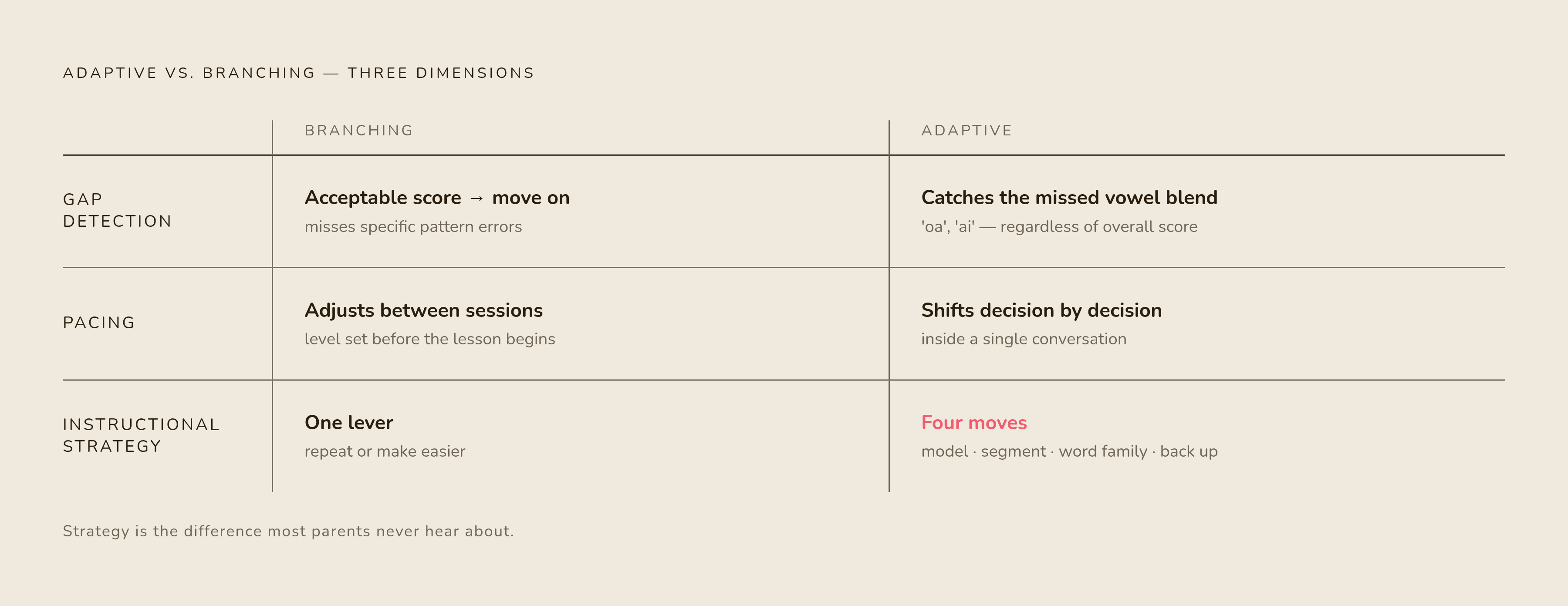
Genuine adaptive instruction runs on a continuously updated model of what a child knows and doesn't know at the level of specific concepts, not a score threshold that trips a lever. Take a child who keeps missing vowel blends, like "oa" in "boat" or "ai" in "rain," but still scores well enough overall to keep advancing. A branching app sees an acceptable aggregate score and moves on. A truly adaptive system catches the specific pattern, flags the vowel blend as an unresolved gap, and addresses it directly, regardless of what the overall score says.
Or take a child who can recite "one, two, three, four, five" perfectly but doesn't yet grasp that the last number named tells you how many objects are in front of them. That gap, between reciting a sequence and understanding cardinality, is invisible to a system that only checks whether an answer matches. A branching app asks: did the child get this right? An adaptive system asks what that response reveals about the child's understanding and what to teach next in response.
The distinction becomes clearest in kids who are struggling or who are ready to move faster than the app expects. A branching system that detects a struggling child typically routes them to easier content. That keeps the child comfortable, but it may never close the actual gap causing the trouble. A real adaptive system finds the precise missing skill, in this case the vowel blend or the concept of cardinality, and teaches to it directly.
Pacing is a second dimension branching misses. A skilled teacher slows down the instant a child gets stuck and speeds up the instant they're ready, making that call decision by decision, inside a single conversation. An app that only adjusts level between sessions, rather than pacing within a session, is working on a completely different timescale than real teaching.
Instructional strategy is the third dimension. When a child fails to decode a word, the right response depends on what's actually wrong. Modeling the sound aloud is one option. Sometimes it's asking the child to segment the word into parts. Sometimes it's connecting the word to a family of similar words, or backing up to an earlier concept the child hasn't secured. A branching system has one lever: repeat the item or make it easier. An adaptive system chooses among several teaching strategies based on the specific misconception it just diagnosed.
How AI Makes Real-Time Adaptive Instruction Possible
What makes moment-to-moment adaptive instruction possible at scale, for the first time, is a specific combination of technology: speech recognition, continuous modeling of what a student knows, and decision logic that acts on that model instantly.
Listening to a child read aloud is the clearest illustration. A system built on this architecture doesn't just check whether a word was read correctly. It has to detect hesitations, substitutions, and mispronunciations, then use those signals to diagnose the underlying gap and choose the right intervention immediately. The equivalent exists in math: a child who arrives at the wrong answer by counting up from one, instead of counting on from the larger number, is showing a different gap than a child who simply reverses two digits. The correct response to each differs, and an adaptive system needs to tell them apart in the moment, not after the fact.
University of Florida researchers built a platform called Storiza specifically to support children's oral reading fluency using generative AI. That project targets one of the most well-supported interventions in reading science, supported repeated oral reading, and one of the hardest to deliver at scale without a human listening closely to every child, every session.
Brief AI interventions tend to produce smaller effects than sustained ones. Duration and continuity matter: an app a child opens for ten minutes once a week will not replicate the effect of consistent, daily practice. Adaptive systems built around well-defined learning objectives, like decoding a specific phonics pattern, also tend to struggle with more open-ended dimensions of reading, building background knowledge, and holding the kind of discussion that develops deep comprehension. The same is true in math for the hands-on, physical exploration that supports early number sense, something a screen can only partially substitute for.
Parents evaluating these tools also face a transparency problem. When an adaptive system decides to reroute a child toward easier or harder content, parents and teachers rarely get to see the reasoning behind that decision. That limits accountability and makes it harder to check whether the app's internal model of the child actually matches reality.
None of this means AI-driven adaptive instruction falls short of being useful. It means the best implementations are meaningfully different from branching apps, not flawless substitutes for a human teacher.
What a Genuinely Adaptive Reading App Does at Each Stage
An app earns the label "adaptive" for reading only if it responds differently to different children at every stage of the literacy pipeline, phonemic awareness, phonics, fluency, and comprehension, not just by adjusting overall difficulty.
At the phonemic awareness and phonics stage, the app needs to identify which specific sound-letter correspondences a child has secured and which they haven't, teach the missing ones explicitly and in sequence, and respond to the child's actual spoken or typed answer. NWEA's research on decoding describes the right instructional sequence as explicit: demonstrate the skill, give practice with feedback, then gradually hand over independence. That release has to happen at a different pace for every child. The system needs to track exactly where each child sits in that sequence, for each concept, individually.
At the fluency stage, the app has to manage exposure, how many times a child reads a given word or passage, and support the natural rhythm and expression of oral reading, not just clock words per minute. At the comprehension and vocabulary stage, the job shifts from decoding support to language itself: asking questions about what was read, building the background knowledge that supports understanding, and responding to what the child did or didn't grasp.
Ello is built around this exact architecture. It listens to each child read aloud in real time and makes teaching decisions in the moment, slowing down when a child is stuck and moving forward when they're ready, rather than waiting for a session to end to make that call. Its reading curriculum is grounded in the Science of Reading, backed by an exclusive library built on that same research, with thousands of books available at each child's level and beyond. Each child gets a personalized daily plan that adjusts to their interests, current skills, and specific growth areas. Ello also lets children co-create their own stories and read them back, tying motivation directly into reading practice.
What a Genuinely Adaptive Math App Does for Children Ages Four to Nine
An adaptive math app for early learners has to track development across three connected areas: counting, number relations, and operational reasoning, while staying sensitive to the language skills those concepts rest on.
At the counting and cardinality stage, which spans Pre-K through kindergarten, the app has to tell whether a child can recite the number sequence from memory or understands that the last number named in a count tells you the total quantity. That gap looks like a fluency issue on the surface. It's actually conceptual, and treating it as a recitation problem rather than an understanding problem means the app is teaching the wrong thing.
As children move past counting into number relations, operational reasoning, and eventually word problems, an app worth using has to keep applying that same standard at every stage: diagnose the specific skill behind each answer, not just whether the answer was right, and teach to the gap it finds. A parent evaluating any app marketed for this age range has one clear question to ask: does it tell you what your child actually understands, or just what score they got?
Sources
- Supporting fluency and comprehension using practices grounded in the science of reading - Teach. Learn. Grow.
- What the science of reading tells us about how to teach decoding—including phonics - Teach. Learn. Grow.
- Full article: Early Numeracy in 3- to 4-Year-Old Children: The Role of Family Variables, Child’s Gender, and Language Skills
- Reciprocal development of numeracy, mathematical language, and general language skills from age 2 ½ to 4 years: A cross-lagged panel perspective - ScienceDirect
- Early numeracy and mathematics development: A longitudinal meta-analysis on the predictive nature of early numeracy.
- Frontiers
- 5 science of reading components - Teach. Learn. Grow.