How Parent Progress Reports in Learning Apps Should Work
Parents need to see which specific skills their child is struggling with, not just overall progress.
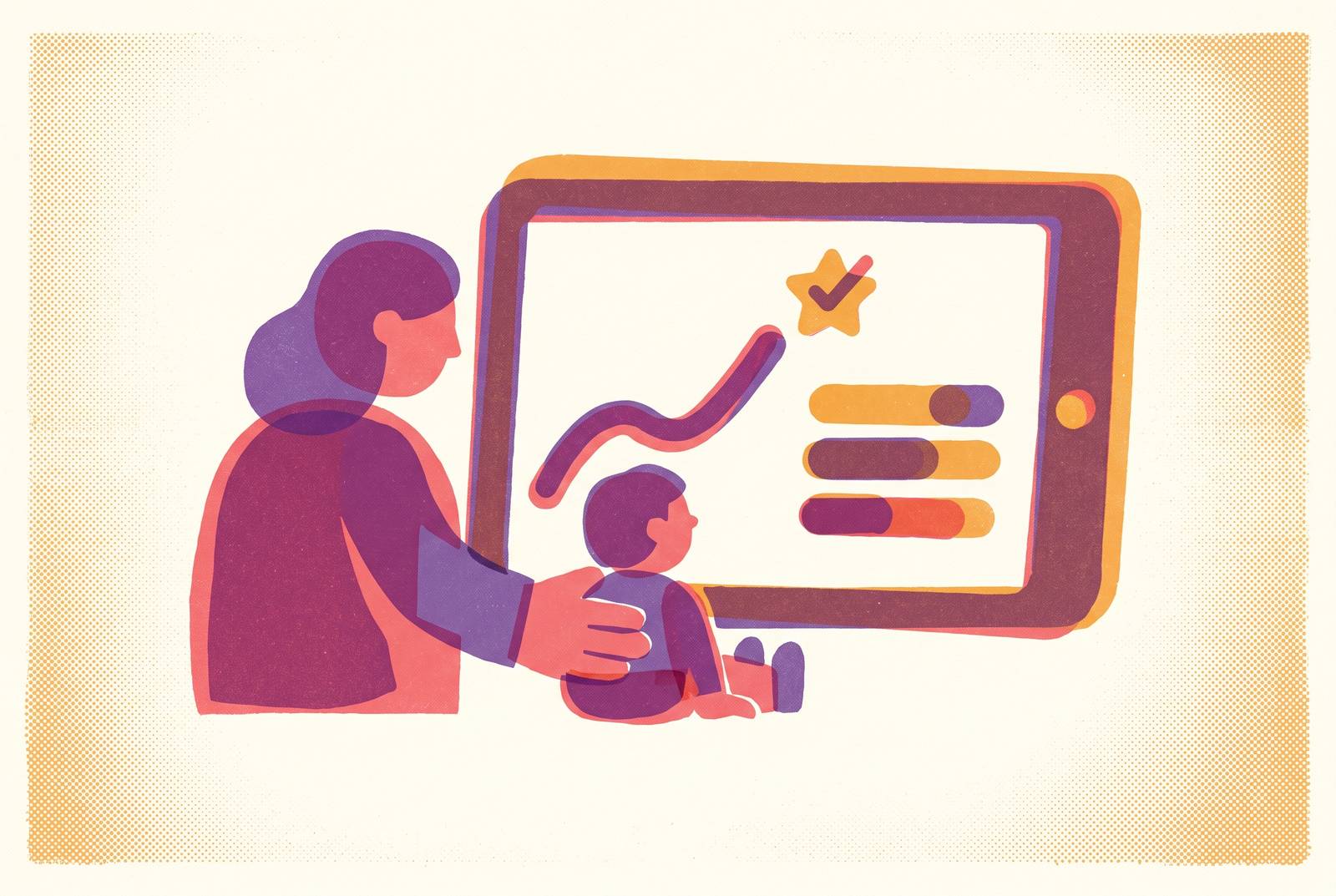
A good progress report in a learning app should tell a parent exactly where a child stands on specific, research-backed skills, not just whether they finished a lesson or earned a badge. The best AI tutors for reading and math, including Ello, do this by tracking component skills like decoding, fluency, and comprehension separately, updating that picture daily, and pointing parents toward what to do next.
A single reading level or score fails to show what a child knows
A parent opens an app and sees "Level 2" or a checkmark next to "Reading Complete." It feels like information. It isn't, not really. That single number or badge can't say whether a child sounds out words slowly but accurately, whether they're guessing at words they don't recognize, or whether they can decode just fine but lose the thread of what a sentence actually means.
NWEA's explanation of the Simple View of Reading makes the problem precise: reading comprehension is the product of decoding (word recognition) and language comprehension. These are two separable strands, and they can fail independently. A child with strong vocabulary but weak decoding looks completely different, on paper and in person, from a child with strong decoding and weak vocabulary. Collapse both of those children into a single reading level, and they look the same. They are not the same, and they don't need the same help.
A child can sit at "Level H" or rack up a badge for "Reading Complete" while still struggling specifically with phonemic awareness, or fluency, or comprehension. The score can't say which. That's the gap this piece is about: the mismatch between what most progress reports show and what reading research says a child's development actually looks like. Parents who see only a level or a streak have no way to identify where help is needed, and kids who need early, targeted intervention in one specific skill often don't get it, because the report never shows the gap.
What reading science says the component skills are
Reading research identifies five distinct components: phonemic awareness, phonics, fluency, vocabulary, and comprehension. They work together, but they develop on different timelines, and each one can become its own point of breakdown. A good progress report has to track them as separate threads, not blend them into one.
Phonemic awareness and phonics sit at the foundation. Systematic phonics teaches children to connect sounds to letters in predictable patterns, a skill described in LiteracyPlanet's 2025 phonics overview as foundational well beyond the early grades, since kids keep leaning on it when they hit complex vocabulary across every subject they study. HMH's explainer on decoding strategies uses Scarborough's Reading Rope to show where this fits: decoding lives inside the word recognition strand of that rope, and when decoding is weak, the whole rope unravels. Kids who can't access words can't get to meaning, no matter how strong their language skills are otherwise. NWEA adds a useful detail here too: screening for phonemic awareness and alphabet knowledge can predict which children are likely to struggle with decoding, even before those children are reading actual words. A report built on that research can flag risk early, not just confirm failure after it's already visible.
Fluency comes next, and it has two parts. NWEA's research on fluency and comprehension breaks it into automaticity (recognizing words accurately and instantly) and prosody (reading with the expression and phrasing that signals real understanding). Both matter, and the mechanism is straightforward: effortful decoding eats up mental bandwidth that a child needs for comprehension. Once word recognition becomes automatic, that bandwidth frees up, and the child can actually think about what the words mean. Fluency is the mechanism that lets decoding turn into understanding. Prosody can only be measured in connected text, not in word lists, which matters a great deal for any app claiming to track fluency.
Comprehension is its own layer, not a byproduct of the other two. Decoding without comprehension produces "word calling," kids who can pronounce every word on the page without understanding any of it. Vocabulary and language comprehension have to be paired with decoding for real understanding to happen. That makes comprehension something a report has to track on its own terms, not something to infer from a decoding score.
Apps built on the Science of Reading, like Ello, which tracks phonemic awareness, phonics, fluency, vocabulary, and comprehension as distinct strands, translate that research into real-time adaptive instruction. Instead of advancing a child forward once a single aggregate score clears some threshold, the adjustment happens based on which specific skill actually needs support.
Why math progress reports need the same component-level thinking
Early numeracy breaks down into separate skills just like reading does: number recognition, counting, cardinality, subitizing, basic operations, spatial awareness, and recognizing patterns. A "math grade" tells a parent about as much as a reading level does, which is to say, not much. It leaves parents just as blind to a specific math gap as a reading level leaves them to a specific reading gap.
The research backing this up is strong. A longitudinal meta-analysis on early numeracy found that early numeracy skills significantly predict mathematics achievement measured six months or later. These component skills aren't just early milestones to check off, they're strong predictors of how a child will do in math down the road. Research on toddler numeracy and mathematical language reinforces the same point from a different angle: early math development is grounded in conceptual understanding built through interaction, not rote drilling. A correct-answer rate on its own is a weak stand-in for whether a child actually grasps cardinality or understands what a number represents.
Just as reading breaks down into separable skills, early numeracy does too, number recognition, cardinality, subitizing, basic operations, and a parent progress report that reduces math to a single grade or score misses the same critical insight that a reading level misses. A child's strengths and gaps in math don't line up neatly behind one number any more than a child's reading does.
The parallel runs even deeper than the skill breakdown. A child can get addition problems right through memorization while having no real grasp of what quantity means, the same way a child can read words aloud with zero comprehension of the sentence. A good report has to separate procedural correctness from conceptual understanding, in math exactly as it does in reading.
Translating skill data into action for parents
Tracking component skills only helps if the report turns that data into something clear and usable. Granular skill data that never gets translated into plain language is just noise with more detail.
A useful report needs three things. It needs a benchmark, because a score only means something next to a developmental expectation: knowing a child reads at a certain pace tells a parent nothing without knowing what pace is typical for that age and grade. It needs a trajectory, since one data point can't show whether a child is improving, stalling, or slipping further behind; progress over time is what turns a snapshot into real guidance. And it needs a suggested response. Research supports specific, targeted intervention for decoding struggles, so when a report flags a gap, it should point toward what to actually do about it, not stop at naming the problem.
This is where the badge-and-streak model falls short. When a progress report measures time-on-task, badges earned, or lessons completed, it hands parents a distorted picture. A child can finish every lesson in a course without mastering a single underlying skill, especially in apps where the gamified design rewards showing up over getting things right. A parent progress report that shows only a reading level or badge leaves the central question unanswered: where exactly does this child need help? That's the gap between what most learning apps report and what parents actually need, a clear picture of which component skills, decoding, fluency, comprehension, are solid and which still need work.
Specific feedback matters here as much as it does in the classroom. Research supports specific feedback over general praise, and that principle applies to what parents see in a report just as much as to what a child hears from a teacher. "Your child decoded multi-syllable words accurately this week" gives a parent something concrete to act on and celebrate. It also reinforces a growth mindset, framing struggle as a normal stage in a sequence. Parent testimonials describing Ello's reports as updated daily, with visible week-to-week improvement, point to what this looks like in practice: a report a parent can actually check in on regularly, not a static summary that rarely changes.
What AI makes possible in progress reporting
AI-driven apps can generate far more detailed progress data than a classroom teacher could produce at scale, tracking which specific phonics patterns trip a child up, how fluency shifts session to session, and how quickly a child moves from effortful decoding toward automaticity. That capability pays off when the curriculum underneath is grounded in real research and the data gets interpreted correctly.
Real-time responsiveness is the genuine advantage. NWEA's fluency research points to guided repeated oral reading and orthographic mapping as evidence-based practices, and both depend on moment-to-moment feedback that a static quiz format simply can't deliver. A listening AI can. Ello, for instance, listens to a child's voice in real time, so its skill tracking reflects actual oral reading performance, accuracy and fluency included. That's a meaningful difference in what the resulting data actually represents.
The limits matter just as much as the capability. An AI-generated report is only as trustworthy as the curriculum model feeding it. If an app's reading model never distinguishes decoding from fluency from comprehension, the AI will produce highly detailed data about an undifferentiated blob called "reading," which ends up no more useful than a single score dressed up to look sophisticated. Parents should ask a direct question before trusting any app's claims: is the curriculum built by educators and grounded in established research, or has AI simply been layered onto content never designed for teaching? That question separates real instructional design from a chatbot wrapped around generic content.
Data privacy deserves a plain mention too. Any app collecting a child's voice or interaction data raises real privacy questions, and parents should ask the same questions of any app before handing over a child's data, checking what gets retained, how it's used, and whether the app's practices fit the age group it serves.
What a good progress report offers parents of struggling readers
For a parent whose child has fallen behind, the frustration is specific. The frustration is watching a child start to flinch at books, start saying "I'm bad at reading," and not having a clear answer to give back. A badge count makes that worse, because it tells the parent nothing about where the actual trouble lives. A good progress report changes that, because it can name the specific skill that's lagging, say decoding unfamiliar multi-syllable words, and that name alone reframes the struggle as a normal, fixable stage.
That specificity changes what a parent can do at home. A parent who can see exactly which skill is developing can spend a few short, focused minutes on something targeted. Praise lands differently too: "I saw you figured out that long word by breaking it into parts" teaches a child that reading success comes from strategy, not some innate talent they either have or don't, and that kind of praise holds up better over time than vague encouragement. A good report also gives parents permission to back off a little. If it shows fluency improving even while occasional decoding errors persist, a parent can let the child keep reading through a mistake instead of stopping to correct every single one, since research suggests constant correction can shut down a child's engagement fast.
For children with special needs or different learning profiles, this kind of reporting carries even more weight. It shows which specific skills are moving forward even when an overall reading level looks stuck, giving parents real evidence of progress that neither they nor the child could otherwise see.
A checklist for evaluating whether a learning app's progress report meets this standard
Parents comparing apps can run through a short set of questions before deciding whether a given progress report actually reflects their child's real skill development, rather than just assuming the data behind a polished interface is trustworthy.
The report should show component skills separately: phonemic awareness, decoding accuracy, fluency, comprehension, and for math, specific numeracy skills. It should benchmark that progress against a developmental expectation, so a parent can tell whether their child's level is on track, ahead, or behind for their age and grade. It should show a trajectory over time, not just a snapshot, so a parent can see whether a given skill is improving, holding steady, or slipping. It should suggest a next step, either something for a parent to try at home or a sign that the app itself is adjusting instruction in response. The curriculum underneath should be built by educators on research-grounded principles, the Science of Reading for reading, established numeracy frameworks for math, so the skill labels in the report map to real developmental science rather than categories a company invented for marketing purposes. The data itself should come from actual performance, oral reading, problem-solving in context, rather than multiple-choice answers or badge counts alone. And the report should update often enough to matter: daily updates give a parent a far tighter feedback loop than a weekly or monthly summary ever could.
Ello meets each of these criteria. Its reading curriculum is grounded in the Science of Reading, and its math curriculum is aligned to Common Core, both built by teachers and subject-matter experts. It listens to children's voices in real time to track oral reading accuracy and fluency directly, and its parent progress reports update daily, showing strengths, development areas, and milestones. Ello is free on iOS and Android, with no ads, and an optional paid premium upgrade for families who want it. Research-grounded design and free access showing up in the same app is the combination to look for, in Ello or in any tool a parent is weighing against it.
Sources
- Supporting fluency and comprehension using practices grounded in the science of reading - Teach. Learn. Grow.
- What the science of reading tells us about how to teach decoding—including phonics - Teach. Learn. Grow.
- Early numeracy and mathematics development: A longitudinal meta-analysis on the predictive nature of early numeracy.
- Frontiers
- Literacy assessment based upon the National Reading Panel’s Big Five components
- Editorial: Letter-sound knowledge, reading, reading comprehension and full literacy
- Developing and validating a measure of parental knowledge about early math development
- Development of numerical relational and counting skills as components of early numeracy - ScienceDirect