How Elementary AI Tutoring Apps Handle the Child Who Is Behind in Reading but Ahead in Math
Skilled AI tutors treat reading and math as separate strengths, not one level.

For a child who is behind in reading but ahead in math, the best AI tutoring setup is one that adapts to each subject separately. With the tools available, a deliberate pairing is the strongest approach, starting with reading support that listens and teaches phonics, then adding math practice based on mastery. A child’s reading difficulty should never set the limit on their math learning.
Why one child can struggle to read while excelling at math
Reading and math depend on distinct cognitive systems that can develop at different speeds. Reading requires a chain of skills, including phonemic awareness, phonics, fluency, vocabulary, and comprehension. These skills need systematic, explicit teaching, and a weakness in one can restrict the whole chain. Being good at math cannot fix that weak link. A child may think well about numbers but still struggle to link speech sounds to written letters.
The Simple View of Reading describes reading comprehension as the product of decoding and language comprehension. That helps explain why being smart does not, on its own, make reading easy. A child may understand spoken language but struggle to sound out the same words on a page because their phonological awareness is weak. NWEA’s explanation of fluency and comprehension describes how effortful decoding uses mental capacity that would otherwise go toward understanding.
Math has its own early building blocks, including number recognition, counting, basic operations, spatial awareness, and patterns. These develop at their own pace, with some overlap with reading, particularly between phonological processing and counting or number identification. But strong spatial reasoning and number sense can coexist with weak awareness of speech sounds. A child who struggles with text while excelling with numbers is not a paradox, and an app should not treat that pattern as one.
How the split-skill child falls through the cracks of one-size-fits-all instruction
A single grade-level setting forces different needs into one box. If the level fits the child’s reading, math may become too easy, leading to boredom and disengagement. If it fits their math, reading may become too hard, so the child gets frustrated and avoids it. The same child can experience both failures. Neither tells the parent much about what the child can actually learn with suitable instruction.
Reading avoidance can also deepen the original difficulty. A child who resists difficult text gets less reading exposure, slowing the development of fluency and orthographic mapping, the process that helps written words become familiar and automatically recognizable. Reading then remains effortful, giving the child more reason to avoid it. A static setting leaves that cycle in place by keeping instruction unchanged even as a specific skill holds the child back.
NYSED’s March 2025 Science of Reading framework calls for formative assessment, differentiated instruction, and scaffolding tailored to learners’ needs and strengths. That standard applies both within reading and between subjects. A child’s vocabulary may be stronger than their decoding, so even a separate reading level is only a starting point. Families who cannot afford separate specialist tutors depend more on one app, so they have more to lose when its single level fails to meet both the child’s weakness and their strength.
What genuine domain-specific adaptation requires an AI tutoring app to do
An app serving this child needs two separate, continuously updated learner profiles, one for reading and one for math. Instruction in each subject must change independently as the child demonstrates progress or difficulty. The test is whether the app can support foundational reading while allowing advanced math, without using performance in one to restrict access to the other.
Within reading, the profile must distinguish phonemic awareness, phonics, fluency, vocabulary, and comprehension. NWEA’s five-component overview explains that no single component is sufficient and that strength in one cannot fully compensate for a gap in another. That makes a broad reading score insufficient. Instruction needs to address the weak component rather than simply offer easier material across the board.
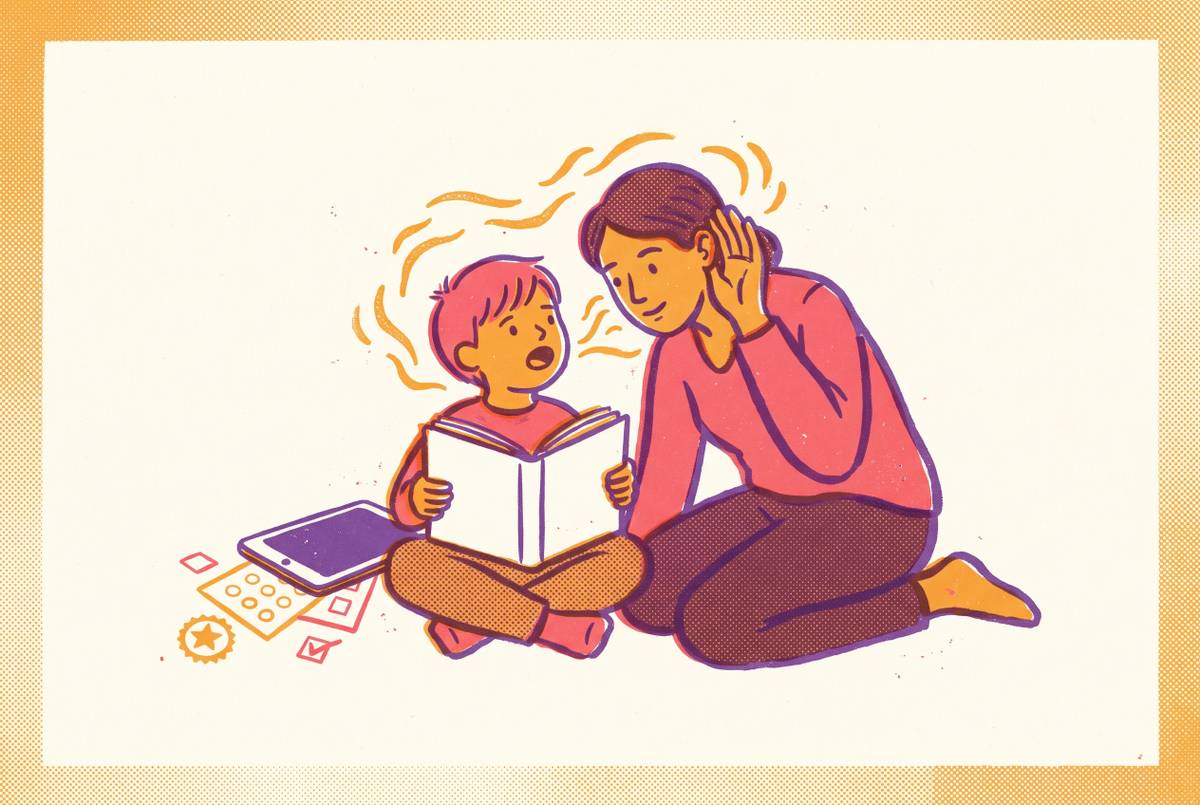
Fluency asks more of the app because it must listen to the child read aloud and respond to accuracy and prosody, the rhythm and expression of speech. A score after a passage is not enough. NWEA identifies guided repeated oral reading as a way to help words move from effortful decoding toward automatic recognition, supported by orthographic mapping. A tutor therefore needs to guide the child as they practise as well as point out slow reading. For math, the corresponding requirement is to adjust problem difficulty and concept order according to demonstrated mastery.
Parent reports must preserve those distinctions rather than collapse them into a reassuring overall score. The hardest requirement goes beyond measuring correct answers, because an app must also detect and respond to frustration, hesitation, and disengagement as they occur. Those states can differ sharply between subjects for this child.
What today's AI tutoring apps actually deliver for the split-skill child
Most available AI tutoring apps specialize in one subject or treat the learner too uniformly across subjects. Very few keep separate adaptive profiles for reading and math that each change on their own. Breadth alone does not close that gap. An app can offer several subjects without tracking the component skills in each or changing how it teaches each one.
DreamBox Math serves K–8 and is available through school licensing and direct family subscriptions. It adjusts difficulty and feedback based on individual student responses, making it a documented option for math practice that responds to the learner. Its scope is also its boundary. The math subscription does not bundle a reading component, so access to it alone leaves the reading gap unaddressed. For a child who is ahead in math, it fills the math role alongside reading intervention in a paired setup.
Khanmigo covers K–12 subjects including math, science, humanities, and coding, and offers a writing coach using Socratic questioning. Its breadth suits a different need. It functions better as homework support for older children than as a phonics-level reading intervention in early elementary school. With limited reading-specific phonics instruction and writing conversations serving a different purpose from systematic decoding practice, its relevance depends on the child’s age and the kind of help they need.
Brighterly combines human tutoring with AI-powered lesson summaries and practice tools across math and reading. That gives it cross-subject visibility that separate tools lack. However, as a human-plus-AI service, it leaves software’s ability to meet the full standard on its own unproven. Its model and pricing place it at the premium tier. The choice across these options is therefore about fit rather than a single winner, while pairing separate tools leaves a further gap because neither knows what the other is doing and no parent report integrates both subjects.
Where AI tutoring genuinely helps and where it still falls short for young learners
AI tutoring’s clearest strength is responsive pacing. It can identify knowledge gaps as they emerge and adjust instruction before misconceptions become established, providing individualized practice at a scale traditional classrooms cannot match. Math tools can change difficulty and feedback in response to performance. That is a real instructional benefit. For a child ready for harder math, responsive practice can offer challenge without waiting for their reading to catch up.
Reading tools can also give phoneme-level pronunciation feedback and track fluency. Generative AI can produce stories matched to a child’s reading level and interests, supporting the repeated reading that helps build automaticity. University of Florida research on fine-tuned language models found that compact models could generate stories with controllable difficulty and outperform larger zero-shot models on difficulty-related measures. The finding shows that text difficulty can be controlled, but it does not prove that generated stories alone can close a child’s reading gap.
Emotional responsiveness remains a much harder problem. Most AI systems cannot reliably interpret the frustration, hesitation, or overwhelm that a human tutor can recognize during a session. An app may therefore miss the moment a struggling reader stops engaging. That limitation is especially serious when reading already brings anxiety or avoidance. Correctly adjusting the next task is useful, but it does not necessarily address the child’s response to doing it.
Young children also cannot judge AI output critically, so they are at greater risk of using a tool to finish work without learning the skill it takes. Reading makes that distinction especially sharp. The child must do the mental work of decoding, even when software provides guidance. Evidence on personalized learning shows gains on average, but the results differ by subject, age, how the teaching is designed, and how well it is put into practice. Math adaptation is more developed, while fully automated reading support remains harder, especially at the phonics level for the youngest learners.
How can parents find a personalized reading and math tool right now?
The practical response is a deliberate pairing, anchored in reading support that works at the skill level. Start with the harder problem to solve. Weak decoding makes it harder to get at content across subjects, while a child who is ahead in math can get enrichment as their reading grows. Among the options described here, there is no established single-app solution that independently adapts both domains to the full standard. The aim is to cover each need well without pretending that two tools become one coordinated tutor.
For reading, choose a tool that listens to the child read aloud and responds at the phonics and fluency level. A content library or quiz app does not provide that kind of instruction by itself. Look for explicit, systematic, sequenced phonics teaching rather than only easier passages or scores on completed work. A tool needs to teach and guide practice when the child struggles.
For math, prioritize independent mastery tracking and access to content above grade level. DreamBox is one documented K–8 option, whether available through a school or a family subscription. The math tool must respond to math performance independently of the child’s reading level. Use the reading tool’s reports for parents to track reading and math progress on two separate trend lines.
At home, the child’s interest in math can also make reading more inviting through math-interest books they can comfortably read or have read to them. Reading together builds oral language and vocabulary and ties reading to something the child enjoys. Match independent reading to current phonics skills. Decodable texts reinforce accuracy and confidence for early readers.
Sources
- 5 science of reading components - Teach. Learn. Grow.
- March 2025 1
- Supporting fluency and comprehension using practices grounded in the science of reading - Teach. Learn. Grow.
- Children's English Reading Story Generation via Supervised Fine-Tuning of Compact LLMs with Controllable Difficulty and Safety