Why a Four Year Old Can Run a Truly Free AI Teaching App Without Adult Help
Voice interaction and real-time error correction let young children learn independently.

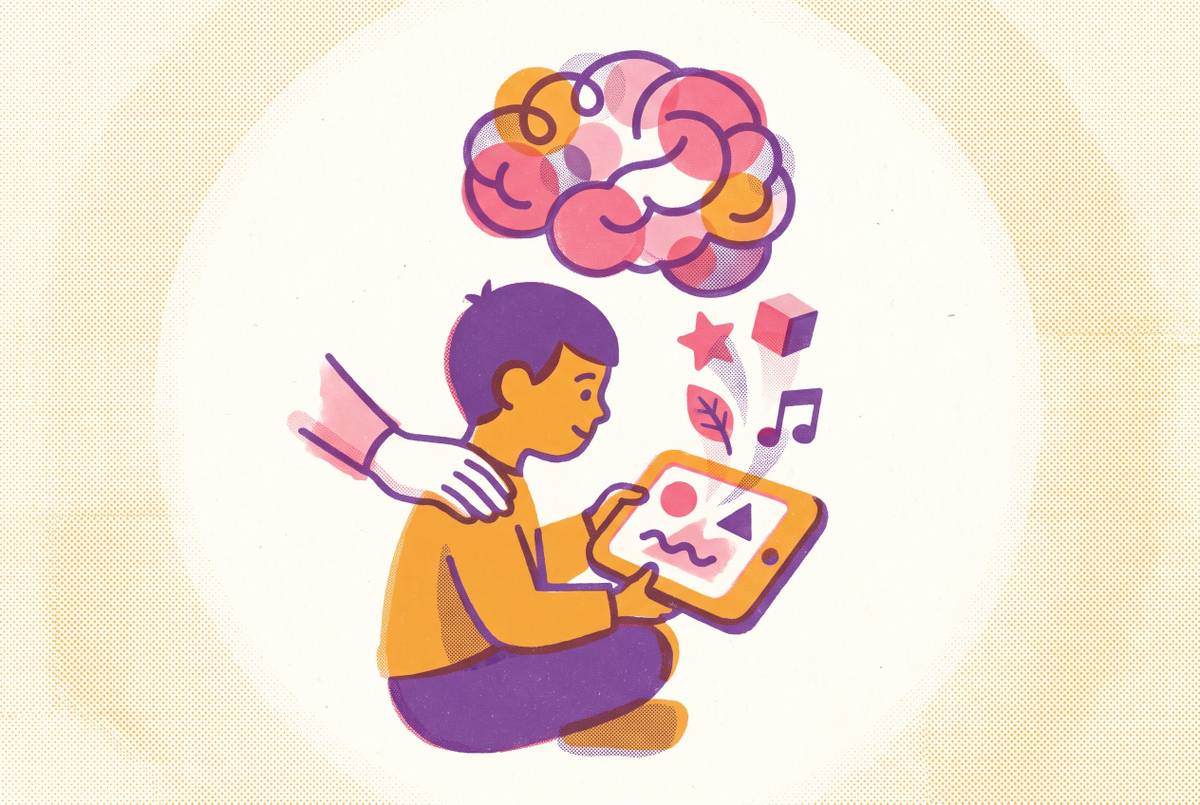
A four-year-old can run a free AI teaching app without adult help when the app uses voice, responds to mistakes in real time, and keeps payment prompts out of the lesson. For families seeking a free AI teaching app for young children, the test is whether the child can keep learning when the adult steps away.
Why four-year-olds can't read a screen but can talk to one
Pre-reading children ages 4–5 have oral language skills but no reliable ability to decode written words. They can hear what to do and answer aloud while still needing someone to read a menu. A child who needs an adult to explain which instruction to follow cannot operate the lesson alone, however suitable its teaching content may be.
Reading is the skill being taught through explicit instruction in how written code works, so a tool for beginning readers cannot depend on that knowledge to get started. Voice interaction removes this circular demand. The child hears a prompt, speaks, and hears an answer, without needing a parent to explain what is on the screen.
That does not mean the screen must stay blank. Letters and words belong on it when they are the objects of instruction. The distinction is between showing a letter to teach its sound and requiring a child to read directions before hearing it.
What independent learning actually requires at age four
Removing the reading barrier does not remove the teaching barrier. When a child struggles, an adult usually does more than say whether the answer was correct. The adult shows how to answer, asks the child to try again, and decides whether to slow down or change the task. An app that merely speaks its instructions takes over the adult’s task of voicing directions.
NWEA describes a research-backed sequence in its discussion of fluency and comprehension. A teacher models the correct decoding of a difficult word, the child reads it aloud, and guided repeated oral reading follows. A voice-interactive app can deliver that sequence by listening to an attempt, providing a correct model, and prompting another attempt at the point of difficulty.
The repetition also has a specific purpose. Reading a word correctly aloud and meeting it multiple times help move it into automatic memory. For independent use, the app must prompt those encounters without waiting for a parent to notice that more practice is needed. Silence or a red X leaves the child with an error but no way forward, while a spoken model supplies the next step.
How the Science of Reading maps onto what a voice app can actually teach
The National Reading Panel identified five components of effective reading instruction, namely phonemic awareness, phonics, fluency, vocabulary, and comprehension. These are connected skills, but they make different demands on a teaching app. Not all are equally straightforward to teach through voice. The strongest fit at age four is that the earliest needs, especially phonemic awareness and early phonics, lend themselves to listening and speaking.
Phonemic awareness means hearing, identifying, and manipulating individual sounds in spoken words. It requires no written text at all. A voice app can present a sound, model it, and listen to the child’s response without asking the child to decode anything. Early phonics links a sound to a letter the child can see. NWEA’s 2025 discussion of decoding explains that pairing sounds with visible letters is more effective than working with sounds alone, so voice-first should not mean voice-only.
As children begin reading words, guided repeated oral reading gives a voice app a way to support fluency. The child speaks, the app listens, and a correct model leads into another attempt when needed. Vocabulary and comprehension need more than accurate sound production. They depend on language comprehension and background knowledge, although an app can still define a word aloud, ask about a story, and hear the answer.
Why the app must adapt in real time, not just adjust difficulty settings
A difficulty setting chosen before a lesson cannot tell an app what just went wrong inside it. It relies on someone having picked the right starting level and stepping in if that level no longer fits. That someone is usually the adult. For a child to continue alone, the app needs to make instructional decisions during the exchange rather than leave the parent responsible for redirection.
But can’t any adaptive app do this? Not if its adaptation depends on results collected at the end of a session or only on button-press answers. Those signals are different from hearing a hesitation, a mispronunciation, or a skipped sound as the child speaks. By listening in real time, a teaching engine can respond while the child is still trying the task. An end-of-session adjustment comes too late to guide that attempt.
A library can offer another activity without accounting for what happened in the last exchange, while a teaching engine changes its next move because of what it heard. NWEA’s decoding discussion emphasizes targeted, early support before children fall behind. Within an independent lesson, that principle calls for ongoing attention to the skill being practiced, with the app deciding when to repeat, slow down, move on, or switch strategy.
The confidence problem: why a child who fears mistakes won't run the app alone
Even a teaching engine that responds to the child can lose them if the way it responds makes mistakes feel unsafe. Some reluctant young readers already think of themselves as “bad readers” before they have received enough instruction to justify any such label. A visible failure signal can reinforce that belief. If an error sends the child searching for a parent or abandoning the session, the app has failed the independence test.
At this age, emotional design is instructional design. A calm model followed by another invitation to try does two jobs at once. It shows the child what to do and keeps the mistake from becoming a reason to stop. No red marks, displayed scores, or penalties are needed to make the correction clear, because the spoken model supplies the information the learner lacks.
Penalty-free repetition is part of this design. Multiple exposures help words become automatically recognizable, so returning to the same word or book can be useful practice. An app that limits or penalizes those attempts works against that learning process.
How parental math anxiety reaches a three-year-old — and why an independent app breaks the chain
Early math skills are strong predictors of later academic achievement, and foundational numeracy develops from birth to age eight. A three-year-old is already inside that learning window. The way math feels during early encounters can therefore shape an experience that begins well before formal schoolwork.
A parent who feels anxious about math may engage less or show more stress when the child struggles. The child does not have to consciously adopt the parent’s view of the subject for that change to affect the learning environment.
An independent app can remove that route during the session. If the app provides the instruction and responds with patient repetition, the child’s immediate math experience does not depend on the parent’s comfort with the subject. The adult’s absence can be an advantage here. It allows a struggle with a concept to remain an instructional problem rather than become an exchange shaped by someone else’s anxiety.
This design argument does not mean an app removes every influence on a child’s relationship with math, or that adult involvement is inherently harmful. It means a well-designed session can keep one source of stress out of the teaching exchange. Independence then offers something more useful than convenience, giving the child room to attempt, miss, and retry without absorbing an adult’s emotional history with the subject.
What "free to use" must mean for a four-year-old's family
“Free to download” answers a different question from “free to learn.” A download price says nothing about whether a lesson will stop at a paywall or redirect a child toward an upgrade. For an independent four-year-old, those interruptions introduce decisions the child cannot evaluate and can require the adult to return.
Children under five cannot reliably tell content from advertising, so a prompt that looks like a story choice or reward may seem to be part of the activity. An interface that makes this distinction the child’s responsibility has added a new barrier after removing the reading barrier.
For children to use the free core, it must run without ads, prompts to buy something, or demands for payment during the session. A clearly optional paid upgrade can exist outside that uninterrupted experience without making the free lesson incomplete in use. For families, affordability and independence meet at the same point, where access to the next teaching step does not depend on payment or adult intervention.
What a parent should look for before handing a four-year-old a device and stepping away
For a parent choosing an app, the practical test begins with voice-first navigation. Can the child start a session, choose a book or activity, and begin without reading a word of directions? A spoken lesson is not enough if the route into it requires text. The child needs control over the session, including setting it up.
Next comes the response to an actual attempt. Does the app listen and redirect within the session, or does it only record an answer for later? The useful evidence is in the exchange itself. A child who needs a word modeled now gains nothing from a dashboard that identifies the difficulty after the lesson has ended.
How the app handles errors needs a close look, too, because responding to a child is not enough to help them. A wrong answer should lead to a patient model and another chance, rather than a penalty or a conspicuous signal of failure. Repetition should remain available without punishment.
Ads, purchase requests, and paywalls all break the promise that the child can continue alone. The relevant boundary is the complete learning session, including what happens when the child needs more practice.
Parent progress reporting should explain what the child practiced, what they mastered, and what comes next. NWEA’s emphasis on targeted early support makes that information useful for judging whether the app is addressing the skills the child needs. The adult’s role shifts from managing every exchange to understanding its outcome, which is the kind of independence a teaching app must earn.
Sources
- What the science of reading tells us about how to teach decoding—including phonics - Teach. Learn. Grow.
- Supporting fluency and comprehension using practices grounded in the science of reading - Teach. Learn. Grow.
- 5 science of reading components - Teach. Learn. Grow.
- Early numeracy development as a foundation of mathematics achievement in primary education - ScienceDirect
- Parental mathematics anxiety is related to children’s mathematical development in preschool and the first school years - ScienceDirect
- Children's perceptions of parents’ math attitude moderate the relation between parents’ math anxiety and children's math anxiety