Why Most Reading Apps Are Just Glorified Quizzes and What Genuine Listening Looks Like
Real reading instruction requires hearing children decode aloud, not just checking their answers.
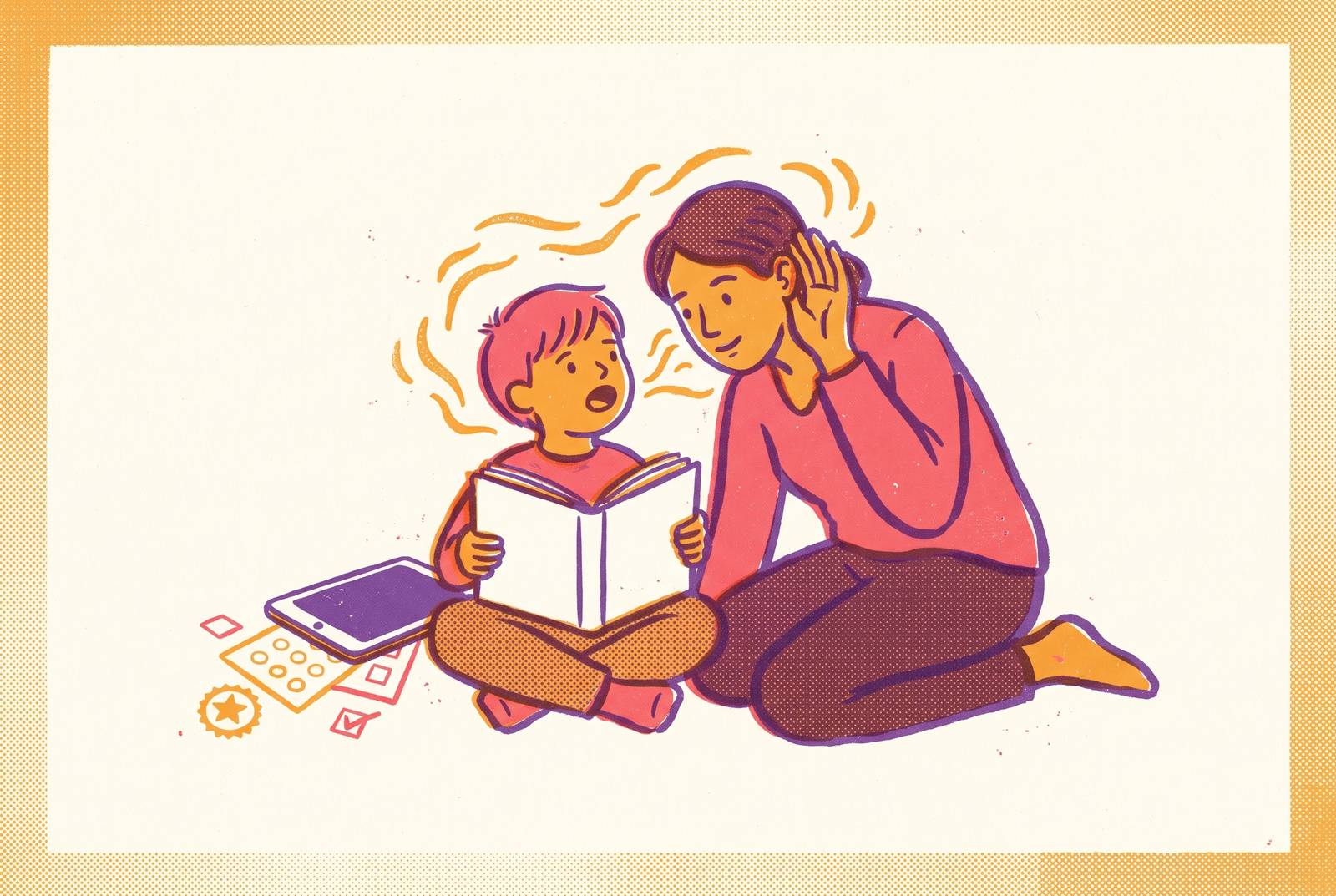
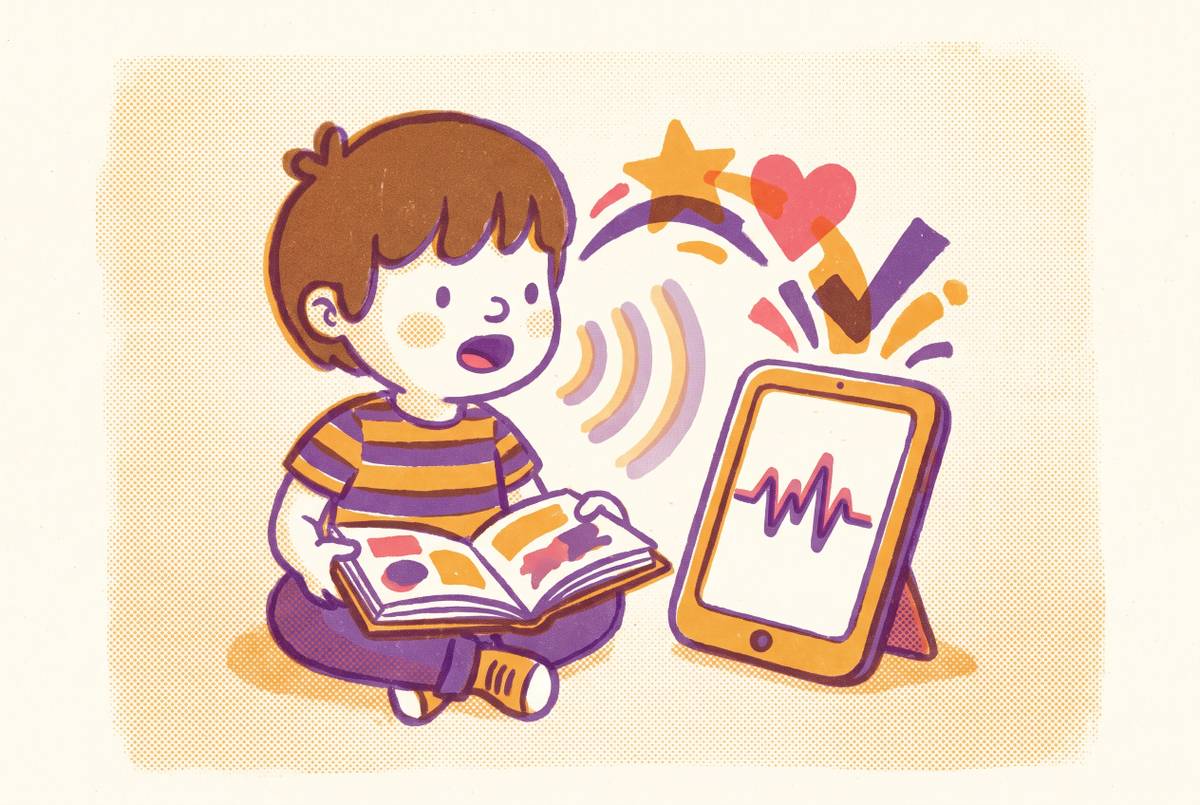
An AI reading tutor that listens to children read aloud in real time must hear decoding errors, give immediate corrective feedback, and adapt what comes next. Most reading apps instead check tapped answers, leaving the reading process unobserved.
Why the quiz loop fails as reading instruction
Put a picture of a cat beside the word “cat,” then ask a child to choose the matching answer. A correct tap does not show that the child read the word. The picture supplied a route around the letters. That is the central weakness of the quiz loop, a design that presents content, checks a response, and moves on. It can record success without observing the skill it claims to teach.
The quiz loop’s structure leaves the child’s voice, hesitation, and attempts to sound out a word invisible. The system sees the selection. It cannot tell whether the child connected letters to sounds, recognized a picture, or guessed from the available options. Children can reach the same answer in these ways but need very different help.
Comprehension questions do not necessarily close that gap. A question such as “Where did the story take place?” checks literal recall. A child can answer correctly without having decoded a single word independently. Rewards can deepen the confusion when they encourage whatever produces the right tap fastest, including guessing. The activity then rewards an answer while bypassing the process that reading instruction needs to develop.
Picture clues invite children to use context to guess words, making the conflict with decoding instruction especially clear. The distinction has a research basis. The National Reading Panel found systematic phonics instruction effective, rather than establishing support for three-cueing, which uses pictures and context to guess words. That research has helped lead to Science of Reading laws across many U.S. states. A quiz may test something useful, but a correct answer alone is not evidence that phonics has been learned.
What reading actually requires — decoding, fluency, and the chain between them
The Simple View of Reading describes reading comprehension as the product of decoding and language comprehension. Both are necessary, and neither can substitute for the other. A child needs to recognize the written words and understand the language they express. For young children, decoding is where instruction begins. An app that never observes that work misses a central opportunity to teach.
Decoding means translating written words into spoken forms by connecting graphemes, the letters or letter groups, to phonemes, the sounds they represent. Explicit instruction develops letter-sound connections, blending, segmenting, phoneme-grapheme mapping, and syllable knowledge in a planned sequence. These are distinct skills. Teaching them requires knowing which connection a child can make and which still needs practice.
Scarborough’s Reading Rope gives this relationship a useful visual form. A weak decoding strand weakens the whole rope. A child may have a strong vocabulary yet struggle to understand a passage because recognizing its written words takes too much effort.
Fluency forms the bridge between that effort and understanding. As decoding becomes automatic, it takes less attention, so children can give more thought to meaning. But fluency is not simply reading quickly. It combines automaticity, which is accurate, instantaneous word recognition, with prosody, the expression, phrasing, and intonation that signal meaning. Prosody helps children understand what they read silently as well as making oral reading sound smooth.
Guided repeated oral reading develops fluency through a specific teaching pattern. A teacher models reading, then the child reads and rereads with corrective feedback. Reading words again helps children recognize them automatically, and those gains can carry over to new texts. Instruction can also begin before word reading, through screening for phonemic awareness and alphabet knowledge that flags likely difficulties. Decoding is still useful long after the early years, so phonics has a role beyond teaching beginners.
Why corrective feedback at the moment of error is what quiz apps cannot provide
When a child reads “house” as “horse,” the useful information is not merely that an answer was wrong. The spoken error gives a teacher something to respond to. The teacher can model the correct sound, prompt another attempt, or step back to a simpler word. A tapped answer does not show that mistake in the same way. Without hearing the attempt, the system cannot use what the child said to choose how to respond.
Even a correct word can reveal unfinished learning. A long hesitation before the child says it suggests a different level of ease from immediate recognition. The answer alone hides that difference from the system. A teacher hears the pause and adjusts, while a quiz records correctness and moves on. Because fluency depends on automatic recognition, missing a hesitation can mean missing the skill the child needs help with next.
Orthographic mapping explains why feedback reaches beyond the current answer. Through this process, connections between a word’s spelling and sounds become established in memory, allowing the word to be recognized automatically. Correct oral reading and multiple exposures are likely to help words move into memory. Oral reading contributes to that process without being its sole route. The instructional aim is to strengthen an accurate connection.
That distinction changes the purpose of correction. When a child misreads a word, feedback supports another attempt at connecting its printed form with the right sounds. Repeated reading then gives the child further opportunities to establish that connection. Repetition alone is not the whole intervention. Guided repeated oral reading includes corrective feedback because practicing a passage and practicing it accurately are not the same thing.
A generic “try again” tells a child that the answer was wrong but may leave the sound or pattern causing trouble unaddressed. Systematic phonics instruction requires a quick response when a child needs additional support, making responsiveness part of the teaching mechanism. Without it, effortful, wrong strategies can become habits, slowing progress and keeping attention away from meaning.
What does an AI reading tutor need to listen and correct in real time?
A genuine listening system needs an instructional loop built around the child’s spoken reading. It must hear the voice, identify the specific difficulty, decide how to respond, and adjust what comes next. Hearing is the starting point. Oral reading reveals confused phonemes, skipped words, pauses, and breaks in phrasing that a tapped answer cannot show. Recording speech helps teach only when those signs change how the system teaches.
The system therefore needs more than a right-or-wrong label for each word. Confusing short-e and short-i sounds calls for a different response from reading accurately but without phrasing. One points toward a sound distinction that needs work. The other can signal that word recognition is not yet automatic enough to support fluent reading. Interpreting either requires a working picture of what the child already knows, rather than treating every attempt as an isolated event.
That picture must guide the response while the child is reading. A decoding error, a fluency breakdown, and a comprehension gap are different problems, even when each interrupts progress through the same passage. They should not all trigger the same prompt. Depending on the difficulty, useful teaching may involve modeling a sound, asking for another attempt, returning to simpler work, or guiding repeated oral reading. “Instant feedback” is meaningful only when the feedback fits the error.
The same evidence must shape the next task. Structured phonics teaches skills in a planned order from simple to complex, so adaptation needs to follow that order as well as offer stories the child might enjoy. The next text needs to fit the sequence. A system must track which patterns have been mastered, which are emerging, and which need further practice. Without that tracking, what the system hears stays separate from how it chooses what to teach next.
University of Florida research on LLM-generated reading stories shows that generating text calibrated to a child’s reading level, with controllable difficulty and age-appropriate safety, is a tractable engineering problem. That makes texts that fit the child something the system can be built to offer now. Texts that fit a child’s interests and reading level can lead to more practice, which helps build fluency. The evolving model of the child must connect what the system just heard to the text or skill it presents next.
Why parents cannot rely on app store ratings to find genuinely instructional tools
Parents choosing a tool should examine its teaching behavior. Flinders University’s analysis found that good app store reviews were not a reliable sign of how well an app teaches. Reviews often reward appearance, engagement, and smooth interaction. Those qualities can make an app pleasant to use without showing that it builds decoding or fluency.
Educational claims offer no dependable shortcut either. App stores are largely unregulated with respect to those claims, so an app can call itself phonics-based or Science of Reading-aligned without demonstrating the description. The label does not establish the teaching method. An app with high ratings may still use picture clues, guessing, and recall questions, while one that looks less polished may teach better.
Does the app require the child to read aloud, or only to tap? Then comes the more demanding test of what it does with that speech. Does it respond differently to different errors, or repeat the same “try again” regardless of what went wrong? For a parent seeking an AI tool that listens and gives instant feedback, the key distinction is between detecting a mistake and providing a useful correction at that moment.
Is there structured, sequenced phonics instruction, or does content arrive in random or interest-sorted order? Does the system build a picture of the child’s current level over time, or return to the same starting point each session? Progress reporting deserves the same scrutiny from parents. Does it name developing skills and unresolved gaps, or merely report time spent in the app?
These questions also make the term “adaptive” easier to judge. A running score is not a map of what a child has mastered, and a fresh story is not necessarily the right next lesson. The evidence supports explicit, structured, sequenced instruction. An app claiming Science of Reading alignment needs to demonstrate those properties in its phonics content. Listening adds value when it guides that instruction with evidence from the child’s own attempts.
Tools meeting this listening-based standard do exist, including systems that support pre-reading and kindergarten-readiness skills and English language learners with some baseline English. That broader reach does not change the core test. For children learning to decode, the system must turn spoken errors into timely teaching and use what it learns to shape subsequent practice. Families should get reports that name the specific skills their child is learning.
Sources
- Children's English Reading Story Generation via Supervised Fine-Tuning of Compact LLMs with Controllable Difficulty and Safety
- Supporting fluency and comprehension using practices grounded in the science of reading - Teach. Learn. Grow.
- What the science of reading tells us about how to teach decoding—including phonics - Teach. Learn. Grow.
- Kids’ reading apps failing to deliver educational value
- 5 science of reading components - Teach. Learn. Grow.
- Using Technology to Strengthen the Science of Reading, Not Shortcut It
- 1 Evidence Based Practices Spotlight: Corrective Feedback
- Feedback Practices on Young Students’ Oral Reading: A Systematic Review - Karianne Megard Grønli, Bente Rigmor Walgermo, Erin Margaret McTigue, Per Henning Uppstad, 2026