Mental Math Strategies Taught in Kindergarten Through 3rd Grade
Building number sense through deliberate stages prepares children for multiplication and beyond.
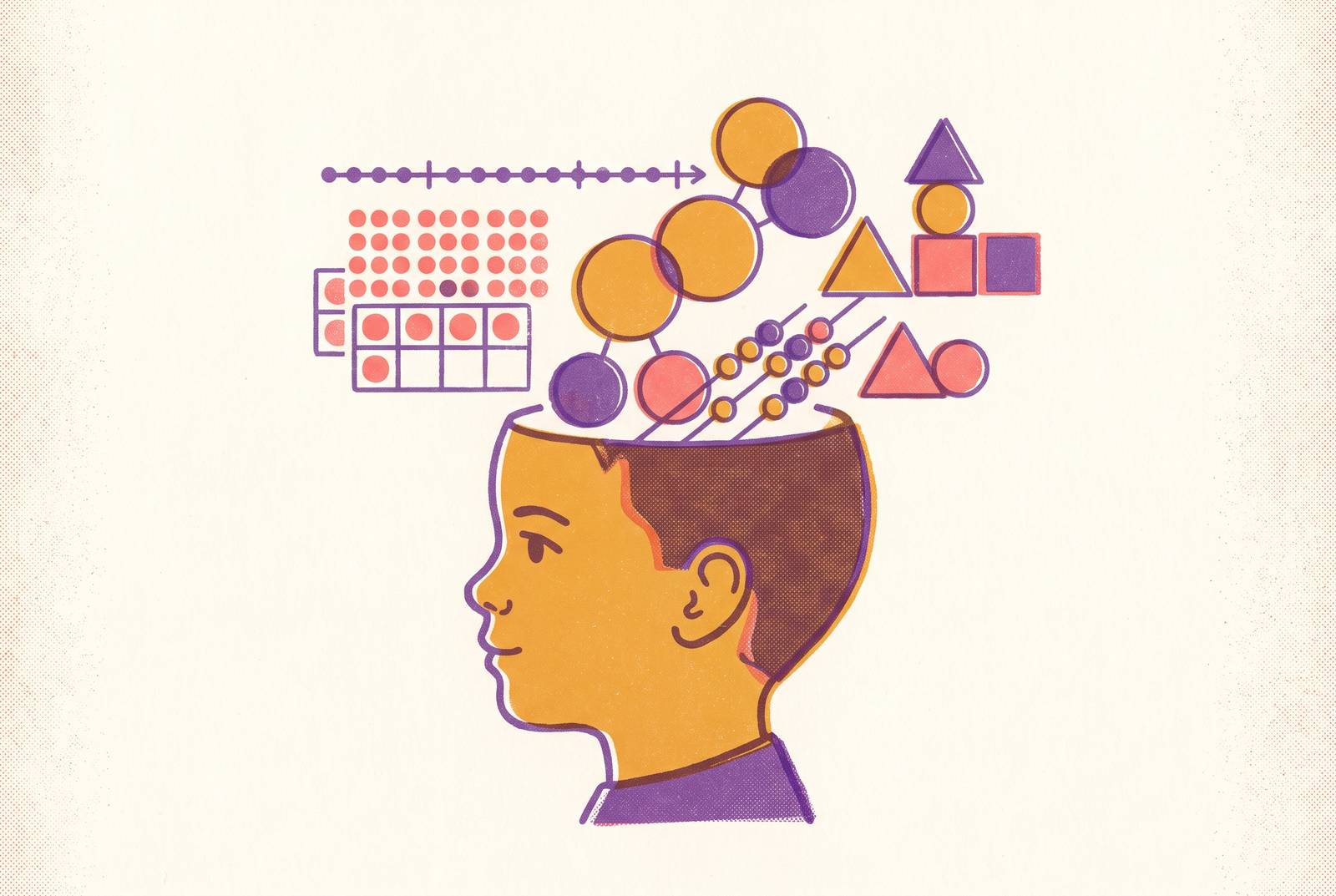
Mental math strategies taught from kindergarten through 3rd grade follow a deliberate progression. Children move from seeing small quantities to breaking apart numbers and choosing efficient ways to calculate. Understanding that sequence helps parents and educators know what to practice and when to move forward. The goal is not merely a fast answer, but an accurate answer reached through a method that fits the numbers.
Why mental math in K–3 is a progression, not a bag of tricks
Parents may wonder why a child is learning several ways to add when they could just memorize the facts. The curriculum is building something broader than recall, namely an understanding of how numbers work together. A child who can break apart a number, use a known fact, and check the result has tools that reach beyond one problem.
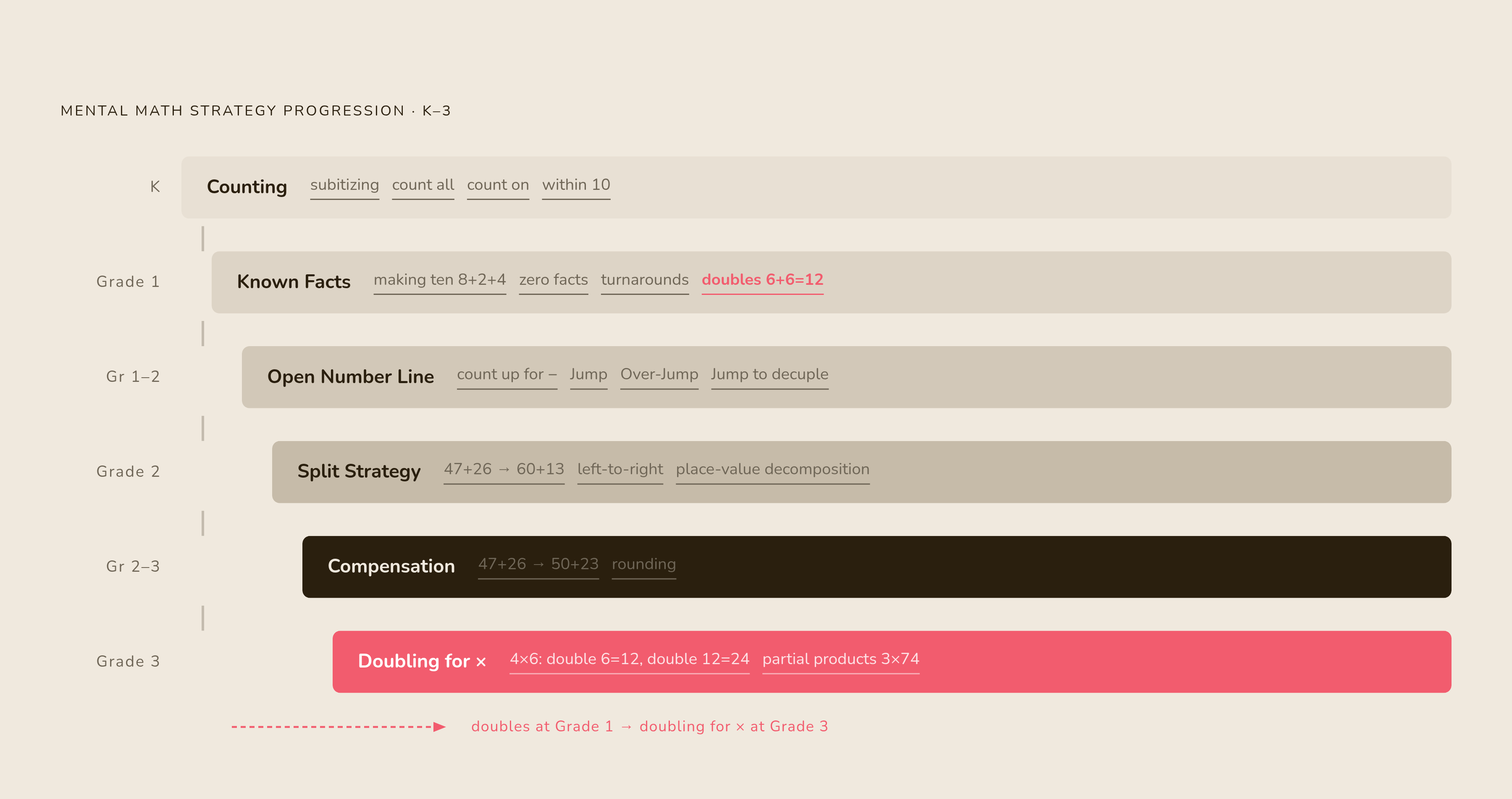
The order matters because each strategy depends on earlier knowledge. Making ten prepares children for compensation, while automatic doubles support later multiplication. Kindergarten begins with concrete quantities and counting, grades 1–2 develop flexible number relationships, and grade 3 extends that reasoning to multiplication. Reading the sequence as a whole makes the purpose of each stage clearer.
The cognitive foundation that makes the progression necessary
Working memory is the mental space a child uses to hold information while doing something with it. Counting all the objects in a problem uses much of that space because the child must keep track of both the count and the task. Counting on reduces some of the work, but it still requires attention to each step. As useful facts become automatic, children have more room to reason about unfamiliar problems. That is why a compensation strategy cannot simply be handed to a kindergartner as a shortcut.
Cognitive scientist Daniel Willingham explains that automaticity with key number facts frees children’s minds to think about concepts. The facts need to become dependable enough to support the next layer of thought. At the same time, children need manipulatives to build the concepts before working entirely in their heads.
Subitizing and counting foundations in kindergarten
A child looks at a dot card showing 4 and knows the quantity without counting each dot. That is subitizing, the ability to recognize a quantity at a glance. It helps children see a number as a unit that can also contain smaller parts. A child still counting five dots individually is not yet using that same view of five as three and two. Holmqvist et al.’s 2026 study identified subitizing as important for detecting early numeracy challenges.
In kindergarten, five frames, dot cards, and rekenreks help children see those relationships. Counting all and counting back give children their first procedures, while counting on begins the move away from tallying every object. Work within 5 and within 10 aims at reliable recognition and beginning decomposition. Tally marks group quantities by fives, and ten frames show the space between a quantity and ten. Children keep using tools like these as they learn new strategies, with ten frames and number bonds helping them along the way.
Making ten, doubles, and the identity property in grade 1
Making ten is the pivot from recognizing quantities to deliberately reshaping a problem. For 8 + 6, a child breaks 6 into 2 and 4, works out 8 + 2 = 10, then adds 4 to get 14. The ten frame makes that move visible, while a number bond shows how one addend has been split. The child uses ten as a stopping point they know well, which saves counting six separate steps. This prepares the ground for regrouping later.
Other grade 1 strategies make known facts do more work. Zero facts express the identity property: any number plus zero stays the same. Turn-around facts show the commutative property, so a child who knows 2 + 3 = 5 also knows 3 + 2 = 5. Counting on becomes more efficient when children start with the larger number and move forward only a few steps.
Doubles provide another dependable base, with facts such as 6 + 6 = 12 practiced until they are automatic. A child can then derive 6 + 7 as one more than 12. Near-doubles show how to build an unfamiliar fact from a familiar double, leaving attention for the adjustment.
Using addition to subtract, and the number-line strategies in grades 1–2
Subtraction becomes easier to understand when it is treated as a relationship between numbers. For 16 − 8, a child can use the known fact 8 + 8 = 16 to find the answer. Counting up uses the same relationship and fits situations such as working out change at a store. Instead of holding a sequence of removals in mind, the child finds the distance between amounts.
An open number line lets children see those distances and moves. In the Jump strategy, children add tens and ones in manageable steps. For 38 + 14, they move from 38 to 48, then to 50, then to 52. The structure works whether or not the calculation crosses a ten. Once the moves are secure, children can carry them out without drawing the line.
Over-Jump deliberately goes too far and then corrects the move. To add 19, a child jumps 20 and comes back 1, while subtracting 29 means jumping back 30 and forward 1. Jump to the Decuple instead starts by reaching the nearest ten. For 49 + 25, the child jumps 1 to 50, then 20 to 70, then 4 to 74.
Place-value decomposition and the Split strategy in grade 2
The Split strategy asks children to work with tens and ones as distinct units, then put the results together. For 47 + 26, they calculate 40 + 20 = 60 and 7 + 6 = 13, then combine 60 + 13 = 73. The difficult step is understanding that the 13 contains another ten and leftover ones. That recombination needs explicit teaching.
Subtraction can expose a gap in that understanding through the “smaller-from-larger” error. A child may report 4 for 4 − 8 by reversing the subtraction when the full calculation requires regrouping. That shows the child is following steps without a firm grasp of place value. The practical response is to return to place-value work with manipulatives before pushing forward. It is a clue about what needs teaching.
A hybrid strategy offers another route when recombination is difficult. Children separate and operate on the tens, then jump the ones on a number line. Left-to-right addition also begins with the largest place value, moving through hundreds, tens, and ones. Both ways let children see the value of each part as they work with larger numbers.
Compensation, friendly numbers, and estimation in grade 2–3
Compensation gives a general name to the adjustment children first encountered through Over-Jump. An awkward number becomes a friendly one, and the child accounts for the change. Transformation can keep the sum the same by changing both addends, so 47 + 26 becomes 50 + 23 = 73. The numbers look different, but the amount added to one has been taken from the other. Children are now deliberately changing a problem without changing its answer.
Rounding uses friendly numbers for a different purpose, which is judging the likely size of an answer. For an estimate, 312 + 453 can become 300 + 450. That calculation provides an approximate sense-check before or after computing.
Estimation is part of judging whether the real math makes sense. The distinction between an estimate and an exact adjustment matters as much as the ability to perform either one. Choosing among Split, Jump, and Compensation shows that a child is beginning to judge the numbers.
Grade 3: partial products, doubling, and the first multiplication strategies
Children draw on how they think about addition when they first learn multiplication. On a number line, 4 × 6 can be shown as four jumps of 6. Children can also use doubling, since double 6 gives 12 and double 12 gives 24. That route depends directly on the doubles work from grade 1. The operation has changed, but the known relationships still do useful work.
Partial products extend the Split strategy to a factor. For 3 × 74, children calculate 3 × 70 = 210 and 3 × 4 = 12, then combine the parts to get 222. When a child explains those partial products, it shows they know why they need to multiply both parts. This distributed thinking forms the conceptual core of the standard algorithm they will eventually learn. It is not merely a way to avoid writing the calculation vertically.
Compensation also carries into multiplication. The calculation 9 × 7 becomes 10 × 7 − 7 = 70 − 7 = 63. A friendly multiplication fact supplies the starting point, followed by a precise correction. From subitizing dot cards to using doubles, splitting tens and ones, and calculating partial products, the child has followed one connected line of reasoning.
Number Talks: the classroom routine that ties the strategies together
Number Talks turn strategy knowledge into choices children can explain. In this brief daily routine, a teacher presents a problem, children solve it mentally without pencil or paper, and then share their approaches. The teacher records the different solution paths on the board. Acting as a scribe rather than a judge makes room for several valid methods. Comparing those methods reveals why one may suit the numbers better than another.
The routine starts with thinking aloud so children can hear each step. The problem then changes with the grade, from kindergarten dot cards to grade 3 multiplication that invites partial products, doubling, or compensation. Parents can use a low-pressure version at home by posing one problem and asking how the child thought about it. Any valid reasoning is welcome, because explanation matters.
What math anxiety has to do with strategy instruction, and how to avoid feeding it
When speed becomes the only measure of success, a child who is building sound reasoning can still feel like a failure. Timed tests can contribute to that pressure. Anxiety can then increase avoidance of situations involving numbers. Teaching strategies helps a child's confidence hold up because they have another way to try when one method is hard. The answer matters, but so do choosing a method, explaining it, and checking it.
Carlo Tomasetto’s research team found a link between the math anxiety parents said they felt when their children were three and weaker early numeracy skills in the children. That finding points to the everyday atmosphere around math. Researcher Kinga Morsanyi of Loughborough University, a contributing co-author, says a first step is to stop talking about math in negative ways. Parents can acknowledge difficulty without making it sound like proof that someone cannot do math.
When a child is ready to move forward — and when to revisit an earlier strategy
Readiness depends on the strength of the building blocks. A child is ready for the next layer when the current strategy is secure enough to explain and use flexibly. Checking whether an answer is reasonable is another sign of that control. A correct answer reached only through laborious counting does not show the same readiness. The mental work the child still has to do at every step matters.
Persistent finger-counting for facts within 10 in grade 2 points back to doubles and making-ten work. The smaller-from-larger subtraction error calls for place-value decomposition with manipulatives before compensation. When a child has trouble estimating before computing, they may need more time on number-line and rounding work. These signals make practice purposeful by identifying the earlier skill that needs attention. The progression is a ramp, and moving forward becomes easier when the ground beneath the next step is secure.