How Real-Time Listening Separates True AI Reading Tutors From Quiz-Style Reading Apps
Real-time listening lets AI tutors respond to decoding mistakes as they happen, not after the fact.
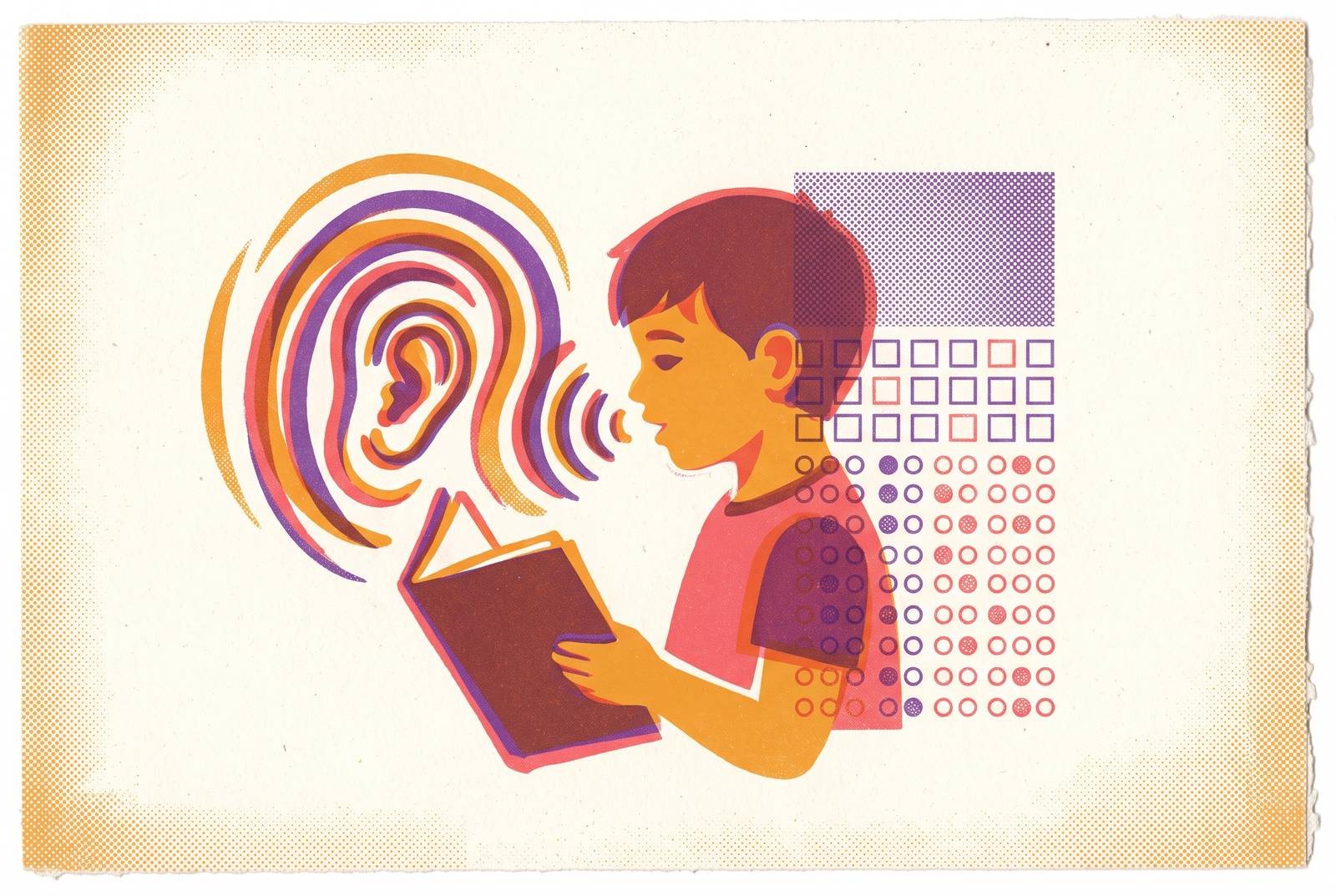
For a parent choosing a personalized AI tutor, the decisive reading feature is whether it listens to the child read aloud and responds during decoding. A quiz-style app can check answers without hearing how the child reached them. This article explains that distinction for reading and why real-time listening is necessary for an AI reading tutor, while proof of good instruction requires more than real-time listening alone.
How children actually learn to decode words, and what can go wrong
The Simple View of Reading describes reading comprehension as the product of decoding and language comprehension. Decoding means turning print into sound, while language comprehension means understanding the words and ideas that those sounds carry. Strong vocabulary cannot make up for an inability to work out the words on the page, even when the child would understand the same passage read aloud.
Systematic, explicit phonics teaches the relationships between letters and sounds that make decoding possible. A child may use the first letter to guess a word that fits the sentence, without checking the remaining letters. Another may name something in the picture and keep going, treating a plausible answer as a successfully read word. Memorizing words by shape can also resemble reading without giving the child a dependable way to tackle unfamiliar print.
Fluency develops as decoding becomes accurate and automatic. The child no longer has to spend so much attention working out each word, leaving more attention for meaning. Fluency also includes prosody, the phrasing and expression that make oral reading sound like connected language. Speed alone is not the goal of practice. Reading aloud gives children practice turning print into sound and makes that process audible, including the places where it breaks down.
Why the moment of error during oral reading is the most instructionally important moment
A reading miscue is more than a wrong answer. A substitution, skipped word, false start, or hesitation gives a listener evidence about how the child is trying to read. Replacing a word with another that begins with the same sound can signal reliance on the first letter. Skipping a word can signal avoidance, while self-correction can show that the child is beginning to notice a mismatch between the spoken word and the print.
A pause at a consonant cluster points toward a different teaching need from repeated trouble with a vowel digraph or a multisyllabic word. Feedback at that point can address the decoding attempt while the child is still making it, rather than returning to the passage after the reading is over.
Social pressure can make those attempts harder to interpret. NWEA describes “itchy reading behavior” during oral reading, including rushing, guessing from the first letter, and watching an adult’s face while looking away from the text. Children may act this way during round-robin reading, timed checks, or even bedtime reading. A child may look more capable through memorization or less capable through stress.
A post-reading quiz can reveal whether a child selected the right answer, leaving unresolved whether the child hesitated, guessed, or corrected a word along the way. A recording can preserve the reading for later review, but it cannot make that review happen during the original attempt. Software that is not listening cannot respond to the decoding event as it unfolds.
What quiz-style reading apps can and cannot see
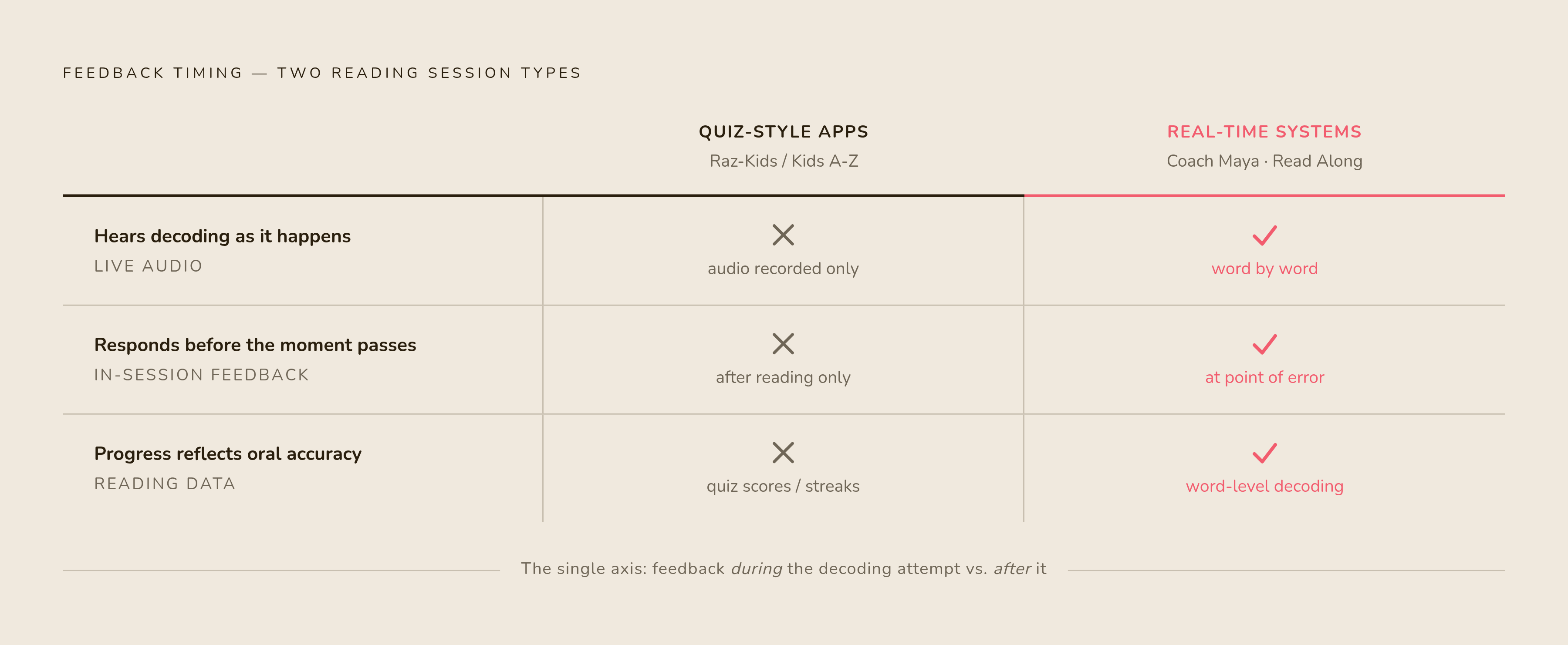
Quiz-style apps generally track what children do around or after reading. Their interactions can include listening to narration, tapping pictures, and choosing from three possible answers. A child can do those things without reading a single word aloud. Even a correct answer about where a story took place may come from the narration or illustrations.
Completion rates, quiz scores, and streaks describe activity or performance on the app’s tasks. They do not necessarily describe the child’s ability to read unfamiliar print. A strong comprehension score can coexist with weak decoding when context and pictures supply enough information. If the activity rewards guessing without requiring sounding out, it can also reinforce the workaround that phonics instruction is meant to replace.
Kids A-Z, including Raz-Kids, illustrates a different approach within this category. Children can record themselves reading aloud, and teachers can listen back later. That recording gives a teacher access to evidence that a quiz alone would miss. The delay is the key distinction here. Correction depends on a human reviewing the audio after the fact, rather than the software responding during the reading itself.
These apps still make useful contributions to learning. Repetition, sequencing, hearing new vocabulary, and game mechanics can give children reasons to come back and practice. Those benefits should not be dismissed because they are not live decoding instruction. The fair comparison is between what each activity teaches and what the child needs, rather than between a supposedly useless quiz and an automatically effective listener.
What a real-time listening system is actually doing word by word
A real-time listening system follows the child’s position in the text as speech arrives. It maintains a running prediction of which printed word the child is producing and looks for departures from the expected reading. Those departures are potential miscues. False starts, repetitions, and skips become useful signals.
Ohio State University’s 2023 research describes a pointer-network approach that predicts a reader’s position directly from streaming speech. Instead of requiring a separate automatic speech recognition step first, the model learns to point to the relevant place in the text. This approach aims to reduce tracking lag. The researchers reported 77.1% tracking accuracy on children’s speech in the CMU Kids dataset, a measure limited to following the text in that study.
NWEA’s Coach Maya, inside MAP Reading Fluency, listens and gives brief help during oral reading in English or Spanish. Its feedback targets phonemic awareness, decoding, fluency, vocabulary, and comprehension. Read Along by Google has a character, Diya, who helps children with accuracy, pacing, and difficult words as they read. It also works offline after stories are downloaded. That makes live listening practice possible for families without reliable connectivity.
The listener’s social role can also affect practice. The University of Chicago’s Human-Robot Interaction Lab found lower observable anxiety and greater willingness to persist through mistakes among children reading to a non-evaluative robotic companion. That finding helps explain why a listener without visible disappointment can be useful. Carnegie Mellon’s Project LISTEN showed decades ago that oral reading with computer-based feedback could lead to gains that could be measured. The architecture predates the current AI label.
The real limits of real-time listening — what the technology still cannot do reliably
Children’s speech is harder for software to process than adult speech. As children grow, their voices vary in pitch, rhythm, and intonation, and systems trained mainly on adults make more mistakes with younger readers. The Ohio State tracker reached a best tracking accuracy of 87.8% on adult speech, with lower performance on CMU Kids and lower still on the Reading Races children’s dataset. Following fluent adult speech is a different challenge from tracking a child who hesitates, repeats, or restarts.
Stellenbosch University’s research on isolated-word reading assessment found much the same trouble. Even with strong learned speech representations, the system performed much worse on children’s speech than on adult speech. Accents, speech differences, and background noise can cause more trouble. A system may mark a correct pronunciation as wrong or miss an error. Either mistake can distort both the feedback the child receives and the progress information shown to parents.
A quiz-style app used with an attentive parent who hears and corrects miscues may support more learning than a listening AI used alone. In that setting, the parent supplies the missing instruction. The comparison is therefore not simply between two apps, but between two whole reading sessions. Listening AI has its clearest advantage when an adult cannot sit beside the child.
A tutor certified in a structured-literacy method can diagnose a significant decoding gap and adjust instruction in response to the child’s understanding and emotional state. Current software cannot reliably reproduce that judgment. Real-time listening closes an important gap in unattended practice, but it does not close every gap between an app and skilled teaching.
How multilingual learners and anxious readers are differently served by listening versus quiz apps
For a multilingual learner, unfamiliar vocabulary and the pressure of reading in front of someone can arrive together. NWEA draws on Krashen’s affective filter concept to explain how anxiety can interfere with processing and internalizing language. The child may know how to decode a word in calm conditions but struggle to access that knowledge under scrutiny. A caring adult can still feel like an evaluator. Visible hope or disappointment can turn practice into a performance.
That pressure also affects developing readers with dyslexia and children who become anxious whenever reading exposes a struggle. A quiz can let them complete an activity without confronting the difficult spoken attempt. A listening tutor offers a different possibility. The child can try the word, get feedback, and try again without watching another person’s face. Feeling more at ease may also make children more willing to do oral practice that helps them learn.
Coach Maya’s English and Spanish support can help bilingual families and English learners who already know some English. But even when a system supports a language, it may mishear some accents. A system that repeatedly mishears correct speech can recreate the discouragement it is meant to reduce.
For parents, the useful comparison is how the child reads alone and in front of others. More willing, accurate, or fluent reading in private suggests that pressure is obscuring at least some of the child’s skill. It does not rule out a decoding difficulty. A non-evaluative listener may help the child show that skill, while trouble that lasts still calls for a look at how the child is being taught.
How do you choose a personalized AI reading app for your child?
First, check whether the app listens to the child read aloud in real time. Recording for later review is not the same thing, and neither are tapping, swiping, or answering questions after a story. “Adaptive learning” does not settle the question either. The practical distinction is whether the app can hear a decoding attempt and respond before that attempt has become another completed activity.
Listening then needs to pass an instructional test. The program should be grounded in systematic, explicit phonics and phonemic awareness, rather than rewarding guesses from pictures or context. Parents should also ask whether what the app hears changes what it teaches next. Detecting speech is not enough on its own. A system that merely logs completion is not providing the same service as one that responds to a specific reading difficulty.
Progress reporting should make the learning visible. Parents should be able to see how their child is doing in phonemic awareness, decoding accuracy, and fluency, rather than seeing only minutes used or a streak counter. Access needs a separate check. Some listening tools are school-licensed rather than directly available to families, while Kids A-Z access is often school-mediated. Read Along is free and consumer-downloadable, which gives it a different place in a family’s choices.
A struggling reader needs help with the phonics concept that is breaking down, while a reader who is on track may benefit from practice that builds automaticity. Oral reading with feedback at the right time can help both. But several months of consistent practice without measurable progress calls for a human specialist who can diagnose the gap and change the instruction.
Sources
- How AI tutors can lower the stakes for emerging and multilingual readers - Teach. Learn. Grow.
- End-to-End real time tracking of children's reading with pointer network
- Towards few-shot isolated word reading assessment
- ISCA Archive - Refined Analysis of Reading Miscues
- What’s in a Word? Analyzing Students’ Oral Reading Fluency to Inform Instructional Decision-Making - Jessica R. Toste, Sally K. Fluhler, Emily A. Farris, Brennan W. Chandler, 2025
- Analysis of Automatically Detected Miscues in Oral ...
- Improving Child Speech Recognition and Reading Mistake Detection by Using Prompts
- Automatic reading tutoring using dynamically built language model