Reading Comprehension Strategies for Early Elementary Children
Decoding and language comprehension must work together for reading to make sense.
Reading comprehension in early elementary is the actual destination, the point all the earlier work is aiming for, not a bonus skill tacked on after a child learns to sound out words. Most parents assume that once a kid can decode, understanding follows automatically from practice. It's a reasonable guess, and it's wrong often enough that it catches families off guard when a child reads a passage out loud without stumbling and then can't say what it was about.
That gap has a name and a formula behind it. The Simple View of Reading, laid out by Cabell and Espittia in the Oklahoma Education Journal in 2025, holds that reading comprehension equals decoding multiplied by language comprehension. Both factors have to be present, and weakness in either one puts a ceiling on the outcome, no matter how strong the other one gets. A child can decode every word on the page correctly and still walk away with almost nothing, if the language comprehension side is thin.
None of this happens by accident. Reading is not something the human brain is wired for the way it's wired for spoken language. It has to be taught, explicitly and directly, and that insight sits at the center of what's now called the Science of Reading, a body of work built across decades of research in cognitive science, linguistics, psychology, and neuroscience. Speech develops on its own if a child is exposed to it. Reading doesn't.
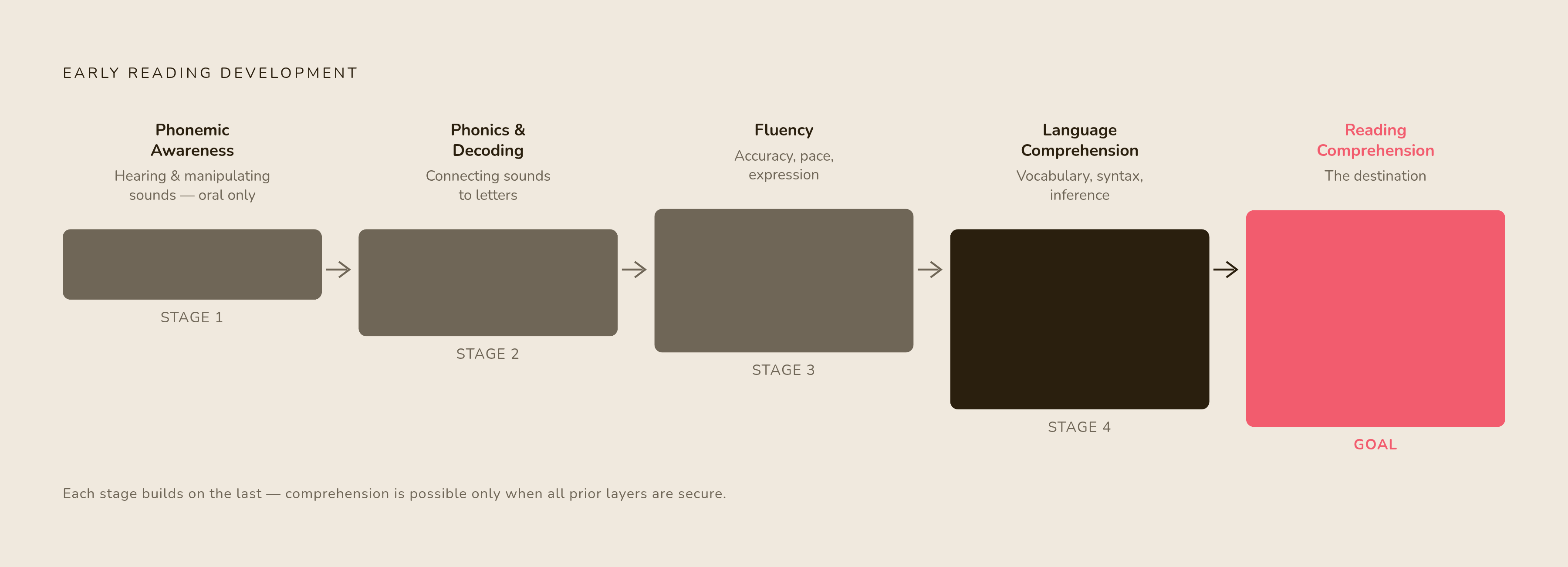
What follows traces that sequence step by step: phonemic awareness, then phonics and decoding, then fluency, then language comprehension, with comprehension sitting at the far end as what all of it is for. None of this is meant to alarm anyone. It's meant to clarify, so that parents and teachers know exactly which stage a child is working through and what to actually do about it.
What phonemic awareness and phonics actually do in the early stages of learning to read
Phonemic awareness comes before letters even enter the picture. It's the ability to hear, isolate, and play with individual sounds in spoken words, and it's entirely an oral skill. A child working on phonemic awareness might pick out the first sound in "dog," blend three sounds together to make a word, or break "cat" apart into /k/, /a/, /t/. None of it involves print yet. A child who can't hear those sounds separately has nothing to hook letters onto once letters show up. This piece comes first in the sequence, and skipping it causes problems later.
Phonics is the next layer: connecting those sounds (phonemes) to the letters and letter patterns (graphemes) that represent them, in ways that are systematic and predictable rather than random. It is not about guessing a word from a picture or from the surrounding sentence. It's an intentional, taught skill, built through direct instruction rather than absorbed by exposure. Research from NWEA in 2025 found that pairing sounds with the actual letters during instruction works better than teaching sounds in isolation. Phonemic awareness and phonics reinforce each other when they're taught together.
Kids move through recognizable phases on the way there. Cabell and Espittia describe a pre-alphabetic phase, where a child recognizes "stop" because of the red octagon shape around it rather than the letters inside it, followed by a partial-alphabetic phase, where the child starts to grasp that letters actually map to sounds. That shift, from shape-recognition to sound-mapping, is the real beginning of reading.
Good instruction reflects all of this in its structure. Skills get introduced in a planned order, simple patterns before complex ones, and new material stays connected to what came before it: kids review previously taught sounds before a new pattern gets layered on top. Practice can and should feel like play, a design choice meant to keep a five- or six-year-old engaged through repetition. At home, watch for whether a child is actually sounding out letters or quietly guessing from the picture on the page. That difference is often the earliest signal of where instruction needs more attention.
How decoding clears the path to comprehension by freeing cognitive resources
Picture a child putting real effort into every single word: pausing, sounding it out, trying again. That effort has a cost, and the cost comes out of the same mental budget the child would otherwise spend on understanding what the sentence actually means. When decoding is labored, there's almost nothing left over for meaning. Once decoding becomes automatic, though, that cognitive load lifts, and the mental resources it used to consume get redirected toward the thing reading is actually for: making sense of the text.
Decodable texts exist to build that automaticity on purpose. These are books written to match the specific phonics patterns a child has already been taught, rather than throwing unfamiliar spelling patterns at them before they're ready. A text only counts as truly decodable if the child has already learned the sound-spelling correspondences it uses, and if the irregular words inside it have already been introduced separately. Used this way, decodable readers aren't busywork. They're where phonics lessons get transferred into actual reading, under conditions where the child can succeed.
Skip this foundation, and kids often default to what's called three-cueing: leaning on pictures or context clues to guess at words instead of decoding them. It can look like reading, for a while. Early books have big illustrations and predictable sentence patterns, so guessing works often enough to seem like progress. Then the pictures disappear, the vocabulary gets less predictable, and the strategy collapses, because it was never actually decoding to begin with.
Policy has caught up to this. Oklahoma's Strong Readers Act, effective at the start of the 2025-26 school year, explicitly bans the three-cueing model in classrooms. New York Governor Hochul's Back to Basics Reading Plan calls for every district in the state to adopt evidence-based methods by 2025. That's not bureaucratic noise. It reflects what the research has established about how much damage guessing strategies do once the training wheels come off.
Which puts parents in an odd spot sometimes. Telling a struggling reader to "look at the picture" or "guess from the sentence" feels supportive in the moment. It can also undercut the decoding work the child is doing at school, so the more useful move is usually to slow down and sound the word out instead, even when that takes longer.
Fluency as the bridge between sounding out words and actually understanding them
Fluency gets mistaken for speed constantly, and that's a shame, because speed is only one piece of it. Real fluency means reading with accuracy, pace, and expression, so the words come out sounding like actual spoken language rather than a flat recitation. A fluent reader's voice rises and falls the way a sentence's meaning demands it to.
That expressive quality is the mechanism. Once a child reads accurately and at a natural pace, attention finally has room to track meaning across a sentence, then across a paragraph, and comprehension becomes possible in a way it wasn't before. Before that point, working memory is too busy holding individual words together to connect them into an idea.
Disfluency in early elementary has a recognizable shape. It sounds choppy, word by word, with the child re-reading the same line more than once and losing the thread of what a sentence meant by the time they reach its end. Building fluency out of that state takes repeated exposure to texts the child already knows. Read-alouds from a fluent adult model the expression and phrasing a child eventually starts to copy on their own. Oral reading with real-time feedback matters too, because it's often the moment a child first notices, on their own, that what they just said didn't sound like normal speech.
Evidence gathered by AERO, cited via LiteracyPlanet in 2025, found that kids who master foundational decoding early are more likely to grow into fluent readers who carry that confidence and understanding across every subject, not just reading class. Racing through a page fast with no expression isn't fluency, it's just speed, and speed without accuracy or natural phrasing does nothing for comprehension. A child who reads correctly but sounds robotic or monotone the whole way through deserves a closer look. That flatness often means the child is decoding without comprehending yet, which is a cue to shift the focus toward meaning rather than more speed drills.
Language comprehension: the second strand that decoding alone cannot replace
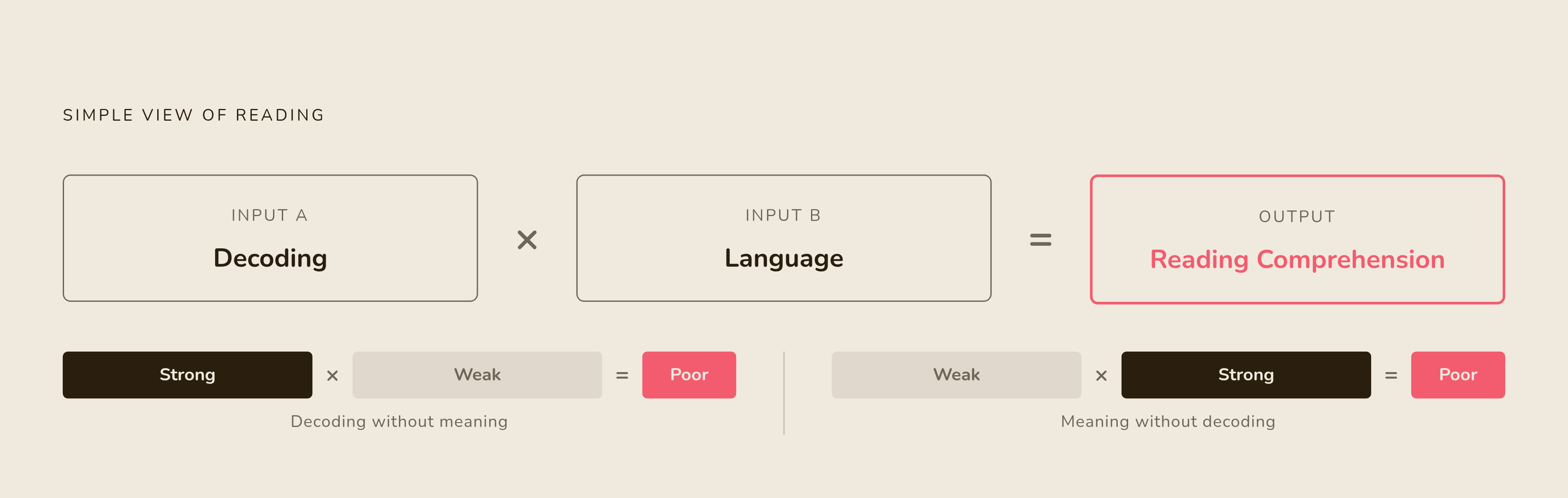
Go back to the formula: decoding times language comprehension. Both sides have to hold up their end. A child with excellent decoding and weak language comprehension still ends up with poor reading outcomes, because multiplication punishes a zero (or a near-zero) on either side, no matter how large the other number gets.
Language comprehension covers more ground than people usually assume. There's vocabulary, which is knowing what a word means and not just how to say it out loud. There's syntax, the way sentence structure itself carries meaning, including trickier constructions like passive voice or subordinate clauses. There's inferential thinking, reading between the lines for what a text implies without ever stating it outright. And there's background knowledge: a child reading a passage about oceans needs to already know something about oceans for that passage to land, since prior knowledge shapes how much a reader can actually pull out of any given text.
Instruction hasn't caught up evenly across these areas. A survey run by the Thomas B. Fordham Institute and RAND Corporation, polling more than 1,200 K-3 teachers in the fall of 2025, found that phonics and phonemic awareness got "a lot" or "some" focus in science-of-reading professional development, at 84% and 83% of teachers respectively https://www.edweek.org/teaching-learning/how-the-science-of-reading-is-reshaping-teaching-what-the-data-say/2026/04. Reading comprehension, vocabulary, oral language, and content knowledge all scored lower. Decoding is getting the training dollars and the classroom hours. Language comprehension, the other half of the equation, is getting less deliberate attention, and that imbalance produces the gap this piece keeps circling back to, visible when children read fluently but cannot explain what they read.
Interactive read-alouds are one of the highest-leverage tools available for closing that gap, at school or at home. A read-aloud that pauses to ask questions, explain an unfamiliar word, or connect an idea back to something the child already knows does more for language comprehension than simply finishing the book. Background knowledge, in particular, builds up over time through content-rich reading, which is a reminder that what a child reads matters just as much as how often they read. A richer vocabulary makes more books accessible, and reading more books builds more vocabulary. Parents can speed that loop up through ordinary conversation at the dinner table, not only through book time.
Comprehension strategies that early elementary children can actually use
None of what follows is a test-prep trick. These are habits of mind, and like any habit, they get stronger the more a child actually uses them while reading.
Before a book even opens, activating prior knowledge sets the stage. A simple question like "what do you already know about this?" surfaces whatever background the child already has and gives the reading a purpose before the first page turns. For early readers, a picture walk, previewing the illustrations before reading the words, builds context in a useful way.
During the reading itself, monitoring comprehension in real time is the harder skill to build, and also the more valuable one. Teaching a child to notice when a sentence has stopped making sense, and to treat "does that make sense?" as a running self-check, gives them a tool they'll use for the rest of their reading life. Good readers re-read a confusing line all the time, and it isn't a sign of failure. Visualizing what's being described, forming an actual mental picture, works especially well with stories. Asking questions of the text itself, like why a character made a particular choice, builds the inferential muscle that plain decoding never touches.
After the reading ends, the work isn't over. Retelling a story in order, what happened first, then, and finally, builds a sense of narrative structure. Connecting the story to something the child already lived through, or to another book they've read, deepens both meaning and vocabulary retention. Conversation about the book does more here than a quiz ever will, because it works the same comprehension muscles an interactive read-aloud does.
Age matters for how these get applied. For four- and five-year-olds, these strategies stay mostly oral, with an adult carrying most of the scaffolding. Kids ages 6–9 can start applying the same strategies with more independence, whether reading silently or with a partner. Letting kids co-create stories, inventing their own narrative rather than only consuming someone else's, is another strategy on its own. Building a story from scratch forces a child to work out structure, vocabulary, and cause and effect from the inside, which is a different kind of comprehension practice than reading alone provides.
Why some children struggle with comprehension even after decoding improves
Some kids can decode a page flawlessly and still can't tell you what just happened in it. That mismatch has a name in the field: "word calling," where decoding has technically succeeded but nothing resembling real reading has happened. It's an easy problem to miss, because a word caller sounds like a competent reader out loud. The trouble becomes visible only when someone asks a question about the content.
Vocabulary gaps are usually the cause: a child who cannot understand enough words cannot understand the passage, no matter how well they decode it. A child who decodes "enormous" perfectly but has no idea what it means gets nothing out of the word, no matter how cleanly it was pronounced. Those gaps don't stay the same size either. They widen as texts get more content-dense in later grades. Vocabulary invested early pays off disproportionately down the line. Background knowledge works the same way: a child with zero prior exposure to a topic will struggle with a passage about it even with flawless decoding. The everyday stuff, conversations, outings, content-rich books, functions as genuine reading preparation long before a child opens a textbook on the subject.
English language learners face a version of this that's easy to misread. A child can have enough baseline English to decode phonetically while still lacking the oral language foundation comprehension actually depends on. The Fordham/RAND survey found real gaps in teacher knowledge specifically around supporting English learners and students with dyslexia, an area where professional development has lagged behind. Dyslexia itself mostly affects the decoding strand, while other language-processing differences can hit the comprehension strand more directly. Different populations, different needs, and neither one is served well by a generic, one-size-fits-all literacy program.
Structured Literacy, the explicit and systematic approach behind most of what's described here, was originally built for kids who struggle. It benefits every learner regardless of where they currently stand, not only the ones who are behind. A child who reads smoothly out loud but gives vague or off-topic answers about the content needs support with language comprehension specifically. More phonics drilling at that point is solving a problem the child doesn't have anymore.
What the current state of reading instruction looks like in classrooms, and what it means for parents at home
Over the past decade, more than 40 states have passed legislation requiring evidence-based reading instruction jezebel.com edweek.org. That's a real shift, and a fast one by the standards of education policy. But legislation changing on paper and instruction changing in an actual classroom are two different timelines.
At the same time, roughly a third of those same teachers were still mixing phonics instruction with cueing approaches that experts say actively work against fluency. Curriculum choices are shifting too: UFLI Foundations was cited by 38% of respondents as a commonly used resource, while Fountas & Pinnell materials, once dominant, fell to 16%. Still, more than 90% of teachers reported using more than one curriculum at once, and 44% used four or more. What a child experiences in one classroom, in other words, can look meaningfully different from what a child down the hall experiences with a different teacher.
Outcomes haven't caught up to the policy shift yet either.
None of that is a reason for parents to panic. It's a reason to pay closer attention. Understanding the actual sequence, phonemic awareness, then phonics, then fluency, then language comprehension, turns a vague parent-teacher conference into a specific one: which strand is this child strong in, and which one needs the work right now? Home reading time can reinforce whichever strand is lagging, but that only works if someone actually knows which strand it is. Knowing where a child sits on that sequence is the starting point for helping them at all.
Sources
- Science of Reading in 2025: Why Phonics Still Matters
- The Science of Reading: What Is It and How Does It Inform Literacy Instruction? | Published in Oklahoma Education Journal
- How the Science of Reading Is Reshaping Teaching: What the Data Say
- What the science of reading tells us about how to teach decoding—including phonics
- news.stanford.edu
- languagemagazine.com