Science of Reading Apps That Also Cover Early Math
Few apps teach reading and math equally well despite their developmental connection.
Finding an app that genuinely covers both Science of Reading and early math requires understanding what "grounded in research" actually means for each subject, and what to look for beyond marketing claims to find tools that teach both with real instructional depth.
Why parents searching for "both" are asking the right question
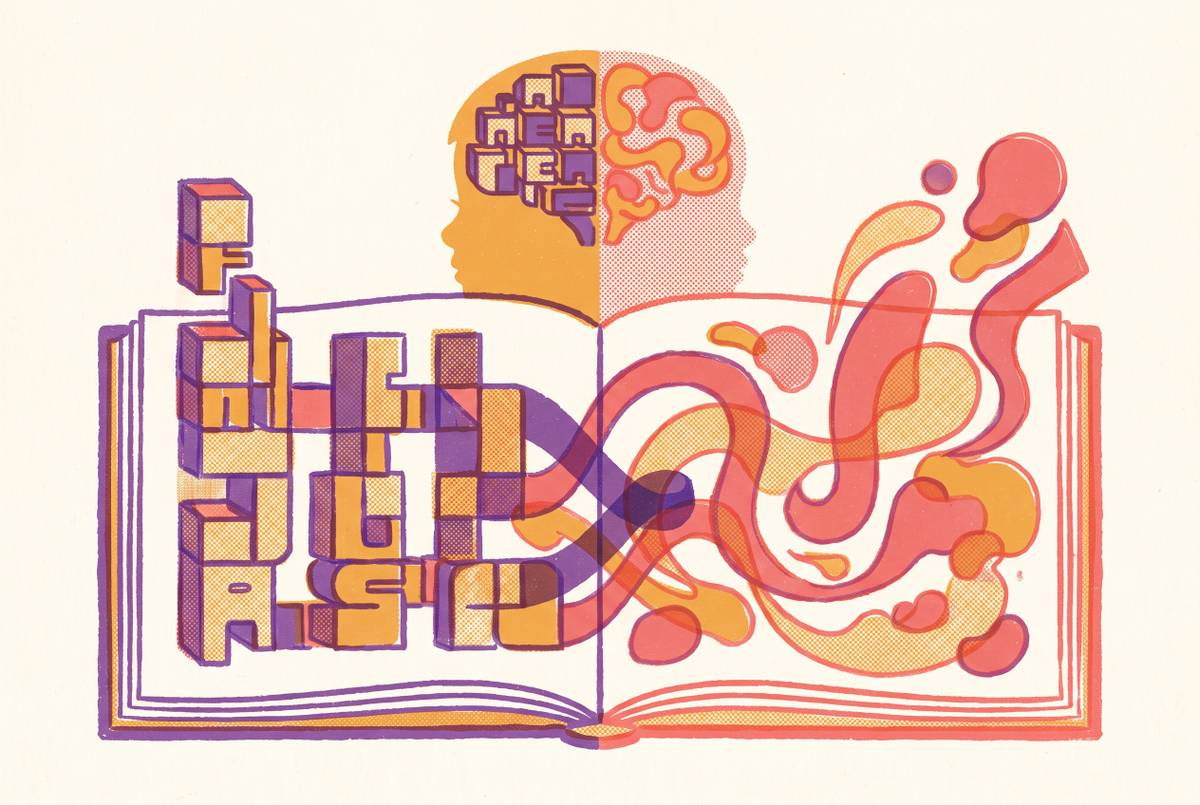
Most reading apps build a phonics ladder. Most math apps build number sense. Very few do both with any real depth, so a parent typing "reading and math app" into a search bar keeps landing on lists that mash unrelated products together. That search instinct is more correct than most people realize. Cross-lagged longitudinal studies tracking 5- and 6-year-olds have found that phonological processing and basic number knowledge actually predict each other's growth over time. Reading and math are tangled up with each other in a young child's brain, developmentally. They're tangled up with each other, developmentally, in ways that make treating them as unrelated subjects a little bit of a fiction.
That has a practical consequence. A kid who needs help in both areas shouldn't need two separate apps calibrated to two separate theories of learning. Coherence matters here more than convenience.
But "covers both" and "teaches both well" are not the same claim, and a lot of products blur that line on purpose. A math tab bolted onto a reading app, thrown in mostly so the marketing copy can say "full curriculum," is a feature checkbox. It's a feature checkbox. The real task for a parent is finding an app where both subjects rest on an actual instructional foundation, not one that merely hits two subject headings on a features page. It's finding one where both subjects rest on an actual instructional foundation, something built by people who understand how kids learn to decode a word and how they learn to understand quantity, not just people who understand how to keep a kid tapping a screen. That means getting specific about what "grounded in research" actually requires for each subject, then holding real products up against that bar.
What the Science of Reading requires from a reading app
The Science of Reading is the accumulated weight of decades of research across cognitive science, linguistics, and psychology. It's the accumulated weight of decades of research across cognitive science, linguistics, and psychology, all converging on one uncomfortable fact: reading doesn't come naturally to the human brain the way spoken language does. It has to be taught, directly and in order.
That instruction rests on a handful of pieces that build on each other. Phonemic awareness comes first: hearing that "cat" is three separate sounds, and being able to swap the "c" for an "h" to make "hat." Phonics follows, teaching the actual relationships between letters and sounds, sometimes called the alphabetic principle. Decoding is what a child does with that knowledge, sounding out print into speech. Fluency is what happens once decoding gets automatic enough that it stops eating up all of a child's attention. And comprehension, along with vocabulary, is the whole point of all of it: the destination fluency was supposed to unlock.
A few features separate an app that's actually doing this from one that just says it is. Phonics instruction needs to be explicit and sequential, not something a child is supposed to absorb by osmosis while reading around it. Texts need to be decodable, using only the sound patterns already taught, not "leveled" books that quietly train kids to guess a word from the picture on the page. Sounds and letters need to show up together, not as separate exercises, because research on how kids build that letter-sound connection favors pairing over isolation. And the sequence should move a child from sounding out letter by letter toward reading in chunks, blends, digraphs, vowel teams, the stuff that makes fluent reading possible.
Watch for certain phrases. "Phonics-inspired" or "balanced literacy" often signal a program hedging its bets rather than committing to explicit, systematic instruction. And here's a detail that surprises a lot of parents: none of this actually requires gamification, streak counters, or a fancy adaptive algorithm. What it requires is a sequence, taught in order, without skipping steps. Engagement mechanics are nice. They are not the thing doing the teaching.
The national numbers explain why this distinction carries real weight right now. On the 2024 NAEP, Louisiana's fourth graders were the only group in the country to exceed pre-pandemic reading achievement, while national scores have mostly sat still Education Week 16 Best Math Apps for Kids.
What research-backed early math instruction looks like
Early numeracy is a wider net than most parents assume. It covers number recognition and counting, sure, but also basic operations, spatial reasoning, and pattern recognition, not arithmetic drills alone. A study published in Developmental Psychology found that math skills at kindergarten entry are among the strongest predictors of a child's later academic achievement, outperforming even early reading skills as a predictor. That's the stake that makes scrutinizing a math app worth the effort.
It gets more complicated than reading. A "Science of Math" movement exists, but it is nowhere near settled the way the Science of Reading is. Between 2022 and 2025, eighteen states passed legislation pushing math instruction toward a more structured, intervention-focused model Center on Reinventing Public Education 16 Best Math Apps for Kids. Still, researchers in the field are candid about where things stand. Matthew Burns, a professor of special education at the University of Florida who helped build the Science of Math website, said: "I don't think the movement has caught on yet 16 Best Math Apps for Kids. I think it's an idea 16 Best Math Apps for Kids." That's a strikingly honest admission from someone at the center of the movement, and it should recalibrate how much confidence a parent puts in any single vendor's "Science of Math" label.
Where researchers do find common ground: instruction should be explicit and systematic, building new concepts on older ones in small, deliberate steps. That's basically the same sequencing logic that governs phonics instruction, just applied to number sense instead of letter sounds. An old fight is resurfacing with new branding underneath that agreement. Play-based approaches to early math show genuine cognitive gains in the research, while advocates of explicit instruction argue that structure and sequence beat open-ended discovery, especially for foundational skills. Anyone shopping for a math app should know which side of that argument the product has picked, and should check that this lines up with what the evidence actually supports for a child's specific age.
There's also an emotional cost to getting this wrong. An NCFR policy brief found that roughly half of all elementary students report medium to high levels of math anxiety 16 Best Math Apps for Kids. Pacing and scaffolding aren't just nice-to-haves, in other words. They shape whether a kid comes to associate math with confidence or with dread. The practical checklist, then: does the app sequence skills explicitly, build each new concept on a clear prerequisite, and catch gaps in understanding rather than just marking answers right or wrong?
The spectrum of apps claiming both subjects: what each delivers
A small number of products handle both subjects with genuine depth, and it's worth starting there before moving toward the narrower, single-subject tools.
Both programs use embedded assessment that adjusts content based on what a child has actually mastered, not simply how long they've spent tapping through screens. These are two separate subscriptions and two separate apps, not one unified experience.
Further down the spectrum sits a platform covering math and ELA for Pre-K through fifth grade under one roof. The detailed skill-level analytics and trouble-spot tracking that some sources praise in this category belong to a different, unnamed platform, not this one, so the two shouldn't be confused. And no source in this space makes an explicit Science of Reading claim for this platform's literacy side, so none should be assumed.
One phonics app built around a genuinely sequential three-stage curriculum, moving from letter exploration into structured phonics practice, does earn an explicit SoR-aligned label in the research. Reading is clearly the main event here; the depth of its math coverage isn't detailed enough in available research to evaluate with any confidence.
It skips adaptive algorithms and gamified streaks entirely in favor of a clean, sequential phonics structure, which is a feature for SoR purists. There's no free tier: home use runs through Family Literacy Centers starting around $175 a year, and the app carries a 4.2 rating on the App Store as of August 2026 16 Best Math Apps for Kids.
Nessy's math coverage lives in a separate companion product, Mathseeds, rather than being folded into the same app. And Read Along by Google, a free guided oral reading app for ages 5 and up that works offline, uses an in-app character named Diya to listen to a child read and step in on pacing, accuracy, and tricky words in real time. It's strong for fluency practice specifically and carries no math component whatsoever.
Flip to the math-first side: Prodigy Math stands out for scale, with more than a million teachers, three million parents, and over twenty million students worldwide using it, covering more than 1,500 skills from first through eighth grade inside a curriculum-aligned fantasy RPG 16 Best Math Apps for Kids. It adapts to a student's curriculum and goals, and teachers can customize the questions kids see. It carries no reading component at all, and it's free to play, with an optional premium membership for parents.
For families weighing a different model entirely, tutoring platforms are worth a mention. Brighterly is a web-based platform offering 1:1 math and reading tutoring with real instructors supplemented by AI Lesson Summaries, covering K–12 math and reading and aligned to U.S. standards. As of August 2026, it prices from $17.70 a lesson on a 12-month plan with the first lesson free, and carries a 4.4 Trustpilot rating 16 Best Math Apps for Kids 20+ Best Reading Apps for Kids in 2026. That's a genuinely different animal than a self-directed app, live human instruction rather than software teaching alone, on its own terms rather than measured against the app-based products above. As of September 2026, the mobile app requires a one-time purchase of $8.99 to unlock full content, while it remains free on the website with limited content 16 Best Math Apps for Kids. Ages 3–6. There are five levels: toddler, preschool, pre-K, early learner, and growing learner. Ages 2–8, or 3–8 depending on source listing. Pricing is $12.99 per month or $79.99 per year, with a 30-day free trial. The depth of SoR alignment is not confirmed by independent study in sources, as "developed based on authentic research" is the vendor's own claim. Lexia Core5. It is a research-backed adaptive reading program used in 1 in 4 US schools. It shows strong SoR alignment and is well-regarded for reading level growth tracking and MTSS data. Ages roughly 4–7. Reddit reviews cited in sources say it is a frequent choice among parents of dyslexic children. As of September 2026, the annual subscription is $126 per year, with a free trial available on application 16 Best Math Apps for Kids. It is reading-focused, with a structured literacy approach consistent with SoR principles. Reading Eggs. Education Week and NAEP Long-Term Trend put the ages at 2–13 Education Week / NAEP Long-Term Trend. Pricing is $12.99 per month, available on iOS, Android, and Web. Its Trustpilot rating is 3.5 as of August 2026 16 Best Math Apps for Kids.
What genuine AI teaching adds
AI earns its keep in early education by doing a few things well: adjusting difficulty and pacing in real time based on how a specific child is performing, catching misconceptions as they form, and sequencing lessons around what a child actually has and hasn't mastered yet. Meta-analyses on AI tutoring systems point to real effect sizes for math learning specifically, with adaptive content delivery showing particular strength for procedural skills, step-by-step operations that benefit from tight, individualized pacing.
But there's a meaningful gap between an app that gets harder or easier based on performance and one that actually understands why a child got something wrong and changes its teaching approach accordingly. Adjusting difficulty is a dial. Diagnosing a misconception and responding to it is something closer to real instruction, and a lot of products marketed as "adaptive" are really only doing the former.
New York City Public Schools laid out an AI policy for the 2026-27 school year that states this: AI cannot replicate the care, expertise, and commitment of a human educator, and schools have to remain places where kids think, reason, and sit with difficulty rather than route around it 16 Best Math Apps for Kids. CNN's coverage from September 21, 2026 warns that some AI programs are interfering with key lessons of childhood, which is supposed to involve inefficient thinking (young children learn partly by guessing wrong, arguing about why, and revising, and handing an answer too quickly removes the learning, not just the confusion) 16 Best Math Apps for Kids. Childhood learning is supposed to involve inefficient thinking. Kids guess wrong, argue about why they were wrong, and revise their thinking, and that messy process is where a lot of the actual learning happens. Handing a child the right answer too fast clears up the confusion, but it also erases the opportunity to build the skill in the first place 16 Best Math Apps for Kids.
That warning applies directly to both subjects covered here. Sounding out an unfamiliar word and working through an addition problem a child hasn't seen before both depend on a moment of effortful struggle, not instant correction. An app that swoops in the second a child hesitates might feel supportive. It may also be quietly undermining the exact skill it claims to be building.
How to evaluate any app against both standards before committing
Start with the reading side. Look for explicit, sequential phonics instruction, decodable texts that match what's already been taught rather than leveled readers that invite picture-guessing, and a clear progression from sounding out individual letters toward reading in larger chunks. Ignore streak counters and badge systems. They tell a parent nothing about instructional quality.
Then check the math side with equal skepticism, given how much less settled that field still is. Does the app sequence skills explicitly, building each new concept on a clearly identified prerequisite? Does it catch specific gaps in understanding, or does it just tally right and wrong answers and move on? And does it hold up under Matthew Burns's blunt assessment: it's still an idea, not a consensus, so any vendor claiming firm "Science of Math" grounding deserves a harder look than a reading app making the equivalent claim 16 Best Math Apps for Kids.
Test how the app behaves inside a moment of struggle. Does it let a child sit with a hard problem for a beat before stepping in, or does it swoop in the instant a wrong answer appears? Does the feedback actually explain the mistake, or just prompt another try? And does a parent get real visibility into where a child is genuinely stuck, beyond a percentage-complete bar that says nothing about mastery?
Finally, weigh whether the product's dual coverage is real or cosmetic. Depth beats a longer feature list every time, in reading, in math, and in whatever a vendor is currently calling both. SOURCE PAGES, what the pages behind the outline's links say.