Phonological Awareness Activities for Preschoolers at Home
Building sound awareness before letters helps children's brains prepare for reading.
Phonological awareness is the ability to hear and play with the sounds inside spoken language, separate from reading itself. It's noticing that "cat" and "hat" end the same way, clapping "ban-a-na" into three distinct beats, or catching that "Sam" and "soup" start with the same sound. None of that requires a letter on a page. It happens entirely through the ear and the mouth; preschool, before formal reading instruction starts, is the right window to build it.
Why Phonological Awareness Comes Before Reading
Reading is not something a child's brain does automatically the way it learns to talk. Speech develops naturally through exposure, but reading has to be taught, directly and in a specific order, which is the founding premise of the Science of Reading framework. That framework rests on a simple formula: reading comprehension is the product of decoding and language comprehension. If either side of that equation is weak, the whole system underperforms, no matter how strong the other side is. Phonological awareness causes the decoding side to work: it is the oral groundwork that has to exist before a child can map sounds onto letters with any real understanding. Phonics instruction connects those sounds to printed letters and works best in kindergarten and first grade. The preschool years are for building the sound awareness that phonics will later attach itself to. None of this requires knowing the alphabet first. A three- or four-year-old who can't yet identify a single letter can still hear that "pig" and "wig" rhyme. The work can start immediately, with no flashcards and no curriculum, in the car, at the dinner table, or during bath time.
The skill hierarchy the Science of Reading maps out for preschoolers
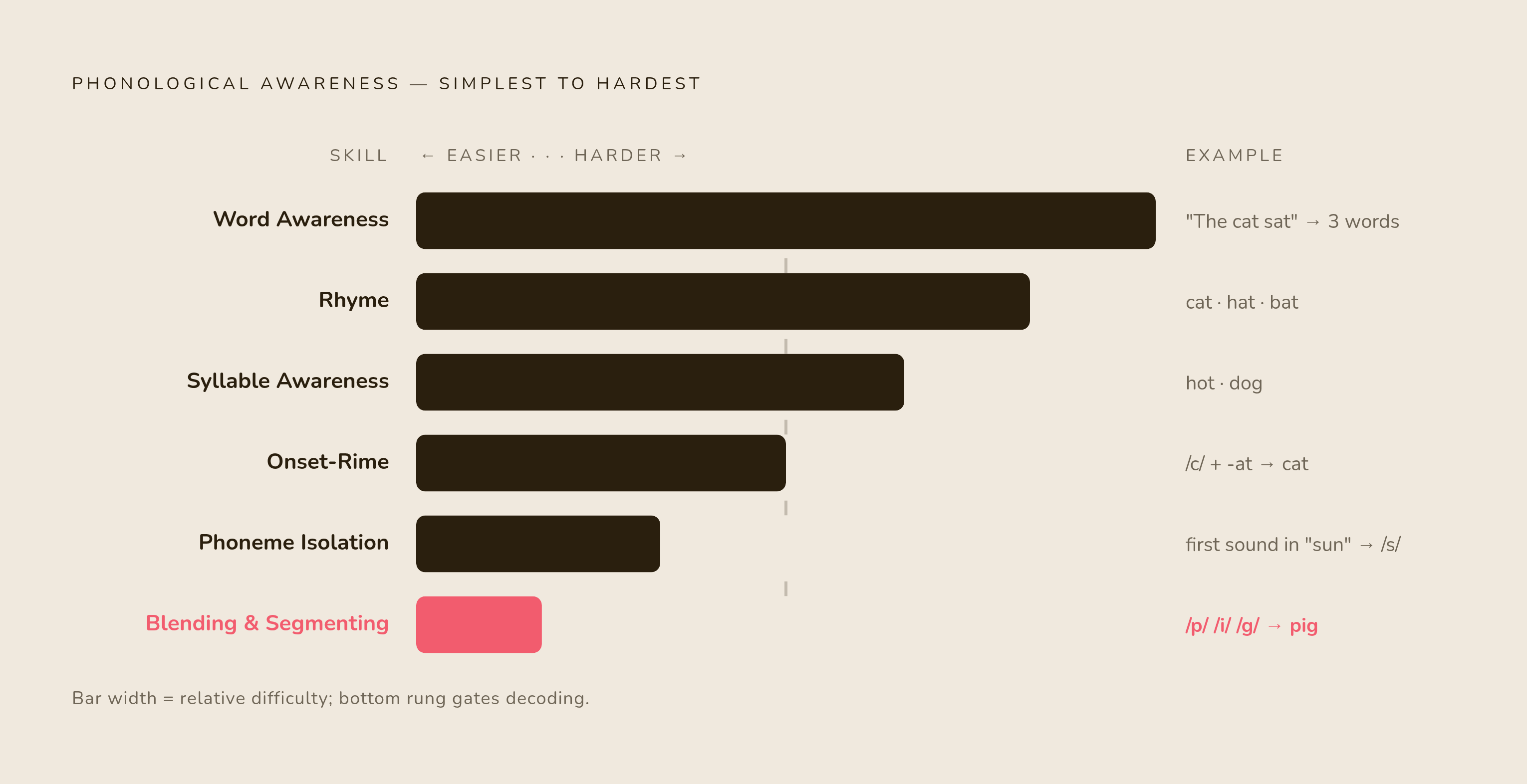
Phonological awareness is a ladder of related skills that move from big, easy-to-hear units of sound down to small, precise ones, and the order isn't arbitrary: each rung gives a child the listening precision needed for the next. At the top sits word awareness, simply noticing that a sentence is made of separate words. Below that comes rhyme, hearing that word endings match. Next is syllable awareness, breaking a word into its beats. Below syllables sits onset-rime, splitting a word into its opening sound and everything after it, like the /c/ in "cat" versus the "-at" that follows. Near the bottom comes phoneme isolation, picking out individual sounds at the start or end of a word. At the very bottom, the most demanding rung, sits phoneme blending and segmenting: joining sounds into a word, or pulling a word apart sound by sound. A child can work on syllables and rhyme at the same time since the skills overlap, but blending individual phonemes should never be where the work starts. This isn't a sequence one school or one program invented. The Common Core standards for kindergarten reading foundational skills (CCSS.ELA-LITERACY.RF.K.2) codify this same order: recognizing and producing rhymes, counting and blending syllables, blending and segmenting onset-rime, and isolating sounds in three-phoneme words. Phonological awareness is the oral-language foundation that must precede decoding, and that's precisely why the preschool years carry so much weight. Intentional, adaptive instruction during this window pays dividends later. Ello, an AI reading app grounded in the Science of Reading, is built to develop these pre-reading and kindergarten-readiness skills and then carry children into phonics once the oral foundation is solid.
Rhyme and word games that build the first rungs of the ladder
Rhyme and word awareness are at the top of the ladder, and they're also the easiest to fold into an ordinary evening, no prep required. Rhyming picture books are the simplest entry point: Room on the Broom, Rhyming Dust Bunnies, The Cat in the Hat, Llama Llama Red Pajama. Read one aloud and pause right before the rhyming word, letting the child jump in and finish the line. Once a child can fill in a familiar rhyme, push a step further and ask for one they invent themselves. Accuracy doesn't matter here. A nonsense rhyme like "cat, zat, lat" still trains the same sound-matching instinct that a real rhyme does, and the sillier it sounds, the more a child wants to keep playing. "Does it rhyme?" works the same muscle from the other direction: say two words, dog and log, or hat and pot, and ask whether they end the same way. That shifts the skill from recognizing a rhyme to actually judging one, a small but real jump in difficulty.
Counting words in a sentence looks less like a reading activity and more like a car game, and that's why it works. Say a sentence together, "The brown dog has the bone," and hold up one finger for each word as it's spoken, then count the fingers at the end. That's the earliest form of phonological awareness there is: understanding that speech isn't one continuous sound but a string of separate words.
Songs carry rhyme and rhythm at the same time without anyone having to think about it. Five Little Monkeys, Down by the Bay, and The Wheels on the Bus all repeat patterned, rhyming lines, and asking a child to sing along on the familiar parts builds memory for how those sound patterns fit together. Alliteration sentences add a related layer: making up silly lines using a child's own name, like "Jodie jiggles giant jars of jam and jelly," introduces the idea that words can share a beginning sound, which quietly sets up the sound-isolation work that comes later.
Syllable clapping and segmenting: moving to the middle of the ladder
Once a child can hear that two words rhyme, the next rung asks for a sharper kind of listening: breaking a single word into its parts. Clapping is the tool that makes this concrete. Compound words are the easiest starting point, since the break between parts is loud and obvious: "hot-dog," "mail-man." A child's own name works well too. From there, move to two-syllable words like "hip-po" and "ap-ple," then build up to three-syllable words like "ba-na-na" and "di-no-saur." The clap doesn't have to stay a clap. Jumping once per syllable, tapping a block, or banging a drum all reinforce the same segmenting move through a different muscle group, and for a preschooler, movement tends to cement a skill faster than sitting still does.
Sorting adds a game layer on top of the clapping. Gather pictures or small objects and sort them into a "one-clap" pile and a "two-clap" pile, turning syllable counting into something closer to a puzzle than a drill. Seasonal themes, fruits, animals, or the names of family members, keep the sorting fresh while building vocabulary alongside the sound skill.
Blending follows naturally once segmenting feels easy. Model it slowly: "sun… shine… sunshine," then ask the child to repeat the blend. That same move, smaller, is what onset-rime work asks for: splitting the /c/ in "cat" away from the "-at" that follows it. Syllable blending and onset-rime splitting are the same skill at two different sizes, so one leads directly into the other.
Sound isolation and sorting: teaching children to hear individual sounds in words
Phoneme isolation, hearing the single sound at the start or end of a word, is where the work gets more precise, though it stays just as playful as everything before it. None of these activities require a child to know a single letter. The work is entirely by ear, which matters for any parent worried that a child "isn't ready" because the alphabet hasn't clicked yet.
The Picky Puppet game is the most memorable way to start. A simple sock puppet only likes things that begin with a chosen sound, say /p/, and the child sorts through picture cards, handing the puppet only the ones that match. The puppet gives the game a built-in reason to listen carefully to the first sound of each word, making the isolation feel like play. Once initial sounds feel solid, shift the same game to final sounds.
Beginning Sound Sort works the same idea with toys. Gather objects for two or three target sounds, ball, banana, and book for /b/, or sun, sock, and spoon for /s/, and have the child sort them by sound while saying each word slowly, "b-all," "b-anana." Hearing the sound stretched out models the exact move the child is learning to make on their own.
Sound Hunt turns the skill into an I Spy game using sounds instead of letters: "I spy something that starts with /t/," prompting a hunt for table, teddy, or toy truck. The game connects spoken sounds to real objects in the room, which is a critical step toward phonics, and it builds vocabulary at the same time.
Word families round out this section as a bridge to what follows. Grouping cat, bat, and hat by their shared "-at" ending asks a child to notice what changes at the front of a word and what stays the same at the back. No reading is involved. It's entirely spoken, but it's the exact listening structure that blending and segmenting will ask for next. Understanding this sequence, from word awareness and rhyme down to phoneme isolation, helps parents see what a child is ready for at a given stage. Many personalized learning platforms, Ello among them, build their early instruction around this same hierarchy, adjusting pace and depth to where an individual child actually is rather than assuming every child moves through it on the same schedule.
Oral blending and segmenting: the skills that sit closest to decoding
A "sound robot" is the easiest way to introduce blending. Speak a word in slow, separated robot sounds, /d/ /o/ /g/, and ask the child to figure out what word the robot just said. Framed as a game, it hides the fact that this is the hardest rung on the ladder. Start with short CVC words, consonant-vowel-consonant: sun, hat, cat, pen. Build difficulty gradually, from two-sound words like /i/ /t/ for "it," up through full CVC words, then longer words once the child blends confidently.
Segmenting runs the process in reverse. Say a familiar word and ask the child to pull it apart into its individual sounds: "Can you tell me all the sounds in pig?" The answer, /p/ /i/ /g/, asks the child to hold a word in memory while breaking it down piece by piece, which is genuinely demanding for a four- or five-year-old. Picture cards or small toys help here, giving the child something concrete to anchor the word to.
For children who move through blending and segmenting with ease, a phoneme swap raises the challenge further: changing the /c/ in "cat" to /b/ and asking what word results. This should come after blending and segmenting feel solid, not before.
The payoff for all of this is visible directly in kindergarten. Once a child can blend spoken sounds into a word without any print in front of them, attaching letters to those sounds is the entire job of phonics instruction. The oral work done at home in the preschool years is what makes that later instruction land quickly and stick.
Building These Activities Into an Ordinary Day
None of this requires a lesson plan, a worksheet, or a set block of time carved out of the day. The research on early literacy backs that up directly: progress comes from a few minutes of daily practice folded into routines a family already has, not from long structured sessions. A car ride is enough time for a round of "Does it rhyme?" Bath time covers a syllable-clapping game. Dinner can carry a sentence word-count or a silly alliteration line built around a child's name.
Sticking to one skill per session, instead of cycling through several in a single sitting, builds mastery faster. A few focused minutes on rhyme, repeated across several days before moving to syllables, builds real mastery faster than jumping between rhyme, syllables, and sound isolation all in one sitting. Repetition across days, not variety within a day, is what turns a game into a skill.
These activities work because they meet preschoolers exactly where they are developmentally: playing with sounds before ever being asked to analyze them. A child who sings along to "Down by the Bay," claps out "di-no-saur," and feeds a puppet only words that start with /p/ is quietly building the auditory patterns that make kindergarten and first-grade phonics instruction land far faster and far more securely, setting up a smooth, unforced move into formal decoding when the time comes.
Sources
- What the science of reading tells us about how to teach decoding—including phonics - Teach. Learn. Grow.
- Phonological Awareness as the Foundation of Reading Acquisition in Students Reading in Transparent Orthography
- Preschool Phonological and Morphological Awareness As Longitudinal Predictors of Early Reading and Spelling Development in Greek
- Skills for Early Reading: Phonological Awareness - Evidence Based Early Literacy
- Phonological and Phonemic Awareness: Activities for Your Kindergartener
- Phonological and Phonemic Awareness: Activities for Your Pre-K Child
- Phonological Awareness for Pre-K
- Word Play Throughout the Day: Phonological Awareness in the Preschool Classroom