What Happens in a Child's Brain When an AI Adjusts Instruction Mid-Struggle
AI tutors work best when they ease cognitive load without taking over the thinking.
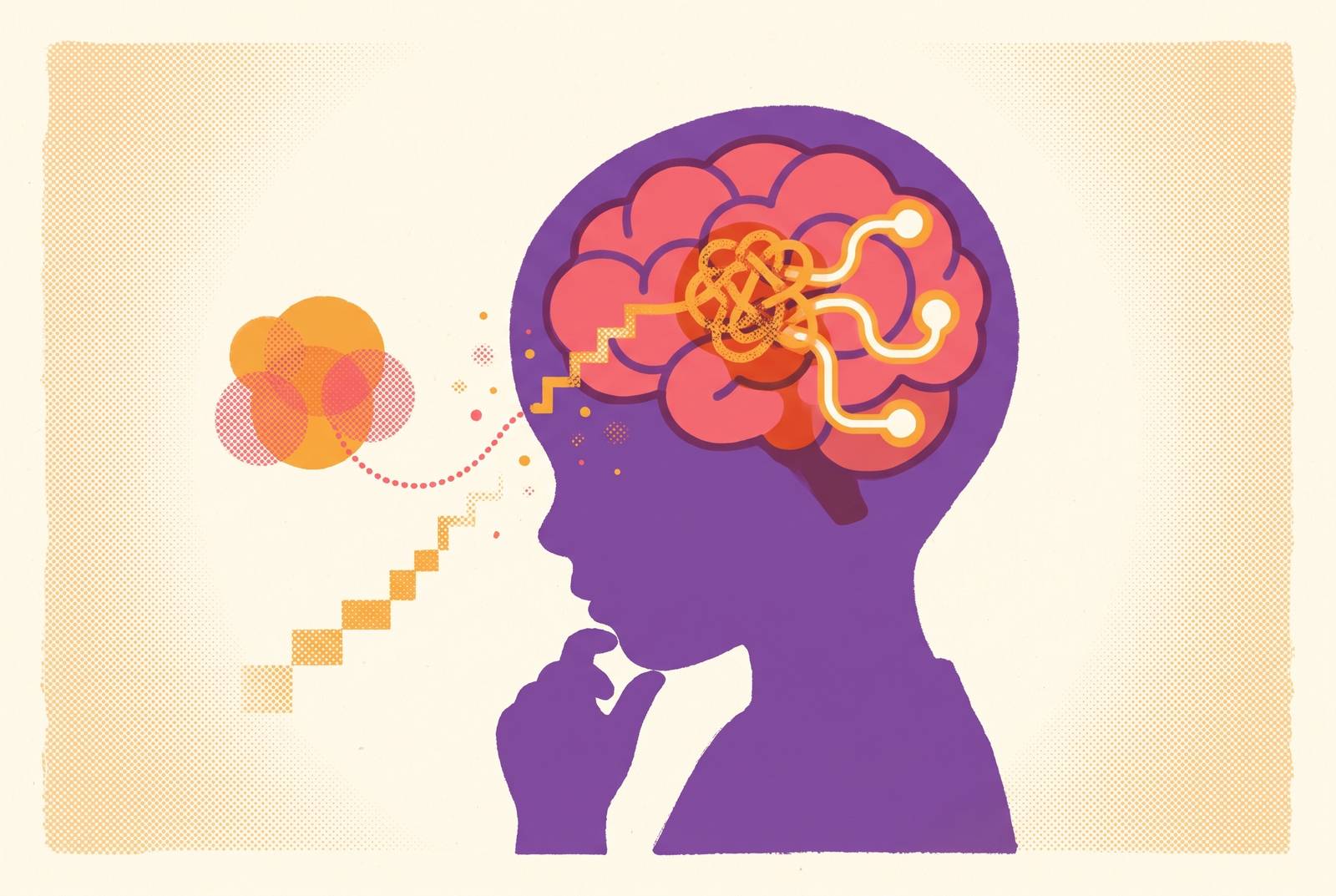
When an AI adjusts instruction mid-struggle, its value depends on whether the child can still use the help. An adjustment should ease the load that is blocking learning while leaving the child to do the thinking. For an AI reading tutor that listens to children read aloud in real time, that means responding to the child’s actual attempt with a timely, specific cue.
What the brain is actually doing when a child hits a wall mid-task
The pencil stops, the child goes blank, or the book gets pushed away. The visible moment can look like refusal. But the child may have run out of room to hold the task together. Working memory, the system that keeps information available while the child uses it, is limited. When sounding out a word or calculating an answer takes most of that capacity, little remains for understanding the sentence or choosing the next step.
Struggle is therefore not one fixed state. A child may work hard and get somewhere at first, then keep making the same errors, and finally reach a point where another explanation cannot help. Phonological processing difficulties, which affect how children work with speech sounds, can come with limits in working memory and processing speed. Several demands then pile up at once. The wall feels total because the difficulty is not confined to the word on the page.
Error-monitoring can also be part of the problem. Stanford’s February 2026 study in the Journal of Neuroscience found that children with math difficulties had weaker activity in the parts of the brain that track errors and help guide changes. These children were less likely to change their approach after mistakes. That finding explains why another wrong answer may not prompt a useful rethink. As overload and stress take over, the next instruction can become another demand.
Why math struggle and reading struggle look different in the brain but share the same breakdown point
Phonemic awareness helps children pick out the sounds in words, and decoding and orthographic mapping help them link print to those sounds. As word recognition becomes more automatic, fluent reading leaves more capacity for comprehension. Until then, decoding can consume the room needed to remember how a sentence began. A child may understand the same content when someone reads it aloud but lose track of what it means when reading alone.
Math struggle can involve a different kind of blockage. Stanford’s September 2026 research in JNeurosci, which drew on 68 children ages 8–10 with developmental dyscalculia, found that they had trouble using and switching between problem-solving strategies. The children took longer to switch, were less sensitive to changes in difficulty, and did not improve in selecting optimal strategies over time. Their brain-system activity differed from that of more proficient peers and could predict counting ability and strategy-switching.
The February study adds an important distinction. Noticing and responding to an error is itself part of solving a problem, and that process was weaker among the children with math difficulties. Reading and math therefore share a bottleneck when basic processing leaves too little capacity for meaning and strategy, but they do not need interchangeable help. A reader may need less decoding to do for a short time, while a child who struggles with math may need fewer, clearer strategies to choose from.
How the brain encodes learning from struggle — and the narrow window when encoding is possible
Struggle is both a threat to learning and part of how learning happens. Working through a challenge strengthens the pathways involved, while simply receiving the answer does not provide the same opportunity for consolidation. The distinction is between difficulty the child can still work through and difficulty that prevents further processing. Help has to preserve the first without prolonging the second.
Oakley and colleagues’ 2025 preprint, “The Memory Paradox: Why Our Brains Need Knowledge in an Age of AI,” provides a useful frame for this tension. Reading and mathematics are biologically secondary knowledge that requires deliberate teaching rather than developing incidentally in the way spoken language can. Structure gives children the knowledge and guidance they need to work through a problem instead of trying to discover every part for themselves.
Retrieval, error-correction, and schema-building turn effort into durable memory. In everyday terms, children recall what they know, revise what went wrong, and connect the new learning to a usable pattern. An AI that gives the answer too soon can skip over those processes while making it look as though the child is doing better. Yet withholding help after overload sets in does not preserve productive struggle. The encoding window is best understood as the range in which the child can still process feedback.
What the brain signals reveal about cognitive effort that observable performance alone cannot
Two correct answers can hide very different levels of effort. One child may answer with little effort, while another uses nearly all the resources they have to get the same result. A count of correct answers treats both results the same. Instruction should not, because increasing demand places the second child closer to overload. Equally, a wrong answer can reflect excessive load, a lapse in attention, or a different strategy.
Sharmin and colleagues at the University of Delaware studied this gap with functional near-infrared spectroscopy, or fNIRS, as children worked through a structured digital task. The method measures brain activity through changes in blood oxygenation. The researchers defined cognitive effort through the relationship between cognitive load and task performance, and found statistically significant differences across sequential task segments. Even small changes in task structure altered demand. The study’s evidence is limited to brain activity during a digital cognitive task.
The study used Relative Neural Efficiency to describe performance in relation to load and Relative Neural Involvement to describe engagement. These measures help separate efficient engagement from overload, disengagement, and deep involvement. Machine-learning models that used brain signals gave estimates of effort that were nearly the same as those worked out from actual performance scores. The signals contained information that output alone could miss. For instruction, accuracy and response time are useful but incomplete clues to what the learner can handle next.
Why the moment of adjustment matters as much as the nature of the adjustment
After an error, a child who can still reconsider the task may benefit from a cue that narrows the next move. That leaves the thinking with the child. If self-monitoring is failing, however, waiting for an independent change of strategy asks the child to rely on the very process that is struggling. More explicit guidance must then supply some of that missing structure.
For reading, the adjustment may be a prompt, a model, or a word-level cue that reduces decoding demand. “Try harder” does not reduce that demand. For math, making a strategy visible and constraining the options can be more useful than asking “what else could you try?” when switching strategies is the problem. The same amount of help can therefore have different effects depending on its form. A broad invitation to think can add load where a specific cue would remove it.
Timing changes the value of either response. An answer delivered too early cuts short retrieval and correction, while useful guidance delivered after stress and overload have taken hold may no longer be usable. The child’s response to difficulty must inform what happens next. Explicit, structured teaching is the form adaptation needs when the child cannot navigate a wide field of possibilities.
What genuinely adaptive AI instruction does at the neurological level, and where the limits are
An adaptive system changes the task, feedback, or support, which changes what the child must process. A system responding only to final-answer accuracy has less information for that decision than one using error patterns, response timing, and strategy choices. Those clues can support an inference about cognitive state. They do not turn the software into a brain scanner.
AI tutoring can support learning through adaptive personalisation, timely diagnostic feedback, sustained participation, and actionable information for teachers. Each depends on interpreting the learner’s need reasonably well. More practice, remediation, and progression are different instructional responses, and a wrong answer alone does not settle which is appropriate. Poorly calibrated algorithms can present work at the wrong level or in the wrong sequence, producing frustration or conceptual errors. Adaptation is not automatically good instruction.
Game elements can introduce another competing demand. Points, rankings, and rewards that do not serve the learning objective can divert attention from understanding toward collecting rewards. This adds extraneous cognitive load just when the child may already have little room to spare. Participation should support retrieval, correction, and the building of knowledge.
There is also a firm limit to inference. Click patterns and response times tell only part of the story of a child’s motivation, emotional context, language background, and attention. Targeted, structured reading instruction has been shown to reorganize brain activation patterns, with different pathways engaging with print, but that does not prove the same effect for any particular AI tool. It shows that instruction can change how the brain handles reading. Whether an AI adjustment helps depends on the quality and fit of that instruction.
What parents can do with this knowledge when choosing tools and supporting their child at home
For parents, the first shift is to stop treating the wall as a character verdict. A child who repeats a mistake may need a more usable cue. During reading, errors that leave the story’s meaning intact can sometimes pass without interruption. When errors block comprehension, the child needs gentle help with the specific error. The help should bring the child back to an understanding of the story without adding stress that breaks the flow of reading.
Repetition deserves the same change in perspective. Wanting to reread a familiar book is not a failure of curiosity. Repeated reading can build fluency, reduce decoding effort, and free working memory for comprehension. It serves the same purpose as revisiting a skill before advancing in adaptive instruction. Moving forward is not the only visible sign of learning.
When choosing a tool, parents should ask what it adapts to. Final-answer accuracy shows how the child did, while error patterns, response timing, and strategy choices give more clues to how much effort it took. An AI reading tutor that listens in real time should be judged by whether it responds to the actual attempt with instruction. Help with reading should be based on phonics and structured literacy. Math feedback should help with strategy as well as tell the child whether the answer is right.
The Science of Reading is a research consensus. Instruction grounded in it integrates phonemic awareness, phonics, fluency, vocabulary, and comprehension systematically, rather than loading every demand onto the child at once. Parent reports should also reveal more than a score, showing which skills are consolidating and where difficulty keeps returning. With that information, a parent can decide whether to let the child keep working through the difficulty, give a specific cue, or ease a demand the child cannot yet handle.
Sources
- Beyond Cognitive Load: AI-Based Estimation of Cognitive Effort Using Brain Signals During Digital Tasks
- The Memory Paradox: Why Our Brains Need Knowledge in an Age of AI
- Children identified for classroom-based math support show altered resting-state connectivity in parietal brain regions
- How math learning disabilities affect problem-solving • Stanford Accelerator for Learning
- The Neuroscience Behind Productive Struggle
- Applying functional near-infrared spectroscopy and eye-tracking in a naturalistic educational environment to investigate physiological aspects that underlie the cognitive effort of children during mental rotation tests
- Artificial intelligence, cognitive offloading and implications ...
- Adaptive Scaffolding Needs Contingency: An AI Tutor That Escalates and Fades on What the Learner Does