The Brain Science Behind Choosing an AI Tutor When Your Child Is Behind in Both Reading and Math
How reading and math skills reinforce each other in struggling learners.
A personalized AI tutor for a child behind in reading and math should teach both through structured lessons that adapt to the same child in real time. The best fit is not two generic practice tools packaged together. Reading and number skills feed each other’s growth, so choosing well means looking for connected instruction.
Why children who fall behind in reading and math face a compounded problem, not two separate ones
A child struggles to read a math word problem, and suddenly a parent cannot tell which subject is causing the trouble. Is the child confused about the numbers, the words, or both? That is the moment when reading and math need to be treated as connected problems.
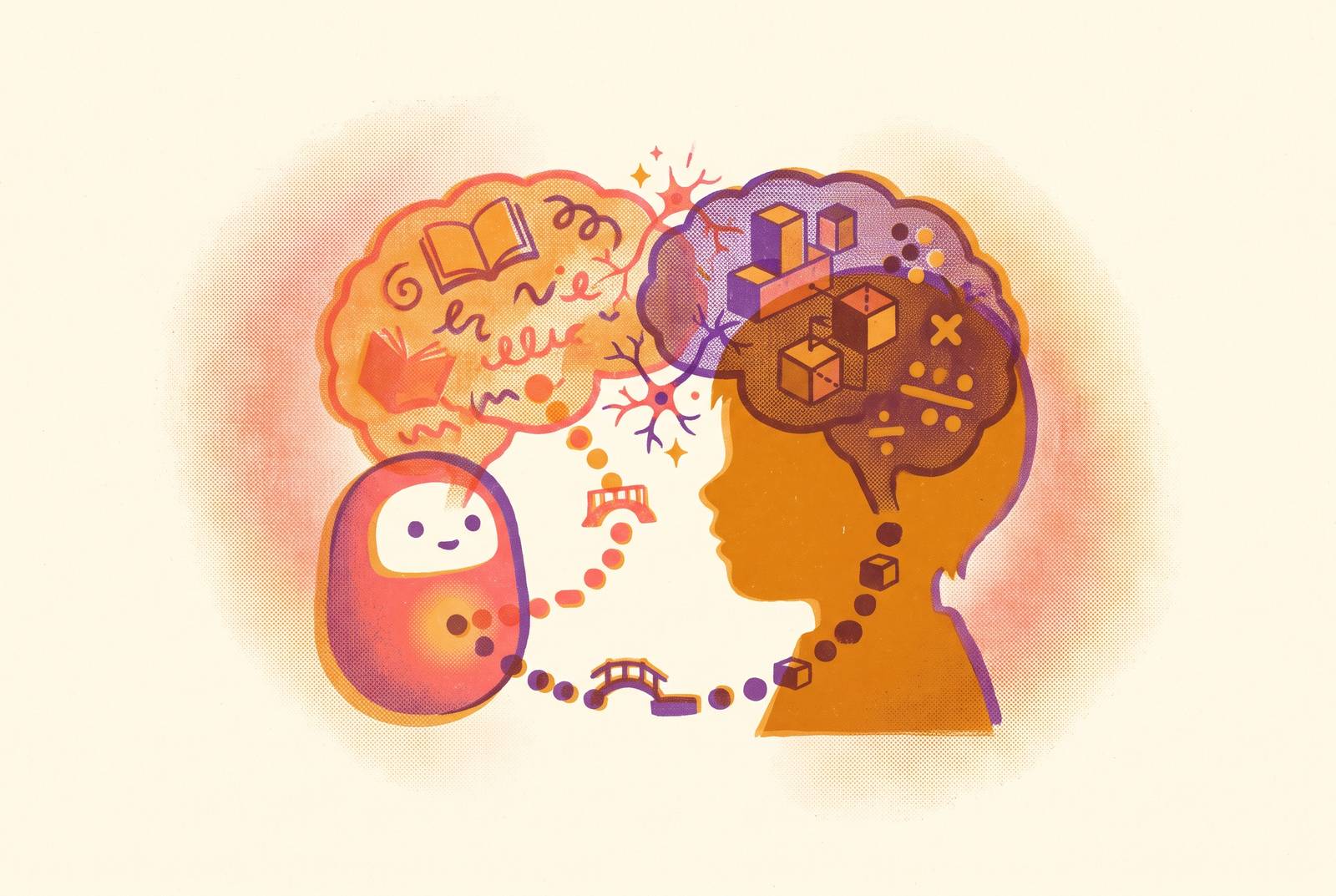
A 2026 behavioral longitudinal study in Learning and Individual Differences tracked children from age 2½ to 4 and found that language development and early numeracy predict each other’s growth reciprocally from ages 3–4 onward. The relationship runs in both directions. Language helps children learn about numbers, and number language helps their broader language development.
Weak reading can keep a child from understanding a math question before calculation begins, and gaps in mathematical language can leave the child with fewer words to learn with. Differences in what children know about numbers before they start school also predict how well they will do later. For a parent choosing support, the implication is direct. A tool needs to teach both sets of skills in sequence and make each a full part of its lessons.
How the reading brain actually builds the skill of decoding — and why the sequence cannot be shortcut
Reading is not a skill the brain simply discovers through exposure to words. Children need explicit instruction that connects speech sounds to print in a structured sequence. Guessing is not a substitute for that connection. A tool can keep a child busy with letters without teaching the decoding skills they need to read words they have not seen before.
Simos et al. (2002) found weak or absent activation in a brain region involved in recognizing written words before structured phonics instruction, followed by measurably stronger activation after 80 hours of intensive instruction. The before-and-after finding gives the teaching sequence a physical basis. Instruction was associated with a change in how the reading system worked and a better score. Those 80 hours describe the instruction in that study, however, and the time needed may vary by child.
The broader Science of Reading brings together more than five decades of research from different fields that backs explicit, structured teaching. Its five components are phonemic awareness, phonics, fluency, vocabulary, and comprehension. Phonemic awareness is about the sounds in spoken words, and phonics links those sounds to print. Fluency helps children read more smoothly, but they still need vocabulary and comprehension to understand what they read. None can stand in for the others.
The relationship between decoding and comprehension is multiplicative. If either ability is close to zero, reading ability as a whole can fall apart, while a moderate weakness lowers the combined result in proportion to that weakness. That makes an app’s claim to “teach reading” too broad to accept without detail. A child needs instruction that builds the whole skill.
How quickly a child can manipulate speech sounds can also signal ease or difficulty in learning. Spoken responses therefore give a tutor information that typed answers cannot. Teaching early literacy on computers has worked for different groups of students, so digital teaching is an option with evidence behind it. Each AI reading tool still needs evidence that it delivers useful instruction.
How the math brain develops number sense — and why the window before age 6 is not a metaphor
Early numeracy is not a waiting room for real math. Counting, understanding number relations, and learning basic arithmetic form the foundation of later mathematical thinking. As with decoding, the early steps do substantial work. Number sense and pattern recognition in the early years are strongly associated with later academic performance, while problem-solving in context strengthens preschool mathematical thinking.
Sakshi Sharma’s January 2026 article in the Indian Journal of Educational Technology describes synaptic connections as reaching their peak by age 5 and states that over 85% of human brain development has already occurred. That framing puts early learning inside a period of rapid development. It does not establish that a child loses the ability to learn math at 6. Early experiences deserve urgent attention.
A 2026 neuroimaging study in npj Science of Learning found that richer home numeracy experiences correlated with lower digit-related activity in the left intraparietal sulcus, a region involved in number processing. It also found stronger functional connectivity between that region and other brain regions. More activity in one area was not the whole story. The pattern involved how parts of the brain worked together, linking everyday number experiences with measurable differences in the number-processing network.
Because this was a correlation, it does not prove that a particular app will cause those changes. It does give home numeracy a stronger place in the discussion than “extra practice.” Counting and talking about quantities belong to the experiences through which children develop number understanding. A tutor that responds to what a child can do now can help that growth without repeatedly giving work the child has outgrown or cannot yet grasp.
The parallel with reading is now clear. Both require foundations that accumulate through experience and instruction, and both are developing during the same early years in the same child.
Why the brain’s entanglement of language and number means teaching them in silos fails
The two learning sequences are distinct, but they are not independent. Reading instruction builds access to written language, including the language used to explain mathematical problems. Numeracy instruction develops concepts and words that also contribute to language growth. The longitudinal study’s reciprocal finding makes the connection especially important when a child is behind in both.
That makes choosing one subject to fix first the wrong frame. It assumes the other can wait without affecting the work underway. Yet a child can get good calculation practice and still struggle to understand what a problem asks. Math activities made for any child can still fall short even when the reading lessons beside them are well designed.
Structured literacy and early numeracy share important teaching requirements, including explicit sequencing, cumulative skill-building, and responsiveness to the learner. These are the basis for evaluating a combined tutor. The tool needs to use what it knows about the child across both subjects and keep the careful teaching sequence each one needs.
What genuine adaptive instruction looks like at the brain level — and what it rules out
“Adaptive” can describe very different kinds of software. An older branching system might send a child to another question after a wrong answer. A more responsive platform considers hesitation, pacing, and error patterns as well as accuracy, then changes content, difficulty, or sequence. Correct or incorrect is useful information, but it is not a complete account of understanding.
For a struggling child, the decisive test is what happens when a prerequisite is missing. A genuinely adaptive tutor identifies the earlier skill that needs work and returns to it. That resembles a skilled teacher’s response during one-on-one instruction. The goal is to repair the gap that made the current question too hard.
Immediate feedback can support learning when it is embedded in sound teaching. A correctness signal alone does much less. This distinction rules out phonics games without adaptive sequencing and math generators that produce problems without identifying conceptual gaps. It also rules out a combined product whose reading and math modules have no shared model of the learner.
A 2025 study on mathematics documented the risk of AI harming learning when it provides direct answers and lets students bypass productive struggle. A tutor should help a child work through difficulty. For parents, the relevant question is what kind of assistance appears when the child gets stuck. More help is not automatically better teaching.
What should you look for in an AI tutor for a child behind in reading and math?
The first requirement is a literacy curriculum grounded in the Science of Reading. That means systematic, explicit phonics taught in a cumulative sequence, with the other reading components developed too. Letter games and sight-word memorization do not meet that standard by themselves. Evidence published in 2025 supports systematic phonics as one of the most reliable ways to build decoding skills, so curriculum deserves closer attention than the product’s AI branding.
The next requirement is real-time voice responsiveness. How a child works with sounds when speaking gives the tutor evidence of phonemic awareness, and reading aloud shows things that typed input misses. Listening alone is not enough, though. The system needs to use what it hears to adjust instruction, rather than treating speech as another way to enter an answer.
That responsiveness should feed an evolving model of the child across both subjects. The model needs to show what the child does well, how fast they learn, and where they have gaps, beyond keeping separate reading and math scores. On the math side, teaching should develop conceptual understanding through number sense and pattern recognition. Arithmetic practice has a role, but it cannot replace understanding quantities and number relations.
Parents also need meaningful visibility into progress. Useful reporting shows where a child is within the skill sequence and which abilities are becoming stronger. Time spent and rewards earned do not answer that question. Progress information should help a parent understand what the child is learning and reinforce it at home without turning every activity into another test.
No ads, no in-app purchases, and no gamification that substitutes rewards for adaptive teaching are clear standards for this choice. Engagement is welcome, but engagement alone is not proof of learning. A child choosing an app over passive entertainment does not, by itself, establish that its instruction works.
For families asking which free AI app is best for ages 3 to 6, these criteria still come first. A free download gives no answer to whether a tool meets them or whether families will have to pay later for the child to keep learning. The evidence given here is too limited to name a best free tool or rank the vendors. It supports a standard for choosing, and price cannot replace that standard.
How to use an AI tutor alongside home support when a child is behind in both reading and math
At home, the parent’s role is to stay connected to the learning without becoming a second examiner. Progress reports can make that easier by showing the skill a child is working on. The aim is to reduce pressure and reinforce learning in ordinary moments. The tutor handles the sequence, while the parent helps create an emotional setting in which the child is willing to try.
Resistance is useful information. The work may be too hard, too easy, or a poor fit for what the child likes. A responsive tutor should adapt to that mismatch, while a parent can notice when frustration starts replacing engagement. Treating resistance as a signal avoids making the session a contest of wills.
For children who are reluctant to read, cozy reading time without pressure helps them learn without another demand to do well. Reading aloud together also keeps language and meaning in the picture. For math anxiety, adults can name their own mistakes and treat them as information. That gives a child permission to try again with a patient tutor.
Progress reports are most useful when they lead to specific encouragement. “You got much better at blending two sounds this week” recognizes a skill. Casual counting games and talking through quantities while cooking are part of the home numeracy environment linked with differences in number-processing networks.
These moments give structured instruction a place in family life, where reading and numbers already overlap. One-on-one teaching has historically been a privilege for families able to afford a tutor, and AI can make that kind of responsive support more accessible. Choosing a tool built around how children learn gives the child access to individual teaching while keeping a parent close to the process.
Sources
- Decoding, Dyslexia, and the Adult Reading Brain: Insights ...
- RESEARCH CLEARINGHOUSE Systematic review and summary of
- Indian Journal of Educational Technology Volume 8, Issue 1, January 2026 1
- Reciprocal development of numeracy, mathematical language, and general language skills from age 2 ½ to 4 years: A cross-lagged panel perspective - ScienceDirect